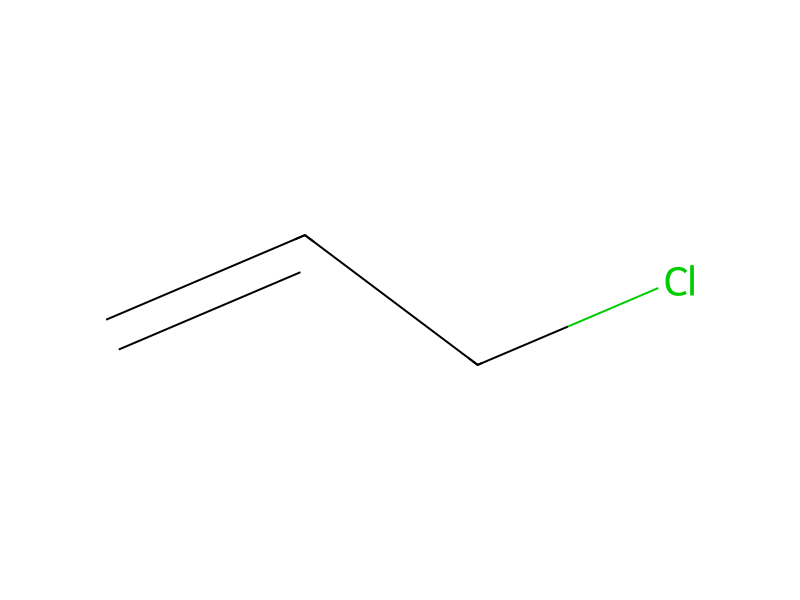
Allyl chloride → HCID 22914126, compound
Reaction equation

[CH3:1][C:2]1([CH3:12])[CH:7]2[CH2:8][CH:3]1[CH2:4][CH2:5][CH:6]2[CH2:9][CH:10]=[O:11].[CH3:13][C:14](C)([O-])[CH3:15].[K+].C(Cl)C=C>CN(C=O)C>[CH3:1][C:2]1([CH3:12])[CH:7]2[CH2:8][CH:3]1[CH2:4][CH2:5][CH:6]2[CH:9]([CH2:15][CH:14]=[CH2:13])[CH:10]=[O:11]Participants
Reactant 3


Product 1

Reagents, catalysts & solvents 1

Procedure
In a procedure similar to Example 6, 100 g of 6,6-dimethylbicyclo[3.1.1]hept-2-yl acetaldehyde at a purity of 98.3% (0.59 mole) in 50 ml of DMF, 82 g of potassium t-butoxide (0.69 mole) in 300 ml of DMF, and 55 g of allyl chloride in 50 ml of DMF (0.78 mole) were reacted in the usual way to afford 110.5 g of crude product composed of 36% starting material, 31% O-alkylate and 21% C-alkylate. The product was heated at 165°-185° C. for 6 hours. The crude aldehyde, 105.6 g, was distilled to afford 21.4 g of purified product (17% yield). A major impurity in the crude was the dialkylation product. BP product 114° C./1.2 mmHg; 1H-NMR (300 MHz), δ 1.05 (3H, s), 1.21 (3H, s), 1.3-2.6 (12H, m), 5.01 (2H, m), 5.7 (1H, m), 9.47 (1H, m); 13C-NMR (75 MHz), spectra consistent with assigned structures; IR (Neat), 2970, 2700, 1730, 1640, 1450, 1370, 910 cm-1 ; MS (m/e), 205 (M+ -1), 191, 175, 163, 122, 107, 93, 41 (Base);
Workup
- customto afford 110.5 g of crude product
- temperatureThe product was heated at 165°-185° C. for 6 hours
- distillationThe crude aldehyde, 105.6 g, was distilled
Sources & evidence
- ORD record
- ord-97315df6c5f748429ac6c983db36ff4c
- Source dataset
- uspto-grants-1997_09
- Patent number
- US05665696
Reaction notes
Loading…