Hexafluoropropylene → 3,3,3-Trifluoro-2-(trifluoromethyl)-1-propene
Reaction equation

[F:1][C:2]([F:10])([F:9])[C:3]([C:5]([F:8])([F:7])[F:6])=S.F[C:12](F)(F)C(F)=C(F)F.C=C=O>>[F:1][C:2]([F:10])([F:9])[C:3](=[CH2:12])[C:5]([F:8])([F:7])[F:6]Participants

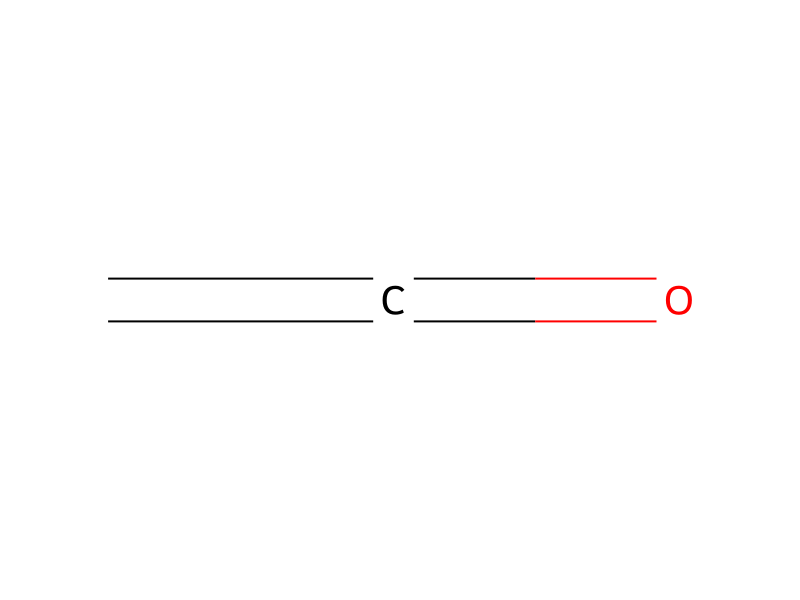


Conditions
- Temperature
- 150 °C
Procedure
Hexafluorothioacetone is a known compound (b.p. 6° C.) and is a relatively reactive and unstable monomer. It is convenient to handle this compound in the form of its dimer 2,2,4,4-tetrakis (trifluoromethyl)-1,3-dithietane which is a stable liquid (b.p. 110° C.). Hexafluorothioacetone may be conveniently generated from its dimer by thermal cracking which may be readily accomplished by passng the dimer through a hot tube at about 590°-600° C. The dimer, in turn, is rapidly formed from hexafluorothioacetone at about room temperature and the dimerization is catalyzed by bases. Alternatively, hexafluorothioacetone may be prepared by reacting sulfur and hexafluoropropene over a carbon bed at about 400° C. and the hexafluorothioacetone produced can be used immediately after it has been prepared. The effluent gases from such reaction containing hexafluorothioacetone, unreacted hexafluoropropene and by-products should be passed through traps maintained at 150° C. to remove unreacted sulfur. The presence of sulfur lowers the yield of hexafluoroisobutylene from the reaction of ketene with hexafluorothioacetone. These gases are then contacted with ketene to form hexafluoroisobutylene. The total effluent should then be passed through caustic traps to remove residual amounts of ketene and hexathioacetone. This procedure eliminates the need to isolate and purify the hexafluorothioacetone dimer.
Workup
- customhas been prepared
- customThe effluent gases from such reaction
- customto remove unreacted sulfur
- customThe presence of sulfur lowers the yield of hexafluoroisobutylene from the reaction of ketene with hexafluorothioacetone
Sources & evidence
- ORD record
- ord-e47ec5e67e33483db5c5598e1df9fd16
- Source dataset
- uspto-grants-1981_01
- Patent number
- US04244891
Reaction notes
Loading…