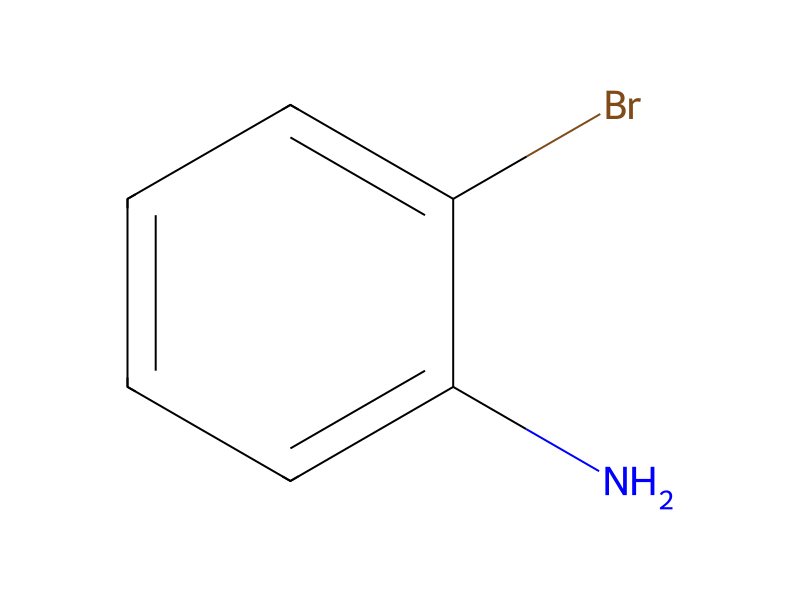
2-Bromoaniline → 5-[(2-Bromo-phenylamino)-methylene]-2,2-dimethyl-[1,3]dioxane-4,6-dione
Reaction equation

[Br:1][C:2]1[CH:8]=[CH:7][CH:6]=[CH:5][C:3]=1[NH2:4].CO[CH:11]=[C:12]1[C:17](=[O:18])[O:16][C:15]([CH3:20])([CH3:19])[O:14][C:13]1=[O:21]>C(O)(C)C>[Br:1][C:2]1[CH:8]=[CH:7][CH:6]=[CH:5][C:3]=1[NH:4][CH:11]=[C:12]1[C:13](=[O:21])[O:14][C:15]([CH3:19])([CH3:20])[O:16][C:17]1=[O:18]Participants


Procedure
A suspension of 2-bromoaniline (20.9 g) and 5-(methoxymethylene)-2,2-dimethyl-1,3-dioxane-4,6-dione (22.6 g) in isopropanol (240 ml) was heated to reflux for 1 hour. After cooling, the deposit was filtrated to obtain 5-((2-bromophenylamino)methylene)-2,2-dimethyl-1,3-dioxane-4,6-dione (34.8 g). A suspension of the obtained 5-((2-bromophenylamino)methylene)-2,2-dimethyl-1,3-dioxane-4,6-dione (10.8 g) in Dowtherm (100 ml) was heated at 210° C. for 1 hour. After cooling, hexane (100 ml) was added to the reaction solution. The deposit was filtrated to obtain 8-bromoquinolin-4(1H)-one (6.3 g). 4-Chloro-8-(4-(1-methyl-1H-pyrazol-4-yl)-1H-imidazol-1-yl)quinoline was obtained according to Example 3(2) using the obtained 8-bromoquinolin-4(1H)-one instead of compound (3a). Compound (130) was obtained as a pale yellow solid (yield based on 6 steps: 3.4%) according to Example 3(3) using 3-(tert-butylamino)-4-cyanophenylboronic acid pinacol ester instead of 4-cyano-3-(ethylamino)phenylboronic acid pinacol ester.
Workup
- temperaturewas heated
- temperatureto reflux for 1 hour
- temperatureAfter cooling
- filtrationthe deposit was filtrated
Sources & evidence
- ORD record
- ord-91826a181e1840de990aa489e1e7c117
- Source dataset
- uspto-grants-2014_12
- Patent number
- US08912181B2
Reaction notes
Loading…