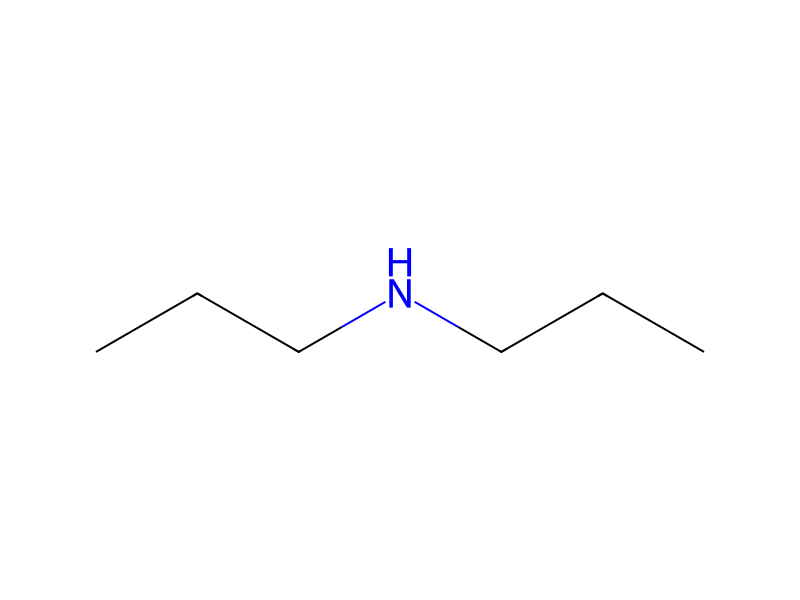
Dipropylamine → HCID 13530898, compound
Reaction equation

[CH3:1][C:2]1[C:7]([N+:8]([O-:10])=[O:9])=[CH:6][CH:5]=[CH:4][C:3]=1[CH2:11][C:12]([OH:14])=O.[C-]#N.[K+].S(Cl)(Cl)=O.[CH2:22]([NH:25][CH2:26][CH2:27][CH3:28])[CH2:23][CH3:24]>>[CH3:1][C:2]1[C:7]([N+:8]([O-:10])=[O:9])=[CH:6][CH:5]=[CH:4][C:3]=1[CH2:11][C:12]([N:25]([CH2:26][CH2:27][CH3:28])[CH2:22][CH2:23][CH3:24])=[O:14]Participants




Procedure
Alternative process for the preparation of Ropinirole is described in J. Med. Chem. 1985, 28, 1533-1536 as shown in Scheme-2. The process comprises, the reduction 2-Methyl-3-nitro-benzoic acid (VIII) with diborane to carbinol of formula (IX). The carbinol compound (IX) is chlorinated with thionyl chloride in pyridine to give highly lachrymatory compound of formula (X), which is further converted to compound of formula (XII) by reaction with Potassium cyanide and followed by hydrolysis. 2-methyl-3-nitrophenyl acetic acid (XII) is converted to its acid chloride with thionyl chloride and treated with Di-n-propylamine to give 2-Methyl-3-nitrophenyl-N,N-di-n-propyl acetamide of formula (IV). The compound of formula (IV) is further reduced with borane in THF under reflux to give 2-Methyl-3-nitrophenylethyl-N,N-di-n-propyl amine (V). The amine of formula (V) is reacted with potassium metal in Ethanol and diethyl oxalate resulting in compound (VI) (where R=H), which is treated with hydrogen peroxide, NaOH and HCl to give the intermediate 2-Nitro-6-(2-di-n-propylaminoethyl)-phenyl acetic acid hydrochloride of formula (VII). This intermediate is hydrogenated on palladium/carbon in ethanol to give desired compound Ropinirole hydrochloride of formula (Ia)
Workup
- customfollowed by hydrolysis
Sources & evidence
- ORD record
- ord-63c1b88cbb984f079c8e5e63430fc5ed
- Source dataset
- uspto-grants-2009_11
- Patent number
- US07619095B2
Reaction notes
Loading…