4-Bromothiophene-2-carbaldehyde → 2-(n-Hex-1-enyl)-4-bromo thiophene
Reaction equation

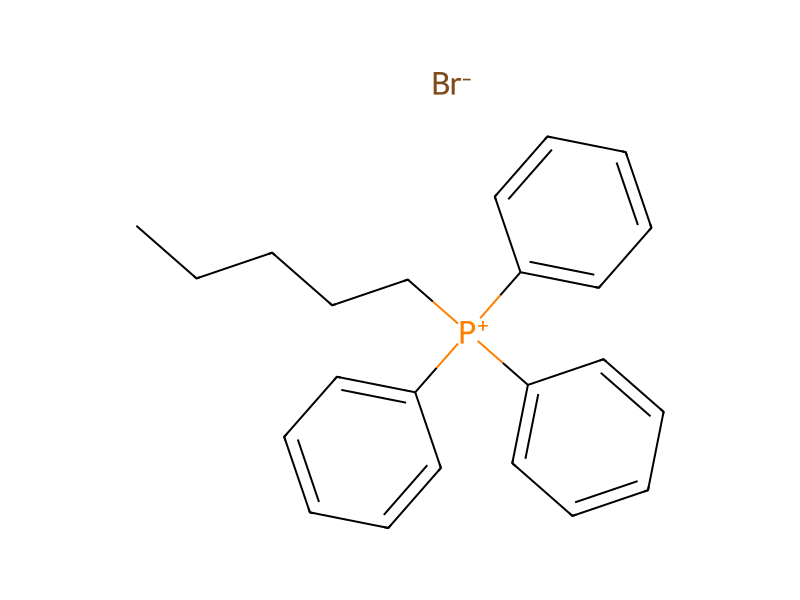
[Br-].[CH2:2]([P+](C1C=CC=CC=1)(C1C=CC=CC=1)C1C=CC=CC=1)[CH2:3][CH2:4][CH2:5][CH3:6].CC(C)([O-])C.[K+].[Br:32][C:33]1[CH:34]=[C:35]([CH:38]=O)[S:36][CH:37]=1.[Br-].[PH4+]>O1CCCC1>[CH:38]([C:35]1[S:36][CH:37]=[C:33]([Br:32])[CH:34]=1)=[CH:2][CH2:3][CH2:4][CH2:5][CH3:6]Participants





Procedure
2.0 grams (10.5 mmols) of (n-pentyl) triphenyl phosphonium bromide was added to 105 ml. of tetrahydrofuran (THF) with stirring. 1.86 gms (15.8 mmol.) of potassium tertiary butoxide was then added to the mixture while stirring at room temperature under an argon atmosphere. After one hour of continued stirring, 2.0 gms (10.5 mmol) of 4-bromo-2-thiophene carboxaldehyde, dissolved in 20 ml of THF, was added to the phosphonium bromide solution. After an additional one hour, the reaction was quenched with water. The organic layer was then separated, washed twice with water and then with brine. After drying over MgSO4 and filtering, the filtrate was concentrated. The concentrate was flushed through a silica plug and eluted with hexane to yield 2.2 gms of a yellow liquid. This liquid included a mixture of cis and trans isomers of the named compound and had the following NMR spectra:
Workup
- customthe reaction was quenched with water
- customThe organic layer was then separated
- washwashed twice with water
- dry with materialAfter drying over MgSO4
- filtrationfiltering
- concentrationthe filtrate was concentrated
- customThe concentrate was flushed through a silica plug
- washeluted with hexane
Sources & evidence
- ORD record
- ord-659c56c889434269a877ac8902228172
- Source dataset
- uspto-grants-1994_04
- Patent number
- US05300499
Reaction notes
Loading…