反应详情
EQUATION
反应方程式

REACTANTS
反应物
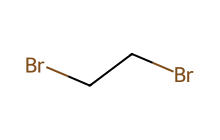


PRODUCTS
产物

AUXILIARIES
试剂、催化剂与溶剂

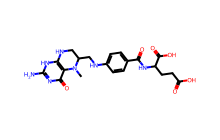
CONDITIONS
反应条件
- 温度
- 20 °C
PROCEDURE
实验过程
Iodobenzene diacetate (78 g, 243.29 mmol) was added to (3R)-4-(2-chloro-6-((S)-methylsulfinylmethyl)pyrimidin-4-yl)-3-methylmorpholine (70.5 g, 243.29 mmol), 2,2,2-trifluoroacetamide (55.0 g, 486.57 mmol), magnesium oxide (39.2 g, 973.15 mmol) and rhodium(II) acetate dimer (2.69 g, 6.08 mmol) in DCM (2433 ml) under air. The resulting suspension was stirred at 20° C. for 24 hours. Further 2,2,2-trifluoroacetamide (13.75 g, 121.64 mmol), magnesium oxide (9.81 g, 243.29 mmol), iodobenzene diacetate (19.59 g, 60.82 mmol) and rhodium(II) acetate dimer (0.672 g, 1.52 mmol) were added and the suspension was stirred at 20° C. for 1 day. The reaction mixture was filtered and then silica gel (200 g) added to the filtrate and the solvent removed in vacuo. The resulting powder was purified by flash chromatography on silica, eluting with a gradient of 20 to 50% EtOAc in heptane. Pure fractions were concentrated and the resultant precipitate collected by filtration to afford N-[({2-chloro-6-[(3R)-3-methylmorpholin-4-yl]pyrimidin-4-yl]methyl)(methyl)oxido-λ6-sulfanylidene]-2,2,2-trifluoroacetamide as a 7:1 mixture of S:R isomers (26.14 g, 27%); 1H NMR (400 MHz, CDCl3) 1.33 (3H, d), 3.28 (1H, dd), 3.42 (3H, d), 3.46-3.57 (1H, m), 3.61-3.70 (1H, m), 3.79 (1H, d), 4.02 (1H, dd), 4.65 (1H, d), 4.85 (1H, dd), 6.49 (1H, d); m/z: (ES+) MH+, 400.94 and 402.85. Chiral HPLC: (HP1100 System 4, 5 μm Chiralpak AD-H (250 mm×4.6 mm) column eluting with Heptane/EtOH 50/50) Rf, 4.367 12.5%, 6.053 87.5%. The mother liquers were concentrated in vacuo to yield a colourless gum. The gum was triturated with isohexane to give a solid which was collected by filtration and dried under vacuum to afford N—R{2-chloro-6-[(3R)-3-methylmorpholin-4-yl]pyrimidin-4-yl}methyl)(methyl)oxido-λ6-sulfanylidene]-2,2,2-trifluoroacetamide as a 2.8:1 mixture of R:S isomers (47.1 g, 48%); 1H NMR (400 MHz, CDCl3) 1.33 (3H, d), 3.31 (1H, t), 3.42 (3H, d), 3.47-3.57 (1H, m), 3.62-3.70 (1H, m), 3.79 (1H, d), 4.02 (1H, dd), 4.65 (1H, dd), 4.86 (1H, dd), 6.49 (1H, d); m/z: (ES+) MH+, 400.94 and 402.86. Chiral HPLC: (HP1100 System 4, 5 μm Chiralpak AD-H (250 mm×4.6 mm) column eluting with Heptane/EtOH 50/50) Rf, 4.365 73.5%, 6.067 26.4%. b) Cesium hydroxide-hydrate (0.390 g, 3.43 mmol) was added to a 7:1 mixture of S:R isomers of N-[({2-chloro-6-[(3R)-3-methylmorpholin-4-yl]pyrimidin-4-yl}methyl)(methyl)oxido-λ6-sulfanylidene]-2,2,2-trifluoroacetamide (0.209 g, 0.69 mmol), 1,2-dibromoethane (0.236 ml, 2.74 mmol) and tetraoctylammonium bromide (0.037 g, 0.07 mmol) in methyl THF (2 ml) at 20° C. under nitrogen. The resulting mixture was stirred at 20° C. for 16 hours. Further 1,2-dibromoethane (0.236 mL, 2.74 mmol) was added and the mixture was stirred at 20° C. for 24 hours. A second portion of cesium hydroxide-hydrate (0.390 g, 3.43 mmol) was added and the mixture stirred over a weekend. The reaction mixture was filtered and silica gel (5 g) added to the filtrate. The mixture was concentrated in vacuo and the resultant powder was then purified by flash chromatography on silica, eluting with a gradient of 0 to 5% MeOH in DCM. Pure fractions were evaporated to afford (3R)-4-(2-chloro-6-(1-((S)—S-methylsulfonimidoyl)cyclopropyl)pyrimidin-4-yl)-3-methylmorpholine (0.099 g, 44%); 1H NMR (400 MHz, CDCl3) 1.31 (3H, t), 1.43 (2H, h), 1.67-1.75 (2H, m), 2.33 (1H, s), 3.09 (3H, s), 3.29 (1H, td), 3.53 (1H, td), 3.67 (1H, dd), 3.78 (1H, d), 4.00 (2H, dd+broad s), 4.33 (1H, s), 6.78 (1H, s); m/z: (ES+) MH+, 331.04 and 332.99. Chiral HPLC: (HP1100 System 4, 5 μm Chiralpak AD-H (250 mm×4.6 mm) column eluting with Heptane/IPA/TEA 70/30/0.1) Rf, 5.948 89.5%.
WORKUP
后处理
- additionas a 2.8:1 mixture of R
- washChiral HPLC: (HP1100 System 4, 5 μm Chiralpak AD-H (250 mm×4.6 mm) column eluting with Heptane/EtOH 50/50) Rf, 4.365 73.5%, 6.067 26.4%
- customat 20° C.
- stirringthe mixture was stirred at 20° C. for 24 hours
- stirringthe mixture stirred over a weekend
- filtrationThe reaction mixture was filtered
- additionsilica gel (5 g) added to the filtrate
- concentrationThe mixture was concentrated in vacuo
- customthe resultant powder was then purified by flash chromatography on silica
- washeluting with a gradient of 0 to 5% MeOH in DCM
- customPure fractions were evaporated