2-Fluoro-4-(4-oxocyclohexyl)benzonitrile → HCID 13710408, compound
Reaction equation

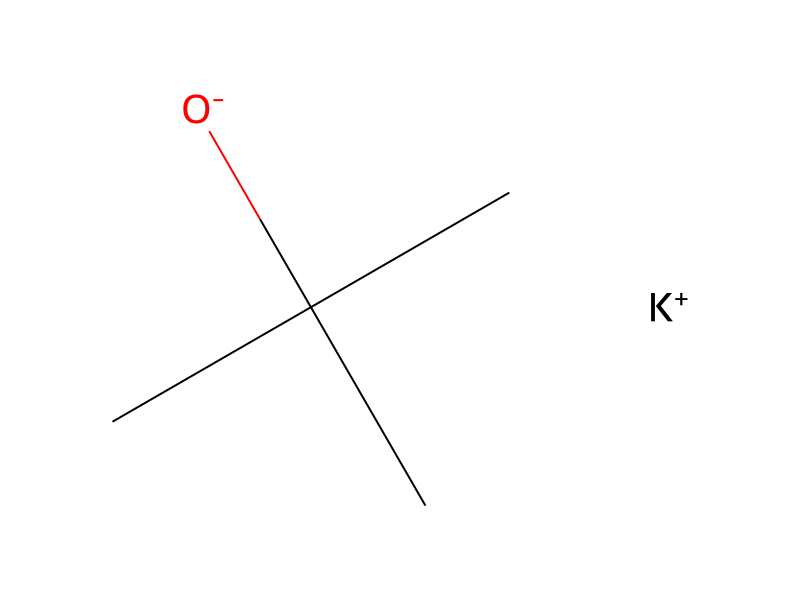
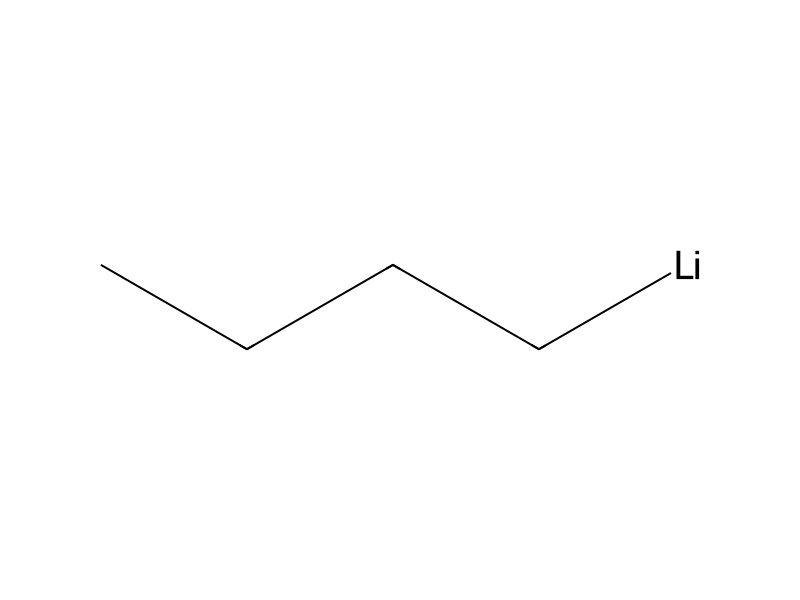
[Cl-].C[O:3][CH2:4][PH3+].C([Li])CCC.CC(C)([O-])C.[K+].[F:17][C:18]1[CH:19]=[C:20]([CH:26]2[CH2:31][CH2:30][C:29](=O)[CH2:28][CH2:27]2)[CH:21]=[CH:22][C:23]=1[C:24]#[N:25]>>[CH:4]([CH:29]1[CH2:28][CH2:27][CH:26]([C:20]2[CH:21]=[CH:22][C:23]([C:24]#[N:25])=[C:18]([F:17])[CH:19]=2)[CH2:31][CH2:30]1)=[O:3]Participants



Procedure
1,4-Cyclohexanedionemonoethyleneketal is reacted with a Grignard reagent prepared from 3-fluorobromobenzene (1), to obtain an alcohol form substance (2), followed by dehydrating it with an acid catalyst (such as p-toluenesulfonic acid, potassium hydrogen sulfate, hydrochloric acid, sulfuric acid, ion-exchange resin, etc.) to convert it into a cyclohexene derivative (3), thereafter subjecting the derivative to catalytic hydrogenation reaction in the presence of a catalyst such as Pd, Ni, Pt, etc., further deprotecting with an acidic aqueous solution (such as acetic acid, hydrochloric acid, formic acid, etc.), to obtain a cyclohexanone derivative (5), next reacting oxalyl chloride for acylation with the compound (5) in the presence of aluminum chloride, to obtain an acid chloride derivative (6), reacting aqueous ammonium with (6) to obtain an amide form substance (7), further reacting benzenesulfonyl chloride with (7) in pyridine, to obtain 4-(3-fluoro-4-cyanophenyl)cyclohexanone (8), reacting an ylide obtained by treating methoxymethylphosphonium chloride with a base (such as n-butyllithium, potassium-t-butoxide, etc.), with the cyclohexanone derivative (8) and further treating it in an acidic aqueous solution to obtain the objective 1-formyl-4-(3-fluoro-4-cyanophenyl) cyclohexane. 1-Formyl-4-(3,5-difluoro-4-cyanophenyl) cyclohexane, too, can be prepared in the same manner as the above, using 3,5-difluorobromobenzene as its raw material.
Workup
- customobtained
Sources & evidence
- ORD record
- ord-e37c0bdbaa3b405298d370bb50e028c5
- Source dataset
- uspto-grants-1994_12
- Patent number
- US05370822
Reaction notes
Loading…