Potassium Carbonate → Perfluorophenyl 1-(3'-chloro-2,5'-difluoro-5-methoxy-[1,1'-biphenyl]-4-yl)-2-oxo-1,2-dihydroquinoline-6-sulfonate
Reaction equation

Br[C:2]1[C:7]([F:8])=[CH:6][C:5]([N:9]2[C:18]3[C:13](=[CH:14][C:15]([S:19]([O:22][C:23]4[C:28]([F:29])=[C:27]([F:30])[C:26]([F:31])=[C:25]([F:32])[C:24]=4[F:33])(=[O:21])=[O:20])=[CH:16][CH:17]=3)[CH:12]=[CH:11][C:10]2=[O:34])=[C:4]([O:35][CH3:36])[CH:3]=1.[Cl:37][C:38]1[CH:39]=[C:40](B(O)O)[CH:41]=[C:42]([F:44])[CH:43]=1.C(=O)([O-])[O-].[K+].[K+]>C1C=CC(P(C2C=CC=CC=2)[C-]2C=CC=C2)=CC=1.C1C=CC(P(C2C=CC=CC=2)[C-]2C=CC=C2)=CC=1.Cl[Pd]Cl.[Fe+2].C(Cl)Cl>[Cl:37][C:38]1[CH:39]=[C:40]([C:2]2[CH:3]=[C:4]([O:35][CH3:36])[C:5]([N:9]3[C:18]4[C:13](=[CH:14][C:15]([S:19]([O:22][C:23]5[C:24]([F:33])=[C:25]([F:32])[C:26]([F:31])=[C:27]([F:30])[C:28]=5[F:29])(=[O:21])=[O:20])=[CH:16][CH:17]=4)[CH:12]=[CH:11][C:10]3=[O:34])=[CH:6][C:7]=2[F:8])[CH:41]=[C:42]([F:44])[CH:43]=1Participants
Reactant 3



Product 1

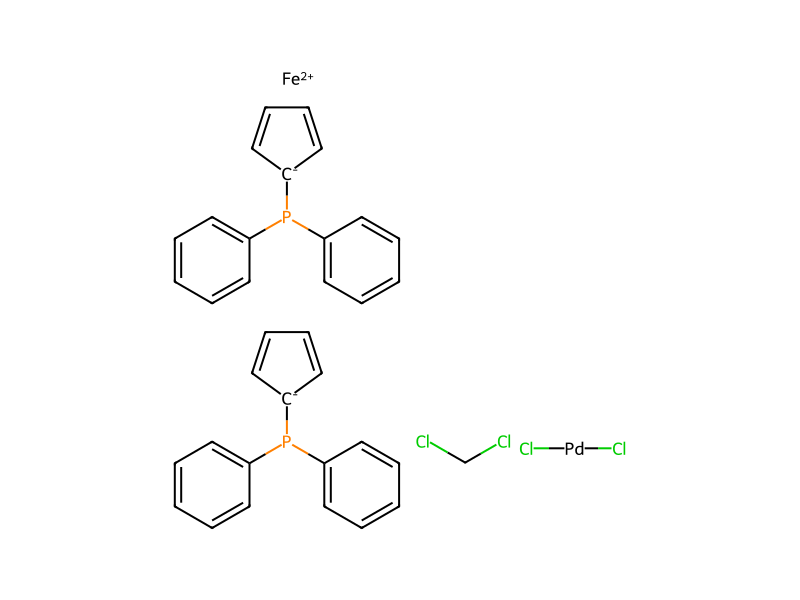
Reagents, catalysts & solvents 1
Conditions
- Temperature
- 50 °C
Procedure
A RBF was charged with perfluorophenyl 1-(4-bromo-5-fluoro-2-methoxyphenyl)-2-oxo-1,2-dihydroquinoline-6-sulfonate, (3-chloro-5-fluorophenyl)boronic acid (1.310 g, 7.52 mmol), PdCl2(dppf)-CH2Cl2 adduct (0.307 g, 0.376 mmol), and potassium carbonate (2.60 g, 18.79 mmol). The flask was flushed with Ar (g), then 1,4-dioxane (14.09 ml) and water (4.70 ml) were added. A reflux condenser was attached, and the flask was heated for 50° C. for 1.5 h. The mixture was cooled, diluted with water, and extracted with EtOAc (3×). The combined organic extracts were concentrated. The residue was purified by chromatography on silica gel (80-g Redi-Sep Gold column, 25-g silica gel loading column, 0-50% EtOAc/Heptane). Several mixed fractions were discarded, and the resulting fractions containing product were combined and concentrated to give a tan solid. The solid was concentrated from DCM, then taken up in DCM and filtered. The filtrate was concentrated to give perfluorophenyl 1-(3′-chloro-2,5′-difluoro-5-methoxy-[1,1′-biphenyl]-4-yl)-2-oxo-1,2-dihydroquinoline-6-sulfonate (1.646 g, 2.56 mmol, 68.0% yield) as a tan solid. 1 H NMR (400 MHz, DMSO-d6) □=8.62 (d, J=2.3 Hz, 1 H), 8.28 (d, J=9.6 Hz, 1 H), 8.00 (dd, J=2.3, 9.1 Hz, 1 H), 7.72-7.57 (m, 4H), 7.52 (d, J=6.8 Hz, 1 H), 6.93 (dd, J=9.4, 10.4 Hz, 2 H), 3.78 (s, 3 H).
Workup
- customThe flask was flushed with Ar (g)
- addition1,4-dioxane (14.09 ml) and water (4.70 ml) were added
- customA reflux condenser was attached
- temperatureThe mixture was cooled
- additiondiluted with water
- extractionextracted with EtOAc (3×)
- concentrationThe combined organic extracts were concentrated
- customThe residue was purified by chromatography on silica gel (80-g Redi-Sep Gold column, 25-g silica gel loading column, 0-50% EtOAc/Heptane)
- additionSeveral mixed fractions
- additionthe resulting fractions containing product
- concentrationconcentrated
- customto give a tan solid
- concentrationThe solid was concentrated from DCM
- filtrationfiltered
- concentrationThe filtrate was concentrated
Sources & evidence
- ORD record
- ord-044d5011bba6442a8c44ef1225431462
- Source dataset
- uspto-grants-2015_12
- Patent number
- US09212182B2
Reaction notes
Loading…