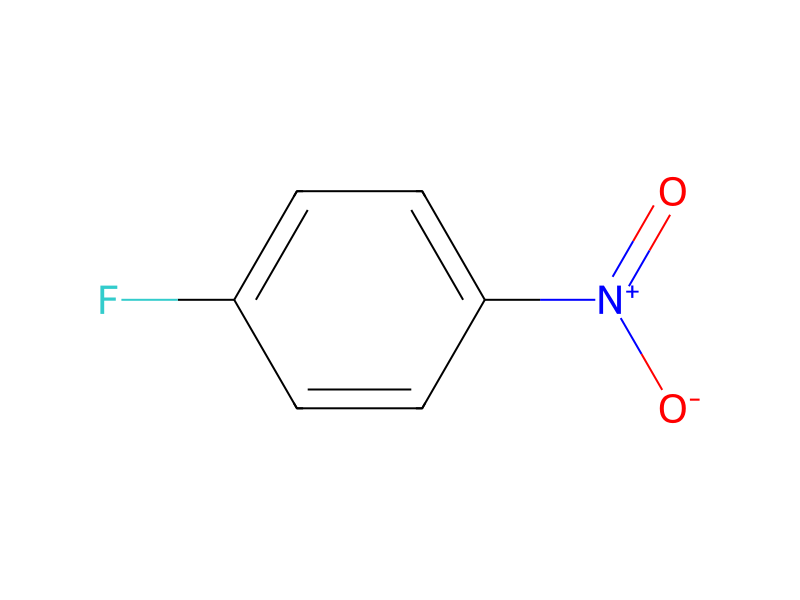
p-Fluoronitrobenzene → Ethyl 1-(4-nitrophenyl)piperidine-4-carboxylate
Reaktionsgleichung

F[C:2]1[CH:7]=[CH:6][C:5]([N+:8]([O-:10])=[O:9])=[CH:4][CH:3]=1.[CH2:11]([O:13][C:14]([CH:16]1[CH2:21][CH2:20][NH:19][CH2:18][CH2:17]1)=[O:15])[CH3:12].C(=O)([O-])[O-].[K+].[K+]>CC#N>[CH2:11]([O:13][C:14]([CH:16]1[CH2:21][CH2:20][N:19]([C:2]2[CH:7]=[CH:6][C:5]([N+:8]([O-:10])=[O:9])=[CH:4][CH:3]=2)[CH2:18][CH2:17]1)=[O:15])[CH3:12]Komponenten
Edukt 3

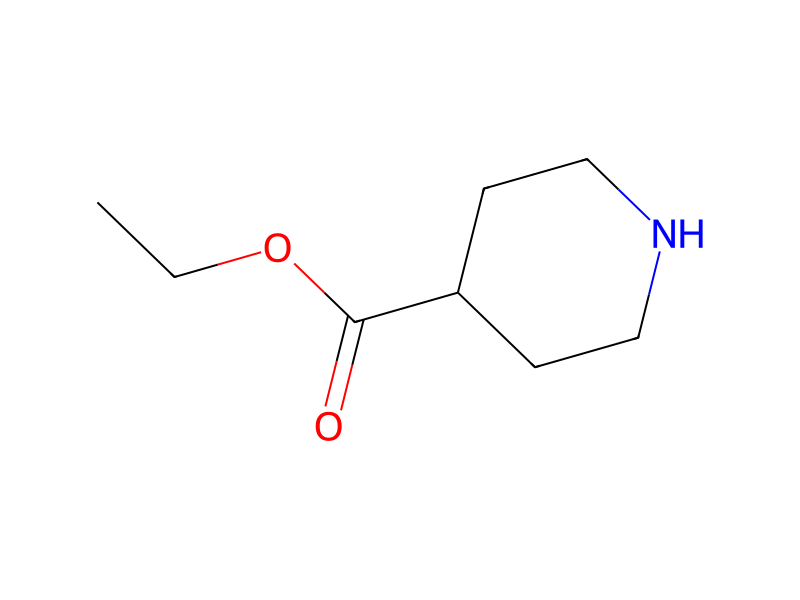
Produkt 1

Reagenzien, Katalysatoren, Lösungsmittel 1

Versuchsvorschrift
A solution of 1-fluoro-4-nitrobenzene (2.0 g, 1.50 mL, 14 mmol), piperidine-4-carboxylic acid ethyl ester (2.2 g, 2.15 mL, 14 mmol), and potassium carbonate (9.7 g, 70 mmol) in CH3CN (20 mL) was stirred at room temperature overnight. The resulting mixture was filtered and concentrated. The residue was purified by chromatography on silica gel (gradient elution with 5-50% ethyl acetate in hexanes) to produce 2.0 g of 1-(4-nitro-phenyl)-piperidine-4-carboxylic acid ethyl ester as a yellow solid. 1.0 g of the above 1-(4-nitro-phenyl)-piperidine-4-carboxylic acid ethyl ester was hydrogenated using 10% Pd/C (200 mg) in MeOH, under 50 psi pressure of hydrogen for 2 hours. The catalyst was filtered, and the residue was concentrated to produce 1-(4-amino-phenyl)-piperidine-4-carboxylic acid ethyl ester. This material was directly used in the next step without further purification.
Aufarbeitung
- filtrationThe resulting mixture was filtered
- concentrationconcentrated
- customThe residue was purified by chromatography on silica gel (gradient elution with 5-50% ethyl acetate in hexanes)
Quellen und Nachweise
- ORD-Eintrag
- ord-b1513f35bf54470a98a703b2b005ab6f
- Quelldatensatz
- uspto-grants-2012_07
- Patentnummer
- US08211914B2
Notizen zur Reaktion
Wird geladen…