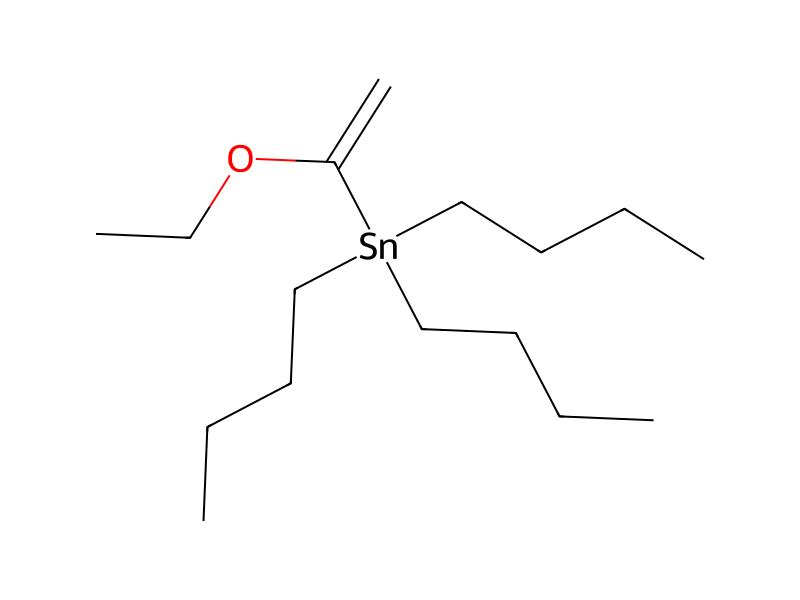
4,6-Dichloro-2-methyl-5-nitropyrimidine → 4-Chloro-6-(1-ethoxyvinyl)-2-methyl-5-nitropyrimidine
Reaction equation

Cl[C:2]1[C:7]([N+:8]([O-:10])=[O:9])=[C:6]([Cl:11])[N:5]=[C:4]([CH3:12])[N:3]=1.C([Sn](CCCC)(CCCC)[C:18]([O:20][CH2:21][CH3:22])=[CH2:19])CCC.[F-].[K+]>O1CCCC1.Cl[Pd](Cl)([P](C1C=CC=CC=1)(C1C=CC=CC=1)C1C=CC=CC=1)[P](C1C=CC=CC=1)(C1C=CC=CC=1)C1C=CC=CC=1>[Cl:11][C:6]1[C:7]([N+:8]([O-:10])=[O:9])=[C:2]([C:18]([O:20][CH2:21][CH3:22])=[CH2:19])[N:3]=[C:4]([CH3:12])[N:5]=1Participants
Reactant 3


Product 1

Reagents, catalysts & solvents 2


Conditions
- Temperature
- 85 °C
Procedure
A mixture of 4,6-dichloro-2-methyl-5-nitropyrimidine (3.12 g), tributyl(1-ethoxy-vinyl)tin (5.3 mL) and dichlorobis(triphenylphosphine)palladium(II) (0.53 g) in tetrahydrofuran (60 mL) was stirred at 85° C. under an argon atmosphere in a reaction vessel equipped with a reflux condenser for 4 hours. The reaction mixture was cooled to room temperature. To the mixture was added 0.5 mol/L aqueous potassium fluoride solution (20 mL), and the resulting mixture was stirred at room temperature for 1 hour. The insoluble material was removed by filtration, and the insoluble material was washed with ethyl acetate. The filtrate and washing were combined, and the organic layer was separated. The organic layer was washed with water and brine, and dried over anhydrous sodium sulfate. The solvent was removed under reduced pressure, and the residue was purified by column chromatography on silica gel (eluent: n-hexane/ethyl acetate=20/1−4/1). The product was dissolved in ethyl acetate. To the solution were added 0.5 mol/L aqueous potassium fluoride solution (20 mL) and water (20 mL), and the mixture was stirred at room temperature for 30 minutes. The insoluble material was removed by filtration, and the filtrate was extracted with ethyl acetate. The extract was washed with brine, and dried over anhydrous sodium sulfate, and the solvent was removed under reduced pressure to give 4-chloro-6-(1-ethoxyvinyl)-2-methyl-5-nitropyrimidine (3.65 g). This material was dissolved in acetone (30 mL). To the solution was added p-toluenesulfonic acid monohydrate (2.28 g), and the mixture was heated at reflux for 4 hours. The reaction mixture was cooled to room temperature, and concentrated under reduced pressure. The residue was purified by column chromatography on silica gel (eluent: n-hexane/ethyl acetate=20/1−4/1) to give the title compound (2.32 g).
Workup
- customequipped with a reflux condenser for 4 hours
- temperatureThe reaction mixture was cooled to room temperature
- stirringthe resulting mixture was stirred at room temperature for 1 hour
- customThe insoluble material was removed by filtration
- washthe insoluble material was washed with ethyl acetate
- washThe filtrate and washing
- customthe organic layer was separated
- washThe organic layer was washed with water and brine
- dry with materialdried over anhydrous sodium sulfate
- customThe solvent was removed under reduced pressure
- customthe residue was purified by column chromatography on silica gel (eluent: n-hexane/ethyl acetate=20/1−4/1)
- dissolutionThe product was dissolved in ethyl acetate
- additionTo the solution were added 0.5 mol/L aqueous potassium fluoride solution (20 mL) and water (20 mL)
- stirringthe mixture was stirred at room temperature for 30 minutes
- customThe insoluble material was removed by filtration
- extractionthe filtrate was extracted with ethyl acetate
- washThe extract was washed with brine
- dry with materialdried over anhydrous sodium sulfate
- customthe solvent was removed under reduced pressure
Sources & evidence
- ORD record
- ord-fbe2ba83db9c475eba4fc35feef015b2
- Source dataset
- uspto-grants-2012_07
- Patent number
- US08217069B2
Reaction notes
Loading…