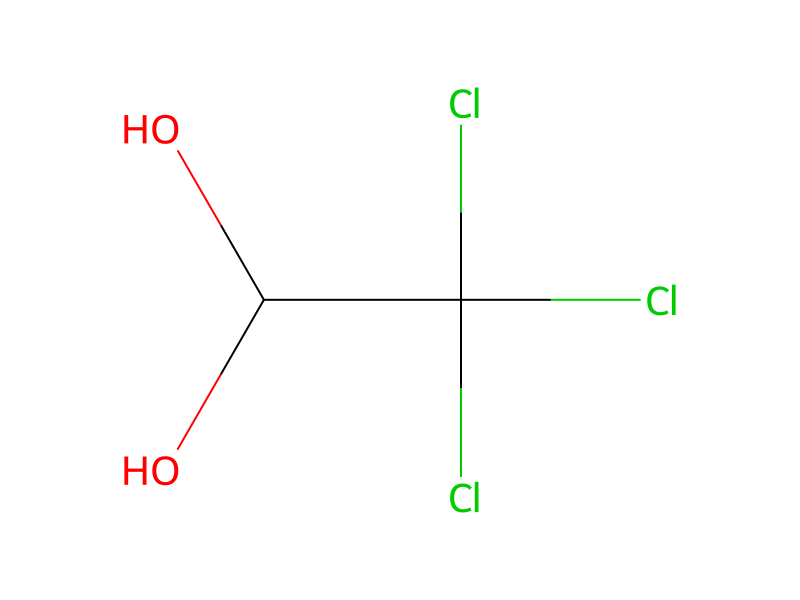
Chloral Hydrate → Acetamide, 2-(hydroxyimino)-N-phenyl-
Reaction equation

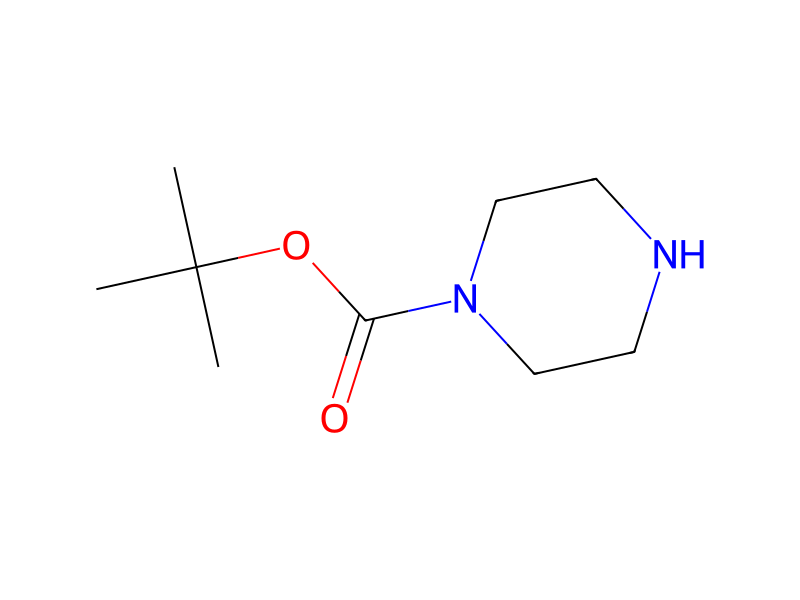
Br[N:2]1[C:11]2[C:6](=[CH:7][CH:8]=[CH:9][CH:10]=2)CN[C:3]1=[O:12].[N:13]1([C:19](OC(C)(C)C)=O)CCNCC1.BrNC1C=CC=CC=1.ClC(Cl)(Cl)C(O)[OH:37].Cl.NO>>[CH:8]1[CH:9]=[CH:10][C:11]([NH:2][C:3](/[CH:19]=[N:13]/[OH:37])=[O:12])=[CH:6][CH:7]=1Participants


Procedure
Referring to FIG. 1, the synthesis of piperazinyl compounds 5a-5f required the key intermediate 16, which was envisioned to be synthesized by Buchwald-Hartwig reaction of bromo-3,4-dihydroquinazolin-2(1H)-one 13 with tert-butyl piperazine-1-carboxylate. Therefore, preparation of 13 was commenced with the reaction of bromoaniline 7 with chloral hydrate and hydroxylamine hydrochloride to afford the corresponding isonitrosoacetanilide 8, which, in turn, was heated in concentrated sulfuric acid to afford (after regioisomers separations) isatin 9. Condensation of intermediate 9 with hydroxylamine hydrochloride smoothly furnished oxime 10. Intermediate 10 was treated with trifluorosulfonic anhydride, followed by exposure of the resultant trifluorate to DBU to afford nitrile 11 in 82% yield. Reduction of intermediate 11 with borane at room temperature generated diamine 12 in good yield 85%. Reaction of diamine 12 with carbonyldiimidazole CDI in THF at 80° C. finally furnished intermediate 13 in 74% yield. However, unexpectedly, the Buchwald-Hartwig coupling of bromide 13 with tert-butyl piperazine-1-carboxylate under different reaction conditions, such as PdCl2 dppf, KOAc, DMF, 80° C.; and Pd(PPh3)4, toluene, ethanol, Na2CO3, reflux, were unsuccessful. The desired intermediate 16 was not observed in any case. Rather, the starting intermediate 13 was recovered instead (scheme 1). Therefore, bromide 13 was protected with di-tert-butyl dicarbonate to furnish 14, whereas diamine 12 was acetylated with acetic anhydride in pyridine to render intermediate 15. Buchwald-Hartwig reaction of intermediates 14 or 15 with tert-butyl piperazine-1-carboxylate under different reaction conditions, as was attempted in the case of intermediate 13, also failed. The desired coupled products were not detected in any case. Rather, the starting 13 (when 14 was used as coupling partner) and 15 were recovered from the reactions instead (see FIG. 1).
Sources & evidence
- ORD record
- ord-e86e5e13e1bb4835a8dd06a2d6cd8499
- Source dataset
- uspto-grants-2015_07
- Patent number
- US09073900B2
Reaction notes
Loading…