Benzenemethanol, alpha-ethenyl-, 1-acetate → Vinylbenzyl alcohol vinylbenzyl acetate
Reaction equation

[C:1]([O:4][CH:5]([CH:12]=[CH2:13])[C:6]1[CH:11]=[CH:10][CH:9]=[CH:8][CH:7]=1)(=[O:3])[CH3:2]>O1CCCC1>[CH:12]([CH:5]([OH:4])[C:6]1[CH:11]=[CH:10][CH:9]=[CH:8][CH:7]=1)=[CH2:13].[C:1]([O:4][CH:5]([CH:12]=[CH2:13])[C:6]1[CH:11]=[CH:10][CH:9]=[CH:8][CH:7]=1)(=[O:3])[CH3:2]Participants
Reactant 1

Product 1

Reagents, catalysts & solvents 1
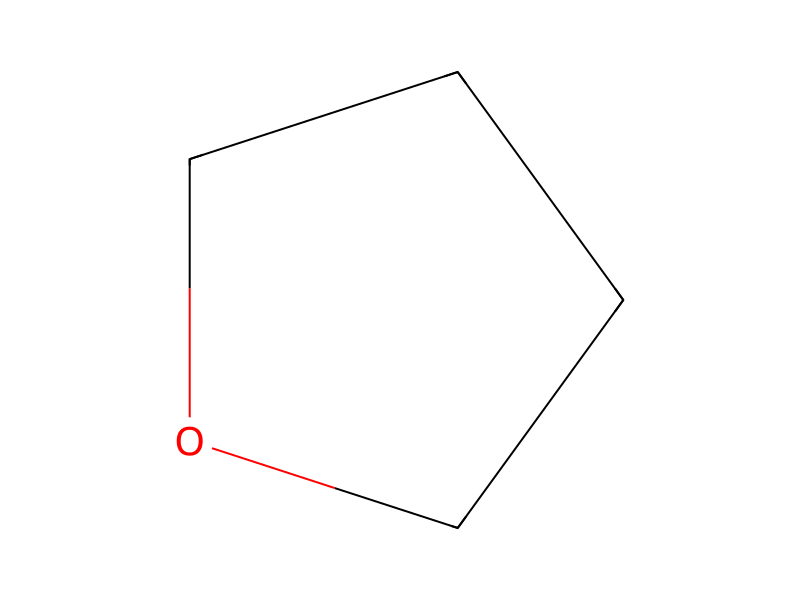
Procedure
Poly(vinylbenzyl acetate) (20 grams from Example 2) in anhydrous tetrahydrofuran (200 grams, Aldrich) were allowed to react with a 1 molar solution of borane-tetrahydrofuran complex (Aldrich) in a 1-liter, 3-neck, round-bottom flask situated in a silicone oil bath and equipped with an argon inlet, reflux condenser, mechanical stirrer, and rubber septum stopper. The amount of 1-molar borane-tetrahydrofuran complex solutions used determined the amount of benzyl alcohol groups formed. One mole of borane complex reduced 1 mole of benzyl acetate groups. Consequently, 53 mL (46.9 grams), 72 mL (63.7 grams), 108 mL (95.39 grams), 117 mL (103.4 grams) and 126 mL (111.5 grams) of 1 molar borane-THF complex when reacted with poly(vinylbenzyl acetate (20 grams in 200 grams THF) produced poly(vinylbenzyl alcohol-vinylbenzyl acetate) copolymers with 36.5, 55, 76.5, 85, and 93.5 mole % benzyl alcohol groups. For complete reduction to poly(vinylbenzyl alcohol), a minimum of 140 mL (124.5 grams) of 1 molar borane-THF complex is required. The reaction mixture was heated for at least 1 hour at reflux, and the polymer gelled and formed a dispersion upon stirring. When the reaction mixture returned to 25° C., methanol was cautiously added and vigorous out gassing took place. A clear polymer solution formed that was added to water at a ratio of 25 mL of polymer solution for every 1 liter of water using a Waring blender controlled with a variable transformer (Variac). The precipitated polymer was collected by filtration, washed with water, and then was vacuum dried. The conversion of benzyl acetate groups to benzyl alcohol groups was determined by 1H NMR spectrometry. The recovered yield of copolymer varied between 10 and 12 grams.
Workup
- customsituated in a silicone oil bath
- customequipped with an argon inlet
- temperaturereflux condenser, mechanical stirrer
- customformed
Sources & evidence
- ORD record
- ord-ae2196425bd848bcbdbbb6cf4cb799dd
- Source dataset
- uspto-grants-2001_03
- Patent number
- US06200716B1
Reaction notes
Loading…