2',4'-Dichloroacetophenone → 2-Bromo-1-(2,4-dichlorophenyl)ethan-1-one
Reaction equation

[Cl:1][C:2]1[CH:7]=[C:6]([Cl:8])[CH:5]=[CH:4][C:3]=1[C:9](=[O:11])[CH3:10].[Al+3].[Cl-].[Cl-].[Cl-].[Br:16]Br>CCOCC>[Br:16][CH2:10][C:9]([C:3]1[CH:4]=[CH:5][C:6]([Cl:8])=[CH:7][C:2]=1[Cl:1])=[O:11]Participants
Reactant 3



Product 1
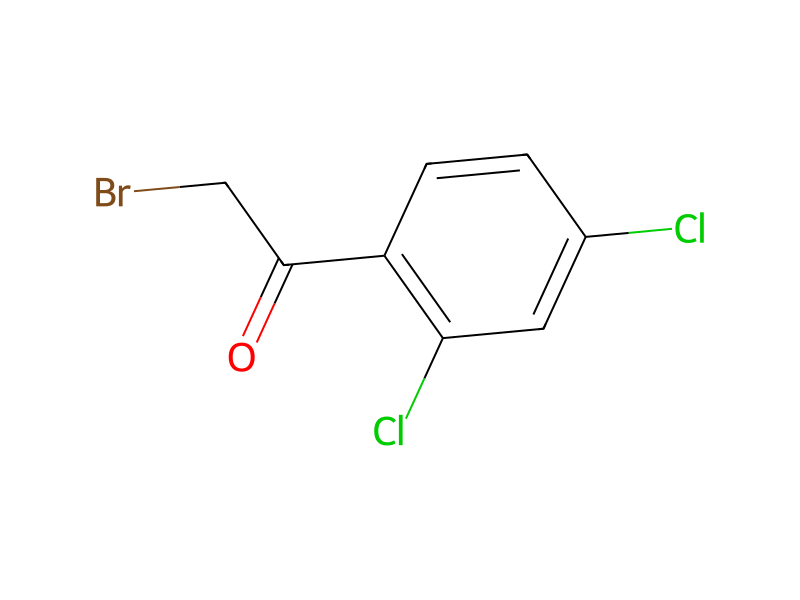
Reagents, catalysts & solvents 1

Conditions
- Temperature
- 0 °C
Procedure
25 g (0.1322 mol) of 2′,4′-dichloroacetophenone was placed in a three-neck round bottom flask equipped with a magnetic stir bar, reflux condenser, and dropping funnel. Anhydrous ether (30 mL) and AlCl3 (0.20 g) were added. The solution was stoppered and cooled to 0° C. in an ice bath. Br2 (21.13 g, 0.1322 mol) was added dropwise (at a rate of approximately 0.5 mL/min). After addition of Br2 was complete, HBr and the solvent were removed under reduced pressure. The remaining HBr was removed by blowing a stream of nitrogen over the orange oily product. The resulting oil was placed under high vacuum until all the bubbling had ceased. The product was obtained as a viscous orange oil, which solidified upon standing in the refrigerator. Yield: 35.72 g (100%); TLC: 95% Hexanes/5% Acetone, Rf=0.35.
Workup
- customequipped with a magnetic stir bar
- temperaturereflux condenser
- customHBr and the solvent were removed under reduced pressure
- customThe remaining HBr was removed
- customThe product was obtained as a viscous orange oil, which
Sources & evidence
- ORD record
- ord-be001c5cdd144f3cb80be2884de1f961
- Source dataset
- uspto-grants-2001_03
- Patent number
- US06207695B1
Reaction notes
Loading…