2-Tert-Butylphenol → Phenol
Reaction equation

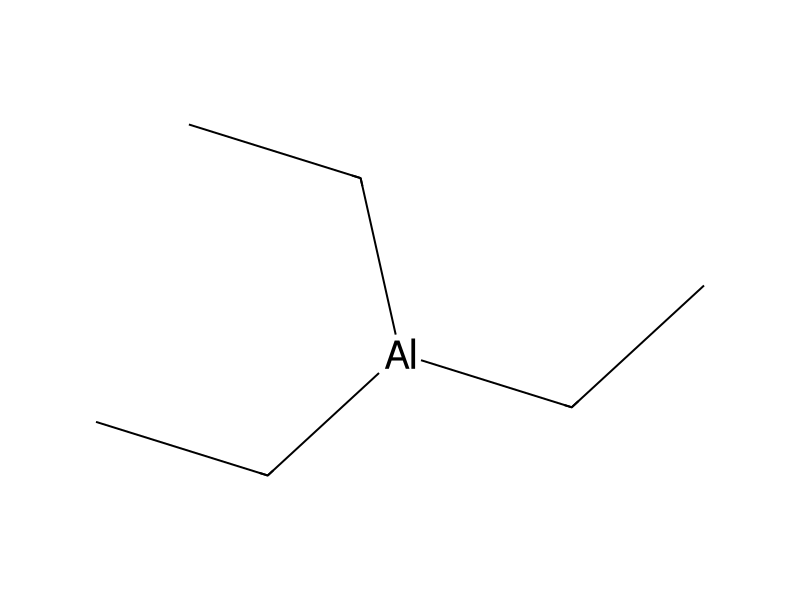
C([C:5]1[CH:10]=CC=CC=1O)(C)(C)C.[C:12]1([O-])[CH:17]=CC=CC=1.[Al+3:19].[C:20]1([O-])[CH:25]=CC=CC=1.[C:27]1([O-:33])[CH:32]=[CH:31][CH:30]=[CH:29][CH:28]=1.[Al]>C1(O)C=CC=CC=1>[CH2:25]([Al:19]([CH2:10][CH3:5])[CH2:17][CH3:12])[CH3:20].[C:27]1([OH:33])[CH:32]=[CH:31][CH:30]=[CH:29][CH:28]=1Participants
Reactant 3


Product 2

Reagents, catalysts & solvents 1
Procedure
It is known that 2,6-di-tert-butylphenol can be obtained by the addition of isobutene to phenol or to 2-tert-butylphenol in the presence of aluminum phenolates (cf. Ullmann, "Enzyklopaedie der Technischen Chemie [Encyclopedia of Industrial Chemistry]," Volume 18 (1979), page 205 ff.). The alkylation of phenol or 2-tert-butylphenol is usually performed in the presence of aluminum phenolate at 100° C. and above, typically at 110° C. to 120° C., under pressure, which can be up to 25 bars. The catalyst is obtained by dissolving 1 to 3% by weight of aluminum in the phenol to be alkylated [cf. US-PS 2 831 898, DE-PSS 944 014, 1 044 825; J. Org. Chem. 22 (1957) 642; Ang. Chem. 69 (1957) 699]. It can also be produced by the reaction of aluminum alcoholates or of triethyl aluminum with phenol, as well as by other methods. The 2-tert-butylphenol or 2,6-di-tert-butylphenol obtained is a function of the ratio of the respective phenol used to the isobutene. Both 2,4-di-tert-butylphenol and 2,4,6-tri-tert-butylphenol occur as by-products. The use of excess isobutene results in high yields of the trisubstituted phenol [cf. Ullmann, "Enzyklopaedie der Technischen Chemie, " Volume 18 (1979), p. 200; Kirk-Othmer, "Encyclopedia of Chemical Technology," Vol. 2 (1978), p. 85)]. In addition, with increasing reaction time, there is an increase in the portion of compounds containing a para-position tert-butyl substituent (2,4-di-tert-butylphenol, 2,4,6-tri-tert-butylphenol). Therefore, the reaction is interrupted at an optimal moment for the production of 2,6-di-tert-butylphenol. At the end of the alkylation, the aluminum phenolate catalyst is deactivated, at the latest, before the separation of the reaction products by distillation to avoid dealkylation of the products. In general, this deactivation takes place by hydrolysis with water, acid or diluted lye, but even traces of acids have to be removed or neutralized again before the distillation. This requires (cf. Ullmann, p. 202) a careful washing of the alkylate with lye and water, and waste water results, which (after separating of the aqueous phase) has to be subsequently treated, to avoid polluting the environment. The rectification of the organic phase obtained according to this production process yields, for example, with the use of 2 mol of isobutene per mole of phenol, about 75% of theory of 2,6-di-tert-butylphenol and about 10% of theory of 2-tert-butylphenol. The distillation residue consists primarily of 2,4,6-tri-tert-butylphenol. Alternatively, if only 1 mol of isobutene per mole of phenol is used, then in addition to unreacted phenol and some 2,6-di-tert-butylphenol, 2-tert-butylphenol is isolated as the main product, which is obtained in about a 70% yield in relation to the reacted phenol.
Workup
- customtypically at 110° C. to 120° C.
- customThe catalyst is obtained
Sources & evidence
- ORD record
- ord-27690f71a5ad4dadbc4fe737f397168b
- Source dataset
- uspto-grants-1992_02
- Patent number
- US05091594
Reaction notes
Loading…