1,2,3-Trimethoxybenzene → 3,4,5-Trimethoxybenzoic Acid
Reaction equation

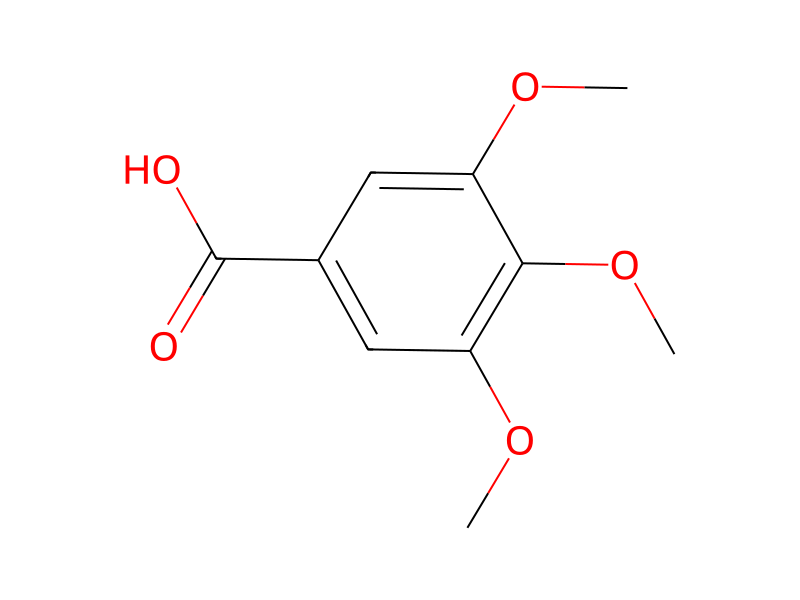
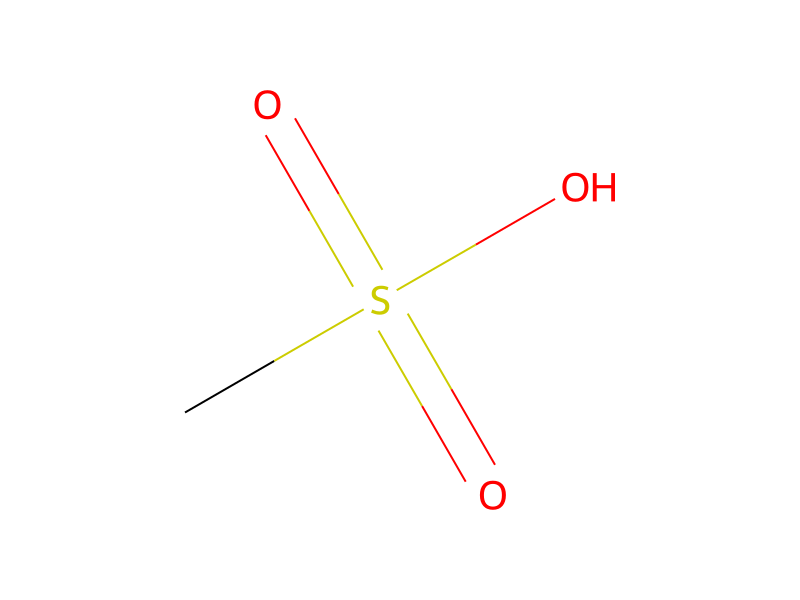
COC1C=CC=C(OC)C=1OC.[OH:13][C:14]1[C:22]([O:23][CH3:24])=[C:21]([O:25][CH3:26])[C:20]([O:27][CH3:28])=[CH:19][C:15]=1[C:16]([OH:18])=[O:17].O=P12OP3(OP(OP(O3)(O1)=O)(=O)O2)=O>CS(O)(=O)=O>[OH:13][C:14]1[C:22]([O:23][CH3:24])=[C:21]([O:25][CH3:26])[C:20]([O:27][CH3:28])=[CH:19][C:15]=1[C:16]([OH:18])=[O:17].[CH3:28][O:27][C:20]1[CH:19]=[C:15]([CH:14]=[C:22]([O:23][CH3:24])[C:21]=1[O:25][CH3:26])[C:16]([OH:18])=[O:17]Participants


Procedure
A mixture of 1,2,3-Trimethoxybenzene (1.48 g) and 2-hydroxy-3,4,5-trimethoxybenzoic acid (2.00 g) is stirred in 40 ml of ~9% solution of P2O5 in methanesulfonic acid at room temperature in a stoppered flask for 4 hours. The 2-hydroxy-3,4,5-trimethoxybenzoic acid was obtained by the method of Mayer and Fikentscher (Mayer and Fikentscher (1956) Chem. Ber. 89:511) from 3,4,5-trimethoxybenzoic acid by bromination and then copper-catalyzed replacement of bromine (by OH) of 2-bromo-3,4,5-trimethoxybenzoic acid. The resultant orange mixture is poured onto crushed ice (500 ml) producing an unfilterable gummy precipitate. This crude product is then subjected to base-catalyzed ring closure by heating in a beaker in 100 ml of 40% ethanol and 10 ml of 10N NaOH just below boiling point. As the mixture reaches 80° C., a white flocculent product appears. The temperature is maintained just below the boiling point and the volume is kept constant by addition of water. After 5 hours, the supernatant is bright yellow and a mass of the precipitate has formed. Heating is continued for 4 more hours. Cooling, filtering (by suction) and washing with water afforded 1.37 g of analytically pure 2,3,4,5,6-pentamethoxyxanthone (yield approximately 45% relative to benzoic acid). This base-catalyzed ring closure is illustrated below: ##STR6## 2,3,4,5,6-pentahydroxyxanthone is then obtained by boron tribromide treatment (200 ml of a 0.8 M solution in CH2Cl2) as the pentamethyl ether (0.45 g) is stirred at room temperature for 24 hours. After this period, the solution is poured into 100 ml of water and stirred for approximately 45 minutes before the precipitate is collected by centrifugation. The supernatant is then decanted, the precipitate is shaken with water and centrifuged again. The final product is obtained by freeze-drying of the wet precipitate to produce an orange powder (0.290 g, 81%).
Sources & evidence
- ORD record
- ord-97851692145347d48a3cbc37b78d6a45
- Source dataset
- uspto-grants-1999_11
- Patent number
- US05977077
Reaction notes
Loading…