Benzoyl Peroxide → 2-Bromoethyl Benzoate
Reaction equation

[C:1]1([CH:7]2[O:11][CH2:10][CH2:9][O:8]2)[CH:6]=[CH:5][CH:4]=[CH:3][CH:2]=1.C(OOC(=O)C1C=CC=CC=1)(=O)C1C=CC=CC=1.[Br:30]N1C(=O)CCC1=O>C(Cl)(Cl)(Cl)Cl>[C:7]([O:11][CH2:10][CH2:9][Br:30])(=[O:8])[C:1]1[CH:6]=[CH:5][CH:4]=[CH:3][CH:2]=1Participants
Reactant 3


Product 1

Reagents, catalysts & solvents 1
Procedure
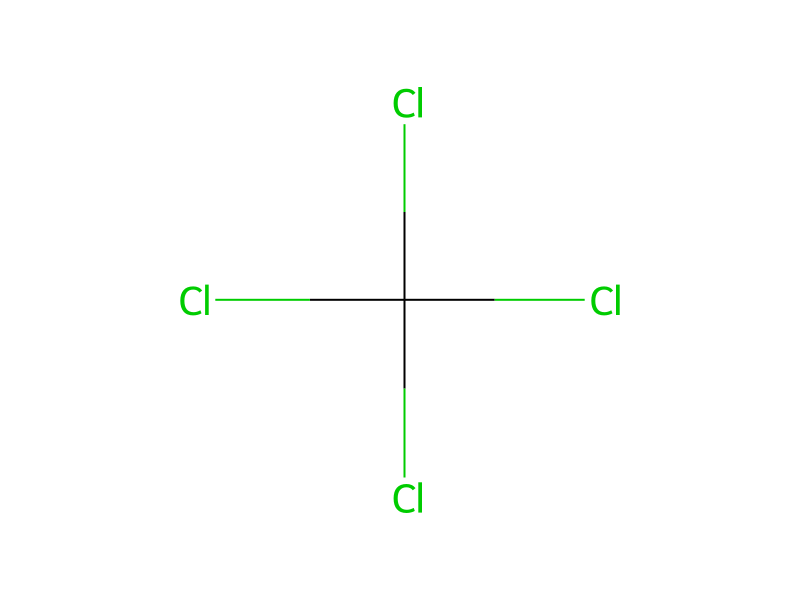
The preferred aldehyde for the second route is benzaldehyde, especially when the glycol is ethylene glycol and the N-halogenated imide is N-bromosuccinimide. More specifically, 2-phenyl-1,3-dioxolane can be prepared by mixing benzaldehyde and ethylene glycol in a 1.0 to 1.2 mol ratio in an organic solvent containing a catalytic amount of an organic acid, such as p-toluenesulfonic acid. The mixture is heated and allowed to reflux for about an hour and a half, then treated with potassium carbonate, filtered, and distilled to produce 2-phenyl-1,3-dioxolane. The dioxolane is subsequently dissolved in carbon tetrachloride with an equimolar amount of N-bromosuccinimide and a catalytic amount of benzoyl peroxide. After heating under reflux conditions for up to 16 hours, cooling, and filtering, the mixture produces a filtrate that can be further concentrated to yield an ester, 2-bromoethyl benzoate. The ester so produced is used as an alkylating agent when reacted with a tertiary amine yielding a quaternary ammonium salt.
Workup
- temperatureAfter heating under reflux conditions for up to 16 hours
- temperaturecooling
- filtrationfiltering
- customthe mixture produces a filtrate that
- concentrationcan be further concentrated
Sources & evidence
- ORD record
- ord-dcc76f9ba70d45018165e908e4401556
- Source dataset
- uspto-grants-1993_03
- Patent number
- US05194472
Reaction notes
Loading…