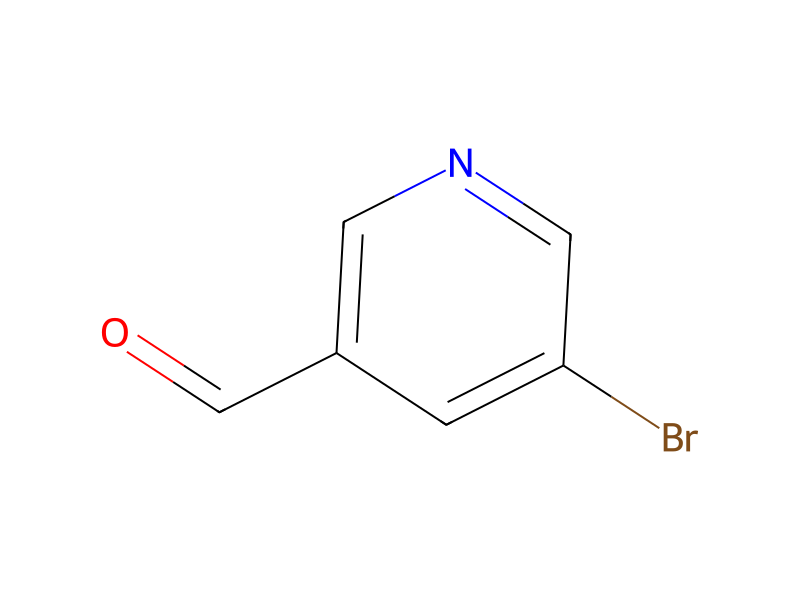
5-Bromo-3-pyridinecarboxaldehyde → (5-Bromo-pyridin-3-yl)-cyclopropyl-methanol
Reaction equation

[Br:1][C:2]1[CH:3]=[N:4][CH:5]=[C:6]([CH:8]=[O:9])[CH:7]=1.[CH:10]1([Mg]Br)[CH2:12][CH2:11]1>C1COCC1>[Br:1][C:2]1[CH:7]=[C:6]([CH:8]([CH:10]2[CH2:12][CH2:11]2)[OH:9])[CH:5]=[N:4][CH:3]=1Participants
Reactant 2

Product 1

Reagents, catalysts & solvents 1

Procedure
To a solution of 3-bromo-5-pyridinecarboxaldehyde (651 mg, 3.50 mmol) in THF (20 ml) at −78° C. was added cyclopropylmagnesium bromide (0.5M in THF, 7.49 ml, 3.74 mmol). After 10 minutes, additional cyclopropylmagnesium bromide (0.5M THF, 3.0 mL, 1.5 mmol) was added. After stirring for an additional five minutes the reaction was quenched with saturated aqueous ammonium chloride. The resulting mixture was diluted with dichloromethane and water and the layers were separated. The aqueous layer was extracted two additional times with dichloromethane, and the organic layers were combined, dried over anhydrous sodium sulfate, filtered, and concentrated. The resulting residue was purified by silica gel flash chromatography (ethanol-dichloromethane, 0 to 7%) to afford (5-bromo-pyridin-3-yl)-cyclopropyl-methanol; MS (ES+) m/z 228.2 (M+H)+.
Workup
- customwas quenched with saturated aqueous ammonium chloride
- additionThe resulting mixture was diluted with dichloromethane and water
- customthe layers were separated
- extractionThe aqueous layer was extracted two additional times with dichloromethane
- dry with materialdried over anhydrous sodium sulfate
- filtrationfiltered
- concentrationconcentrated
- customThe resulting residue was purified by silica gel flash chromatography (ethanol-dichloromethane, 0 to 7%)
Sources & evidence
- ORD record
- ord-a36ff90377cb4bc595d12fed403943f4
- Source dataset
- uspto-grants-2014_07
- Patent number
- US08778972B2
Reaction notes
Loading…