Ethylenediaminetetraacetic Acid → Nmda
Reaction equation

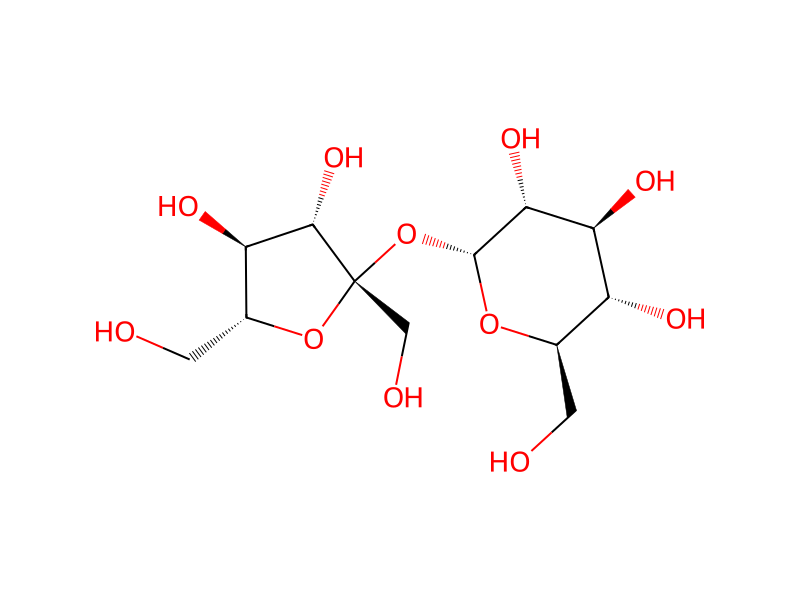
[CH3:1][NH:2][C@@H:3]([C:8]([O-:10])=[O:9])[CH2:4][C:5]([O-:7])=[O:6].C(N(CC(O)=O)CC(O)=O)CN(CC(O)=O)CC(O)=O.[O-]S([O-])(=O)=O.[Mg+2].C(O)C(N)(CO)CO.S([O-])([O-])(=O)=O>C(O)[C@H]1O[C@H](O[C@]2(CO)O[C@H](CO)[C@@H](O)[C@@H]2O)[C@H](O)[C@@H](O)[C@@H]1O>[CH3:1][NH:2][C@@H:3]([C:8]([OH:10])=[O:9])[CH2:4][C:5]([OH:7])=[O:6]Participants
Reactant 4
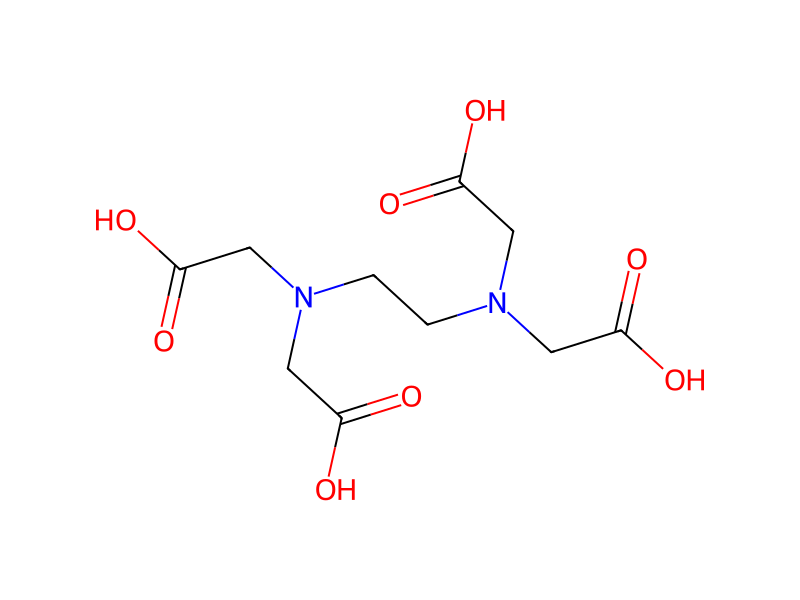
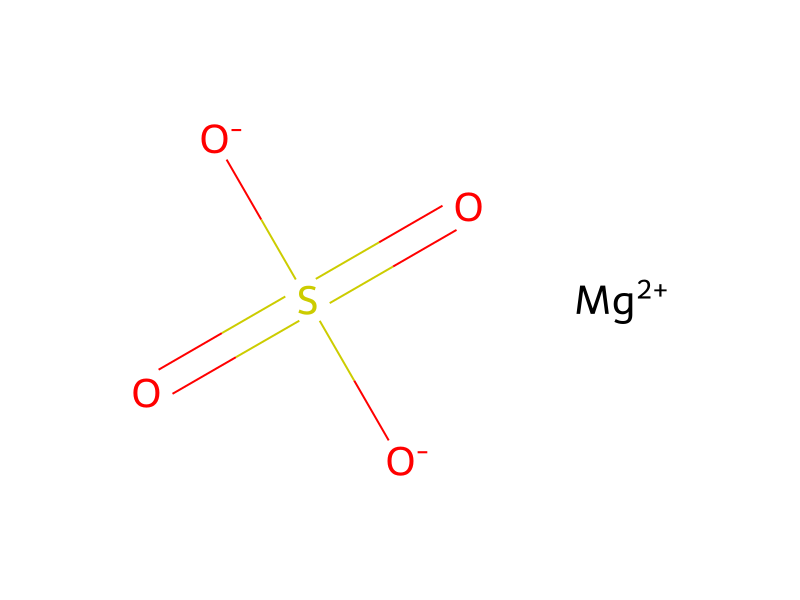


Product 1

Reagents, catalysts & solvents 1
Procedure
Synaptic plasma membranes (SPM) were prepared as previously described Monahan, J. B. and Michel, J., "Identification and Characterization of an N-methyl-D-aspartate-specific L-[3H]-glutamate Recognition Site in Synaptic Plasma Membranes, J. Neurochem., 48, 1699-1708 (1987)]. The SPM were stored at a concentration of 10-15 mg/ml in 0.32M sucrose, 0.5 mM EDTA, 1 mM MgSO4, 5 mM Tris/sulfate, pH 7.4, under liquid nitrogen. The identity and purity of the subcellular fractions were confirmed by both electron microscopy and marker enzymes. Protein concentrations were determined by using a modification of the method of Lowry [Ohnishi, S. T. and Barr, J. K., "A Simplified Method of Quantitating Proteins Using the Biuret and Phenol Reagents", Anal. Biochem., 86, 193-197 (1978)]. The SPM were treated identically for the [3H]AMPA (QUIS), [3H]kainate and sodium-dependent L-[3H]-glumatate binding assays. The SPM were thawed at room temperature, diluted twenty-fold with 50 mM Tris/acetate, pH 7.4, incubated at 37° C. for 30 minutes, and centrifuged at 100,000 g for 15 minutes. The dilution, incubation and centrifugation were repeated a total of three times. Prior to use in the NMDA-specific L-[3H]-glutamate binding assay, the SPM were thawed, diluted twenty fold with 50 mM Tris/acetate (pH 7.4 containing 0.04% (v/v) Triton X-100), incubated for 30 minutes at 37° C. and centrifuged as described above. The Triton X-100 treated membranes were washed with 50 mM Tris/acetate (pH 7.4) and centrifuged at 100,000 g for 15 minutes a total of four times. The basic procedure for the receptor subclass binding assays was similar. This general method involved adding the radioligand (12.5 nM L-[3H]-glutamate; 0.5 nM [3H]kainate or 10nM [3H]AMPA) to the appropriate concentration of the test compound and initiating the assay by the addition of ice cold synaptic plasma membranes (0.2-0.45 mg). The binding assays were performed in 1.5 mL centrifuge tubes with the total volume adjusted to 1.0 mL. Additions of test compounds were made in 50 mM Tris/acetate (pH 7.4) and incubations were carried out at 0°-4° C. The incubation time for each of the NMDA and the AMPA binding assays was 10 minutes, for the kainate binding assay 60 minutes and for the sodium-dependent glutamate binding assay 15 minutes. The AMPA binding assay contained 100 mM KSCN and the sodium-dependent glutamate binding assay contained 150 mM sodium acetate in addition to the previously described reagents. To terminate the incubation, the samples were centrifuged for 15 minutes at 12,000 g and 4° C. in a Beckman Microfuge 12. The supernatant was aspirated and the pelleted membranes dissolved in Beckman BTS-450 tissue solubilizer for a minimum of 6 hours at room temperature. Beckman MP scintillation cocktail containing 7 mL/L acetic acid was then added and the samples counted on a Beckman LS 5800 or 3801 liquid scintillation counter with automatic corrections for quenching and counting efficiency. Nonspecific binding was defined as the residual binding in the presence of either excess L-glutamate (0.1-0.4 mM), kainate (0.01 mM), or NMDA (0.5 mM), and was 15-25% of the total binding in the NMDA binding assay, 19-27% in the AMPA binding assay, 20-30% in the kainate binding assay and 10-15% in the sodium-dependent binding assay. Radioligand binding to the synaptic plasma membranes was analyzed using Scatchard and Hill transformations and the Ki values of the compounds determined using logit-log transformations. Calculations and regression analysis were performed using templates developed for Lotus 1, 2, 3 as previously described [Pullan, L. M. "Automated Radioligand Receptor Binding Analysis with Templates for Lotus", Computer Appln. Biosci., 3 131 (1987)]. Binding results are reported in Table II for example compounds of the invention. Included in Table II are binding data for D,L-AP7[D,L-2-amino-7-phosphonoheptanoic acid].
Workup
- customSynaptic plasma membranes (SPM) were prepared as previously described Monahan, J
- concentrationProtein concentrations
- additionThe SPM were treated identically for the [3H]AMPA (QUIS), [3H]kainate and sodium-dependent L-[3H]-glumatate binding assays
- customwere thawed at room temperature
- additiondiluted twenty-fold with 50 mM Tris/acetate, pH 7.4
- waitcentrifuged at 100,000 g for 15 minutes
- additiondiluted twenty fold with 50 mM Tris/acetate (pH 7.4 containing 0.04% (v/v) Triton X-100)
- waitincubated for 30 minutes at 37° C.
- washThe Triton X-100 treated membranes were washed with 50 mM Tris/acetate (pH 7.4)
- waitcentrifuged at 100,000 g for 15 minutes
- additionThis general method involved adding the radioligand (12.5 nM L-[3H]-glutamate; 0.5 nM [3H]kainate or 10nM [3H]AMPA)
- concentrationto the appropriate concentration of the test compound
- additionby the addition of ice cold synaptic plasma membranes (0.2-0.45 mg)
- customwere carried out at 0°-4° C
- waitwas 10 minutes, for the kainate binding assay 60 minutes and for the sodium-dependent glutamate binding assay 15 minutes
- additionin addition to the previously described reagents
- customTo terminate the incubation
- waitthe samples were centrifuged for 15 minutes at 12,000 g and 4° C. in a Beckman Microfuge 12
- dissolutionthe pelleted membranes dissolved in Beckman BTS-450 tissue solubilizer for a minimum of 6 hours at room temperature
- additionBeckman MP scintillation cocktail containing 7 mL/L acetic acid
- additionwas then added
- customfor quenching
- customBinding results
Sources & evidence
- ORD record
- ord-6254b452d6a3412db6807140d2944e7b
- Source dataset
- uspto-grants-1993_01
- Patent number
- US05177240
Reaction notes
Loading…