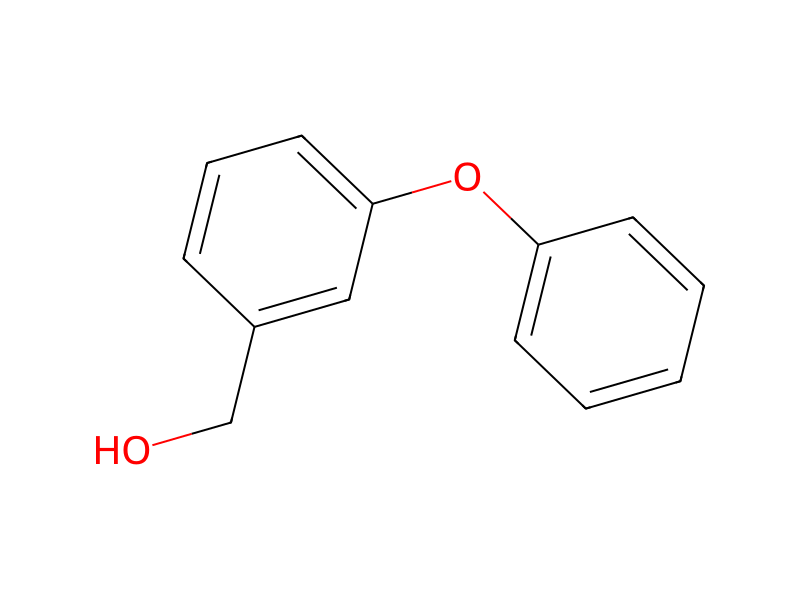
3-Phenoxybenzyl alcohol → (3-Phenoxy)benzyl 2-vinyl-1-cyanocyclopropane-1-carboxylate
Reaction equation

[CH:1]([CH:3]1[CH2:5][C:4]1([C:11]#[N:12])[C:6]([O:8][CH2:9][CH3:10])=[O:7])=[CH2:2].[O:13]([C:20]1[CH:21]=C([CH:25]=[CH:26][CH:27]=1)CO)[C:14]1[CH:19]=[CH:18][CH:17]=[CH:16][CH:15]=1>>[CH:1]([CH:3]1[CH2:5][C:4]1([C:11]#[N:12])[C:6]([O:8][CH2:9][C:10]1[CH:25]=[CH:26][CH:27]=[C:20]([O:13][C:14]2[CH:19]=[CH:18][CH:17]=[CH:16][CH:15]=2)[CH:21]=1)=[O:7])=[CH2:2]Participants


Procedure
Utilizing the product prepared in Example I, a transalcoholysis was carried out with 3-phenoxybenzyl alcohol to obtain (3-phenoxy)benzyl 2-vinyl-1-cyanocyclopropane-1-carboxylate. A three-fold molar excess of the ethyl 2-vinyl-1-cyanocyclopropane-1-carboxylate was employed for the reaction. About 0.7 wt. percent calcium acetate, based on the total reactant charge, was used as the catalyst and a small amount of hydroquinone added as an oxidation and polymerization inhibitor. The reaction mixture was heated with agitation to 150° C. and about 4 wt. percent dibutyltin oxide charged. After 5 hours additional heating the reaction was terminated and the resulting product, containing about 35% of the desired (3-phenoxy)benzyl 2-vinyl-1-cyanocyclopropane-1-carboxylate, dissolved in ethyl ether, filtered to remove insoluble catalyst residue, washed with 5% aqueous sodium hydroxide and saturated sodium chloride solutions. After evaporation of the ethyl ether, the product was dissolved in toluene and separated from the unreacted starting materials using a Waters Preparatory Liquid Chromatograph 500A equipped with a gel permeation column and operated at a flow rate of 0.1 l/min. After two passes, 92+% pure (3-phenoxy)benzyl 2-vinyl-1-cyanocyclopropane-1-carboxylate was obtained and the structure of the product confirmed by mass spectroscopy and nuclear magnetic resonance spectroscopy.
Sources & evidence
- ORD record
- ord-7e3f3d08624640e185fd8b000a93f342
- Source dataset
- uspto-grants-1983_11
- Patent number
- US04418202
Reaction notes
Loading…