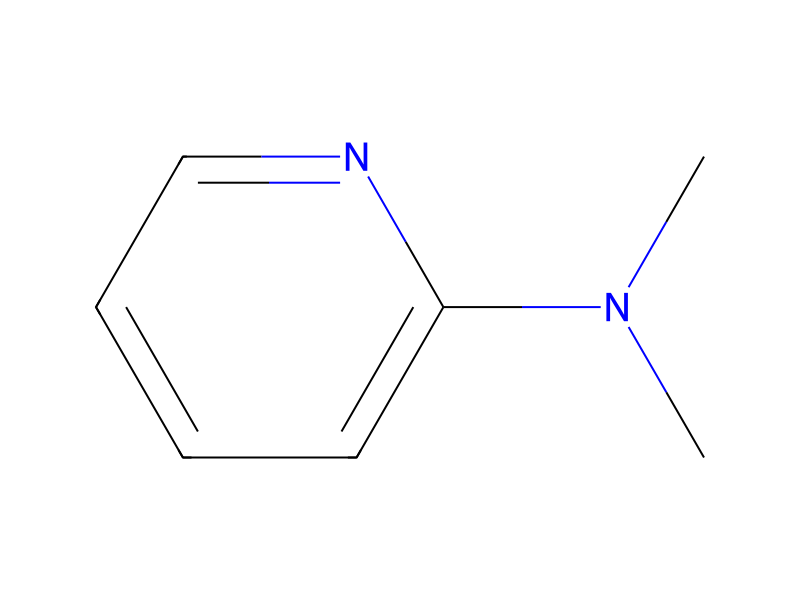
2-Dimethylaminopyridine → Ethyl 6-chloropyridazine-3-carboxylate
Reaction equation

Cl[C:2]1[CH:7]=[C:6]([C:8]([OH:10])=[O:9])[N:5]=[N:4][CH:3]=1.CN([C:14]1[CH:19]=CC=CN=1)C.[ClH:20].CN(C)CCCN=C=NCC>C(O)C>[Cl:20][C:3]1[N:4]=[N:5][C:6]([C:8]([O:10][CH2:19][CH3:14])=[O:9])=[CH:7][CH:2]=1Participants
Reactant 3


Product 1

Reagents, catalysts & solvents 1

Procedure
The compound resulting from Example 170B was chlorinated by the procedure described by Overend and Wiggins, J. Chem. Soc. 239 (1947) to give 4-chloro-6-methylpyridazine. 1H NMR (CDCl3, 300 MHz) δ 2.70 (s, 3H), 7.35 (d, 1H), 7.45 (d, 1H). MS (DCl/NH3) m/e 129/131 (M+H)+, 146/148 (M+H+NH3)+. The chloro-compound was oxidized by the procedure of Horner et al., J.Chem. Soc. 2195 (1948) to give 4-chloropyridazine-6-carboxylic acid. 1H NMR (CD3OD, 300 MHz) δ 7.95 (d, 1H), 8.30 (d, 1H). MS (FAB) m/e 159/161 (M+H)+. The carboxylic acid (243 mg, 1.53 mmol) was dissolved in ~15 mL of ethanol and treated with 24 mg (0.2 mmol) of dimethylaminopyridine (DMAP) followed by 324 mg (1.69 mmol) 1-(3-dimethylaminopropyl-3-ethylcarbodiimide hydrochloride (EDCl). The reaction was stirred at ambient temperature for 4 hours and then worked up by the procedure described in Example 166A. The crude product was purified by flash chromatography on silica gel to give 150 mg (52%) of the title compound as a white crystalline solid. 1H NMR (CDCl3, 300 MHz) δ 1.45 (t, 3H), 4.55 (q, 2H), 7.65 (d, 1H), 8.15 (d, 1H). MS (DCl/NH3) m/e 187/189 (M+H)+, 204/206 (M+H+NH3)+.
Workup
- customThe crude product was purified by flash chromatography on silica gel
Sources & evidence
- ORD record
- ord-9468e4c7d69547c8919235b2cdc8121c
- Source dataset
- uspto-grants-1993_10
- Patent number
- US05250548
Reaction notes
Loading…