Potassium Chloride → Glyphosate
Reaction equation

C(O)C(O)C[O:4][P:5]([OH:13])([CH2:7][NH:8][CH2:9][C:10]([OH:12])=[O:11])=[O:6].C(CNC(CO)(CO)CO)CNC(CO)(CO)CO.[Cl-].[K+]>>[CH2:9]([NH:8][CH2:7][P:5]([OH:13])([OH:6])=[O:4])[C:10]([OH:12])=[O:11]Participants
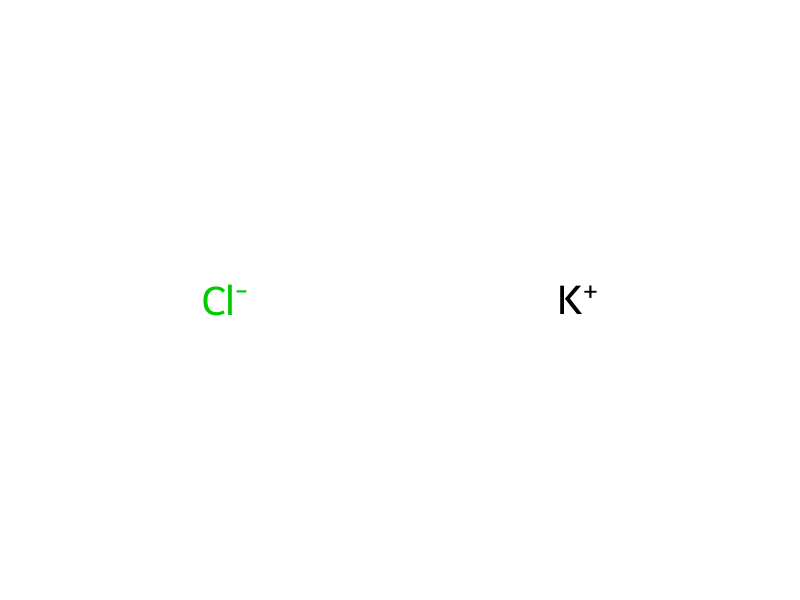


Procedure
The enzymatic reaction can be assayed using labelled (3-14C-) glyceryl glyphosate as a substrate and following the conversion to (3-14C-)glyphosate as a product using a high pressure liquid chromatography system with a radioactive detector. This assay is the most specific for the phosphonate monoester hydrolase enzymes useful for conditional cell lethality. An enzyme assay consists of 40,000 cpm of labelled (3-14C-) glyceryl glyphosate (obtained from NEN Biochemicals), the PEH sample in buffer and buffer to 100 μl final volume. The assay buffer is 10 mM Bis-Tris propane, pH 9.0, plus 100 mM KCl. The reaction is run for 1 hour at 30° C. and then stopped by the addition of 100 μl "quench" which is 100 mM sodium acetate, pH 5.5, in ethanol. The denatured protein is then spun down at 10,000 rpm in a microfuge and the supernatant transferred to an HPLC injection vial. A 100 μl aliquot is then injected onto an Synchropac AX100 anion exchange column 4.6×250 mm) pre-equilibrated in 65 mM potassium phosphate buffer, pH 5.5. The radioactive compounds are eluted isocratically for 15 min at 1 ml/min. The radioactivity of the peaks is measured and integrated by a post-column detector. Typically, the substrate elutes at 4.9 min and the product, glyphosate, at 9.7 min providing baseline separation. The radioactive glyceryl glyphosate has been found to be unstable where stored at -20° C. over a period of 3 months and must first be purified to remove glyphosate and any other contaminant. Alternatively, blank reactions can be included to determine the preexisting glyphosate contamination.
Workup
- customThe enzymatic reaction
- additionstopped by the addition of 100 μl "
- customquench" which
- washThe radioactive compounds are eluted isocratically for 15 min at 1 ml/min
- waitTypically, the substrate elutes at 4.9 min
Sources & evidence
- ORD record
- ord-177a0bd0f234434c89f5e91b521cb24b
- Source dataset
- uspto-grants-1993_10
- Patent number
- US05254801
Reaction notes
Loading…