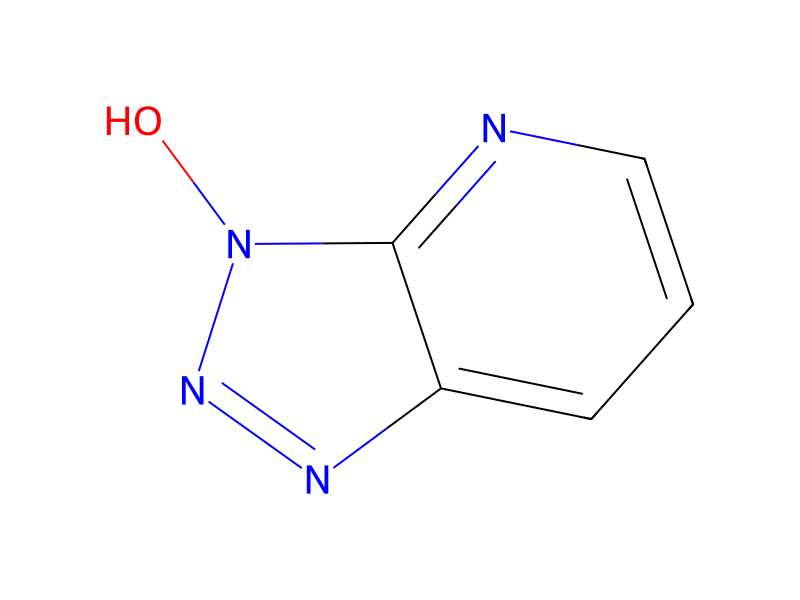
HOAt → HCID 66661059, compound
Reaction equation

[C:1]([C:3]1([NH:6][C:7]([C@@H:9]([NH:14][C:15](=[O:21])OC(C)(C)C)[CH2:10][CH:11]([CH3:13])[CH3:12])=[O:8])[CH2:5][CH2:4]1)#[N:2].C(O)(C(F)(F)F)=O.ClCCl.C1C=NC2N(O)N=NC=2C=1.[O:42]1[C:46]2([CH2:51][CH2:50][CH:49](C(O)=O)[CH2:48][CH2:47]2)[O:45][CH2:44][CH2:43]1.CCN=C=NCCCN(C)C.Cl>C1COCC1.CN(C=O)C>[C:1]([C:3]1([NH:6][C:7]([C@@H:9]([NH:14][C:15]([CH:49]2[CH2:50][CH2:51][C:46]3([O:45][CH2:44][CH2:43][O:42]3)[CH2:47][CH2:48]2)=[O:21])[CH2:10][CH:11]([CH3:12])[CH3:13])=[O:8])[CH2:4][CH2:5]1)#[N:2]Participants
Reactant 5


Product 1

Reagents, catalysts & solvents 2


Procedure
The product from example 34, tert-butyl [(S)-1-(1-cyanocyclopropylcarbamoyl)-3-methylbutyl]carbamate, (1.1 g, 3.72 mmol) was admixed with 20 ml of 1:1 TFA/dichloromethane and stirred at RT for 30 min. Subsequently, the mixture was concentrated by evaporation under reduced pressure and taken up again in dichloromethane and toluene, and solvent and TFA residues were removed under reduced pressure. The resulting N-terminally protected product was reacted further directly. 283 mg (1.5 mmol) thereof were admixed at 0° C. with 136 mg of HOAt (1 mmol, 0.67 eq.), 195 mg of 1,4-dioxaspiro[4.5]decane-8-carboxylic acid from example 33 (1 mmol, 0.67 eq.), 268 mg of EDCl (1.4 mmol, 0.93 eq.) and 0.32 ml of NEM (2.5 mmol) in 2.5 ml of THF and 0.25 ml of DMF, and the mixture was stirred at 0° C. to RT overnight. Subsequently, the solvent was distilled off under reduced pressure, and the residue was taken up in ethyl acetate and extracted by shaking with saturated sodium hydrogencarbonate solution and saturated NaCl solution. Drying over sodium sulfate and evaporating-off the solvent were followed by purification using RP-HPLC (gradient: acetonitrile/water and addition of 0.05% TFA). The product fractions were combined and freeze-dried. Yield: 25 mg (without mixed fractions), corresponds to 7% of theory. 1H NMR: 8.81 (s, 1H); 7.84 (d, 1H); 4.20 (m, 1H); 3.83 (s, 4H); 2.22 (m, 1H); 1.75-0.8 (3m, about 13 H, 1.05 (m, 2H); 0.82 (dd, 6H); MS (ESI+): 364.2. The examples listed in table 1a were prepared in a manner analogous to that described above. Table 1a shows the examples with accompanying characterization:
Workup
- concentrationSubsequently, the mixture was concentrated by evaporation under reduced pressure
- customtoluene, and solvent and TFA residues were removed under reduced pressure
- customThe resulting N-terminally protected product was reacted further directly
- distillationSubsequently, the solvent was distilled off under reduced pressure
- extractionextracted
- stirringby shaking with saturated sodium hydrogencarbonate solution and saturated NaCl solution
- dry with materialDrying over sodium sulfate and evaporating-off the solvent
- customwere followed by purification
- additionRP-HPLC (gradient: acetonitrile/water and addition of 0.05% TFA)
- customfreeze-dried
- additionYield: 25 mg (without mixed fractions)
- customwere prepared in a manner analogous to
Sources & evidence
- ORD record
- ord-52a32413f7434f489952c17f42376690
- Source dataset
- uspto-grants-2011_10
- Patent number
- US08039480B2
Reaction notes
Loading…