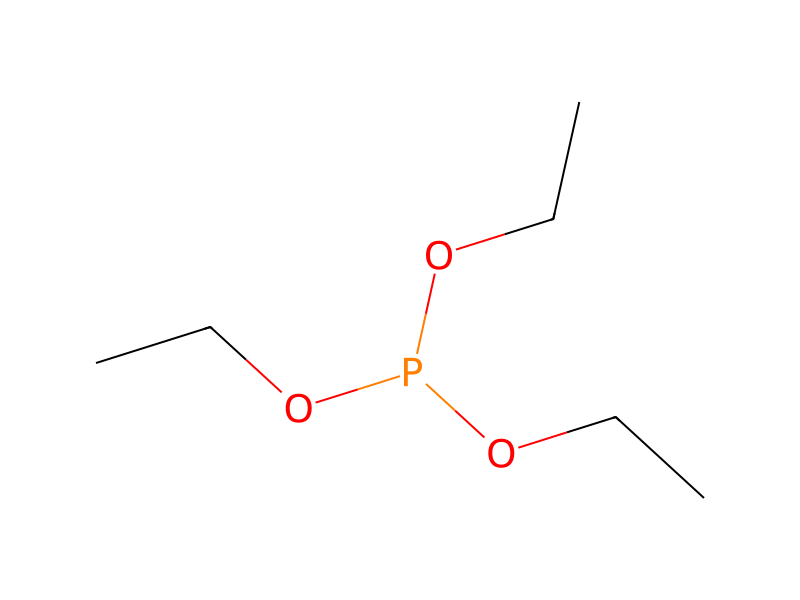
Triethyl phosphite → Diethyl 3-(5-bromopyridin-2-yloxy)benzylphosphonate
Reaction equation

[Br:1][C:2]1[CH:3]=[CH:4][C:5]([O:8][C:9]2[CH:14]=[CH:13][CH:12]=[C:11]([CH2:15]Cl)[CH:10]=2)=[N:6][CH:7]=1.[CH2:17]([O:19][P:20]([O:24]CC)[O:21][CH2:22][CH3:23])[CH3:18]>CCCCCCC>[Br:1][C:2]1[CH:3]=[CH:4][C:5]([O:8][C:9]2[CH:10]=[C:11]([CH:12]=[CH:13][CH:14]=2)[CH2:15][P:20](=[O:24])([O:21][CH2:22][CH3:23])[O:19][CH2:17][CH3:18])=[N:6][CH:7]=1Participants
Reactant 2

Product 1

Reagents, catalysts & solvents 1

Conditions
- Temperature
- 150 °C
Procedure
5-Bromo-2-(3-(chloromethyl)phenoxy)pyridine (3.08 g, 10.3 mmol) from Step 2 was treated neat with triethylphosphite (2.65 mL, 15.5 mmol) and heated to 150° C. After 5 h, the reaction mixture was removed from the heating bath and treated slowly with heptane until an oil precipitated out of solution. Ethyl acetate was added until mixture became homogenous. Heptane was slowly added again (at a cooler temperature) until a white precipitate formed. After the addition of more heptane and stirring for 15 min, the precipitate was filtered to afford a white solid (3.35 g, 81% yield). MS (APCI) M+1=400.0; 1H NMR (400 MHz, CDCl3) δ ppm 1.26 (t, J=7.02 Hz, 6H) 3.17 (d, J=21.64 Hz, 2H) 3.98-4.08 (m, 4H) 6.84 (d, J=8.77 Hz, 1H) 7.00-7.05 (m, 1H) 7.08 (q, J=2.21 Hz, 1H) 7.15-7.20 (m, 1H) 7.35 (t, J=7.90 Hz, 1H) 7.77 (dd, J=8.58, 2.53 Hz, 1H) 8.21 (d, J=2.73 Hz, 1H).
Workup
- customthe reaction mixture was removed from the heating bath
- additiontreated slowly with heptane until an oil
- customprecipitated out of solution
- additionEthyl acetate was added until mixture
- additionHeptane was slowly added again (at a cooler temperature) until a white precipitate
- customformed
- filtrationthe precipitate was filtered
Sources & evidence
- ORD record
- ord-5f26e7f4a24d44ea9d26168db142fb63
- Source dataset
- uspto-grants-2011_10
- Patent number
- US08044052B2
Reaction notes
Loading…