Trifluoromethanesulfonic anhydride → 3,5-Di-tert-butylphenyl trifluoromethanesulfonate
Reaction equation

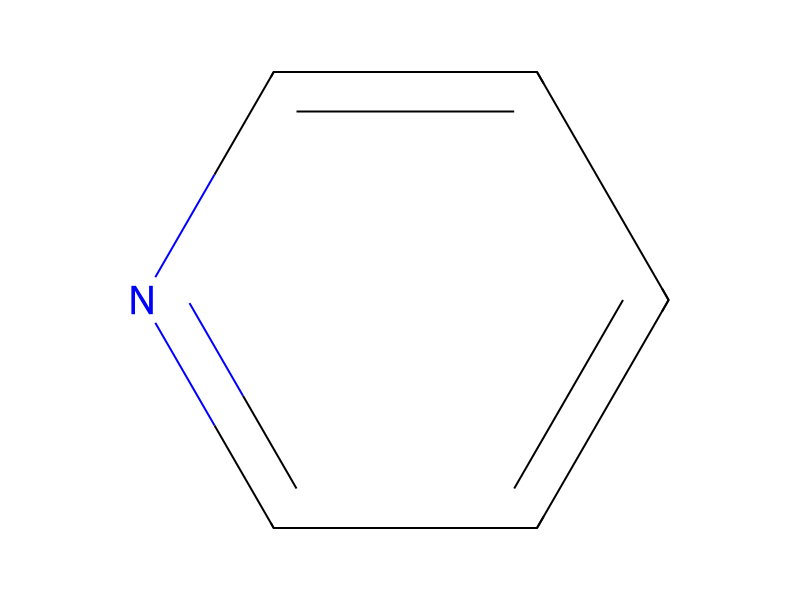
[F:1][C:2]([F:15])([F:14])[S:3]([O:6]S(C(F)(F)F)(=O)=O)(=[O:5])=[O:4].[C:16]([C:20]1[CH:21]=[C:22](O)[CH:23]=[C:24]([C:26]([CH3:29])([CH3:28])[CH3:27])[CH:25]=1)([CH3:19])([CH3:18])[CH3:17]>N1C=CC=CC=1>[O:6]([C:22]1[CH:21]=[C:20]([C:16]([CH3:18])([CH3:17])[CH3:19])[CH:25]=[C:24]([C:26]([CH3:29])([CH3:28])[CH3:27])[CH:23]=1)[S:3]([C:2]([F:15])([F:14])[F:1])(=[O:5])=[O:4]Participants
Reactant 2


Product 1

Reagents, catalysts & solvents 1
Procedure
Molecules of the present invention can be synthesized using well-known organic synthesis methods. FIG. 8 shows a method for synthesizing a molecule belonging to the subclass shown in FIG. 6 according to one embodiment of the present invention. A detailed description of the organic synthesis is described below in an experimental subsection called “Synthesis of 1,4-bis[3′,5′-di-tert-butylphenylethynyl]-5-methyl-2-methoxycarbonylbenzene.” The organic synthesis includes adding nitric acid and water to a solution of 2,5-dibromo-p-xylene 802, which is refluxed to obtain in solution 2,5-dibromo-4-methylbenzoic acid 804. Methanol and concentrated sulfuric acid are added to the solution of 2,5-dibromo-4-methylbenzoic acid 804, which is refluxed to obtain a solution of methyl 2,5-dibromo-4-methylbenzoate 806. In a separate part of the synthesis, trifluoromethanesulfonic anhydride and pyridine are added to a solution of 3,5-di-tert-butylphenol 808 and the solution is warmed to room temperature to obtain 3,5-di-tert-butylphenyl triflate 810. A solution of 3,5-di-tert-butylphenyl triflate 810, PdCl2, (PPH3)2, CuI, tetrabutylammonium iodide, and trimethylsilylacetylene are stirred to obtain 1-[3′,5′-di-tert-butylphenyl-2-trimethylsilylacetylene 812. Combining 1-[3′,5′-di-tert-butylphenyl-2-trimethylsilylacetylene 812, methyl 2,5-dibromo-4-methylbenzoate 806, PdCl2, (PPH3)2, CuI, triethylamine, tetrahydrofuran, and tetrabutylammonium fluoride and stirring at room temperature yields the desired molecule 1,4-bis[3′,5′-di-tert-butylphenylethynyl]-5-methyl-2-methoxycarbonylbenzene 814.
Sources & evidence
- ORD record
- ord-5f4207c71de9424693a33d46d3abcc37
- Source dataset
- uspto-grants-2011_10
- Patent number
- US08044212B2
Reaction notes
Loading…