1,3-Dibromobenzene → 1-Bromo-3-(1-[4-methylsulfanyl-phenyl]-vinyl)-benzene
Reaction equation

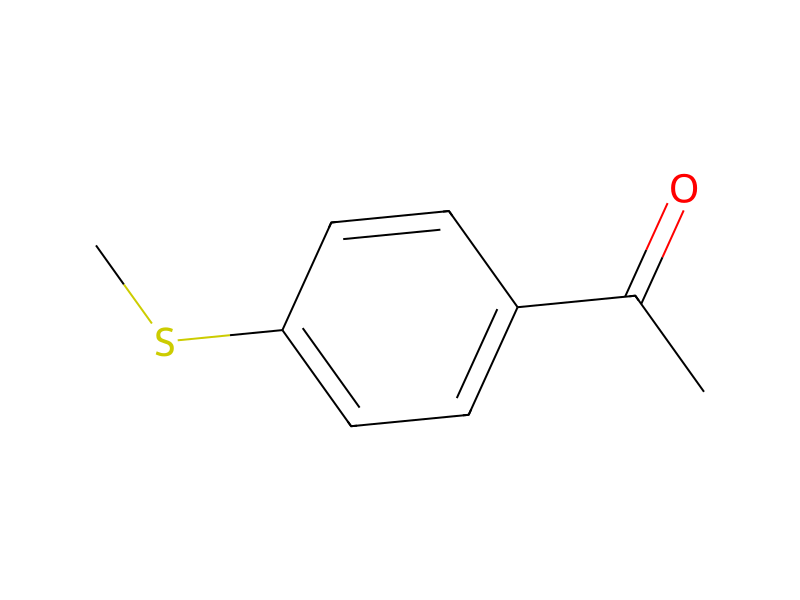
C([Li])CCC.Br[C:7]1[CH:12]=[CH:11][CH:10]=[C:9]([Br:13])[CH:8]=1.[CH3:14][S:15][C:16]1[CH:21]=[CH:20][C:19]([C:22](=O)[CH3:23])=[CH:18][CH:17]=1>O1CCCC1>[Br:13][C:9]1[CH:10]=[CH:11][CH:12]=[C:7]([C:22]([C:19]2[CH:20]=[CH:21][C:16]([S:15][CH3:14])=[CH:17][CH:18]=2)=[CH2:23])[CH:8]=1Participants




Conditions
- Temperature
- -78 °C
Procedure
A solution of n-butyllithium (1.6 M in hexane, 4.50 mL, 7.20 mmol, 1.2 eq) was added over 20 min to a solution of 1,3-dibromobenzene (0.80 mL, 6.61 mmol, 1.1 eq) in 15 mL of dry tetrahydrofuran at −78° C. and under an inert atmosphere. The white suspension formed and was stirred at −78° C. for 30 min. A solution of 1-(4-methylsulfanyl-phenyl)-ethanone (1 g, 6.01 mmol, 1.0 eq.) in 10 mL of tetrahydrofuran was then added dropwise and the reaction stirred for 1 h. The reaction mixture was examined by LC-MS which showed the complete formation of tertiary alcohol. The solution was quenched with a saturated aqueous solution of ammonium chloride and then water was added. 2N hydrochloric acid was added to adjust the pH=5. The two phases were separated; the organic layer was dried over anhydrous magnesium sulfate, filtered and evaporated under reduced pressure. The crude was dissolved in a mixture of acetic acid/sulfuric acid (10 mL of acetic acid, 0.3 mL of sulfuric acid) and the reaction mixture was stirred for 1 h at room temperature; then it was examined by LC-MS which showed the complete formation of desired product. The solution was quenched with ice and dichloromethane (20 mL) was added. The two phases formed and were separated. The organic layer was washed with a saturated solution of sodium bicarbonate and then brine. It was then dried over anhydrous magnesium sulfate, filtered and evaporated under reduced pressure. The crude was purified by flash chromatography eluting with cyclohexane. The desired product was obtained as an orange liquid (1.61 g, Yield: 88% over two steps).
Workup
- customThe white suspension formed
- stirringthe reaction stirred for 1 h
- customThe solution was quenched with a saturated aqueous solution of ammonium chloride
- additionwater was added
- addition2N hydrochloric acid was added
- customThe two phases were separated
- dry with materialthe organic layer was dried over anhydrous magnesium sulfate
- filtrationfiltered
- customevaporated under reduced pressure
- dissolutionThe crude was dissolved in a mixture of acetic acid/sulfuric acid (10 mL of acetic acid, 0.3 mL of sulfuric acid)
- stirringthe reaction mixture was stirred for 1 h at room temperature
- customThe solution was quenched with ice and dichloromethane (20 mL)
- additionwas added
- customThe two phases formed
- customwere separated
- washThe organic layer was washed with a saturated solution of sodium bicarbonate
- dry with materialIt was then dried over anhydrous magnesium sulfate
- filtrationfiltered
- customevaporated under reduced pressure
- customThe crude was purified by flash chromatography
- washeluting with cyclohexane
Sources & evidence
- ORD record
- ord-c4fae6ec723e49319a5e7cd0f5995c60
- Source dataset
- uspto-grants-2011_08
- Patent number
- US07989449B2
Reaction notes
Loading…