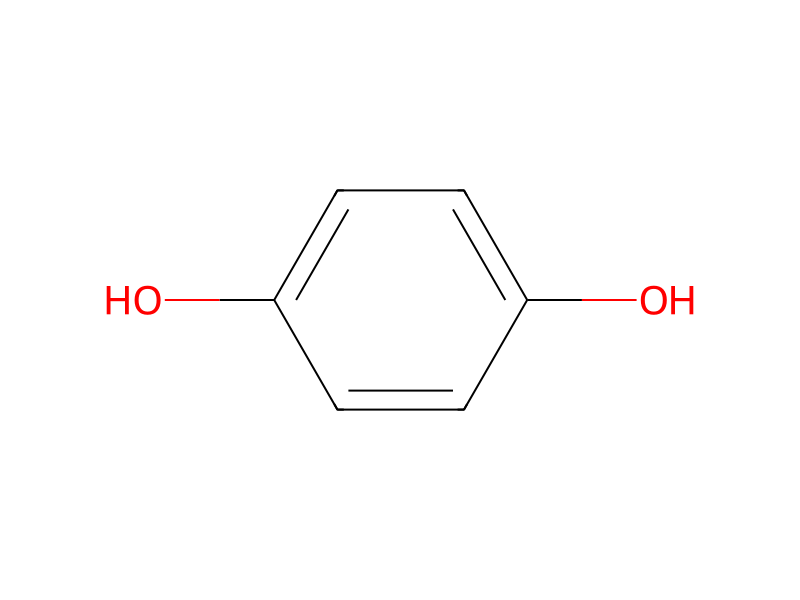
Hydroquinone → Fenson
Reaction equation

[CH:1]1[CH:6]=[CH:5][C:4]([S:7]([O:10][C:11]2[CH:16]=[CH:15][C:14]([Cl:17])=[CH:13][CH:12]=2)(=[O:9])=[O:8])=[CH:3][CH:2]=1.C1(C=CC(O)=CC=1)O.[Cl:26][C:27]1[C:32]([Cl:33])=[CH:31][C:30](Cl)=[C:29]([Cl:35])[C:28]=1[OH:36].IC1C=C(C=C(I)C=1O)C#N>>[Cl:26][C:27]1[C:32]([Cl:33])=[CH:31][CH:30]=[C:29]([Cl:35])[C:28]=1[OH:36].[CH:1]1[CH:2]=[CH:3][C:4]([S:7]([O:10][C:11]2[CH:16]=[CH:15][C:14]([Cl:17])=[CH:13][CH:12]=2)(=[O:9])=[O:8])=[CH:5][CH:6]=1Participants


Procedure
In all cases examined, PcpB converted the substituted phenol to the corresponding hydroquinone. PCP and 2,3,5,6-tetrachlorophenol were converted to a compound with the same HPLC retention time as that of TeCH (Xun and Orser, 1991c). TeCH was confirmed as the end-product by GC/MS (data not shown). PcpB oxidized 2,4,6-triiodophenol (TIP) to a product with a retention time of 7.75 min. by GC analysis and mass spectrum consistent with that expected for 2,6-diiodo-p-hydroquinone (DIHQ, molecular formula of C6H4I2O2). The base peak was at M/Z 362 (M+), and major fragments were found at M/Z 235 (loss of I from 362), 207 (loss of CO from 235), and 108 (loss of 2 I from 362). The end product of 3,5-diiodo-4-hydroxylbenzonitrile was also identified as DIHQ because it shared the same retention time with DIHQ produced from TIP by HPLC analysis. Incubation of 2,3,6-trichlorophenol with PcpB yielded a product with a retention time of 4.65 min. by GC analysis and a mass spectrum consistent with that expected for 2,3,6-trichloro-p-hydroquinone (molecular formula of C6H3Cl3O2). The relative intensities of the peaks at M/Z 212 (base peak, M+), 214 (M+2), and 216 (M+4) are characteristic of a molecule containing 3 chlorine atoms, although the peak expected at M/Z 218 (M+6) was not observable. Major peaks were observed at M/Z 178 (loss of H35Cl from 214), M/Z 176 (loss of H35Cl from 212, H37Cl from 214), M/Z 150 (loss of CO from 178), and M/Z 148 (loss of CO from 1976).
Workup
- customproduced from TIP by HPLC analysis
Sources & evidence
- ORD record
- ord-e55a42b67d4049bd84e9205c1943f9ec
- Source dataset
- uspto-grants-1996_04
- Patent number
- US05512478
Reaction notes
Loading…