Ammonia → 3-Cyano-3-(3,4-dichlorophenyl)propionic acid
Reaction equation

Cl[CH2:2][C:3]([O-:5])=[O:4].[Na+].[Cl:7][C:8]1[CH:9]=[C:10]([CH2:15][C:16]#[N:17])[CH:11]=[CH:12][C:13]=1[Cl:14].N.[NH2-].[Na+].[Na].CC([O-])(C)C.[K+]>CS(C)=O>[C:16]([CH:15]([C:10]1[CH:11]=[CH:12][C:13]([Cl:14])=[C:8]([Cl:7])[CH:9]=1)[CH2:2][C:3]([OH:5])=[O:4])#[N:17]Participants
Reactant 6





Product 1

Reagents, catalysts & solvents 1

Procedure
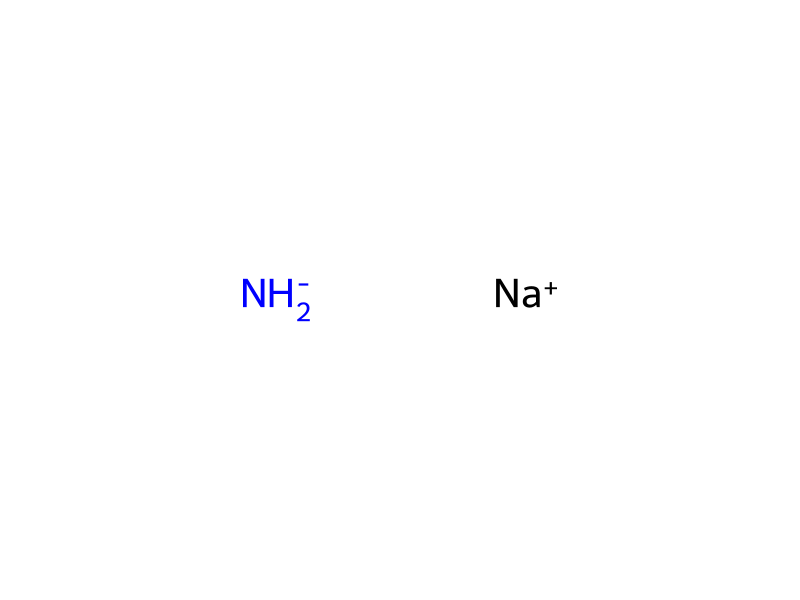
3-Cyano-3-(3,4-dichlorophenyl)propionic acid (III) is prepared by reacting sodium chloroacetate with 3,4-dichlorophenylacetonitrile (II), for example in liquid ammonia in the presence of sodium amide according to the technique of A. G. CHIGAREV and D. V. IOFFE, Zh. Org. Khim. 3, 85-8 (1967), or in the presence of another very strong base such as sodium or potassium tert-butylate in liquid ammonia at -33° C. or in anhydrous dimethyl sulfoxide at room temperature. The yield of 3-cyano-3-(3,4-dichlorophenyl)propionic acid isolated is 74 to 78%, but it is even better if the product is not isolated, because it suffices to react it with D-(-)-N-methylglucamine, an inexpensive industrial product obtained from D-glucose and methylamine (KARRER, HERKENRATH--Helv. Chim. Acta, 20, 37 (1937)), in order to crystallize all the racemic cyanoacid (III) in the form of the salt of the levorotatory acid. The yield is excellent, being 190% based on the levorotatory enantiomer contained in the racemate (III). The crystallization solvent can be methanol, ethanol, Cellosolve® or any other suitable solvent. The resolution temperature is between the boiling point of the solvent and 0° C. The N-methylglucamine must be present in at least the stoichiometric amount. It is preferably used in slight excess.
Workup
- custom3-Cyano-3-(3,4-dichlorophenyl)propionic acid (III) is prepared
- customat -33° C.
- customat room temperature
Sources & evidence
- ORD record
- ord-db86c7b780e0464f9314a273f20a18a4
- Source dataset
- uspto-grants-1996_04
- Patent number
- US05512680
Reaction notes
Loading…