Pyrazole → HCID 43381460, compound
Reaction equation

N1C=CC=N1.[CH3:6][O:7][C:8]1[CH:18]=[CH:17][C:11]([C:12]([CH2:14][C:15]#[N:16])=O)=[CH:10][CH:9]=1.Cl.[C:20]([NH:24][NH2:25])([CH3:23])([CH3:22])[CH3:21]>>[C:20]([N:24]1[C:15]([NH2:16])=[CH:14][C:12]([C:11]2[CH:10]=[CH:9][C:8]([O:7][CH3:6])=[CH:18][CH:17]=2)=[N:25]1)([CH3:23])([CH3:22])[CH3:21]Participants
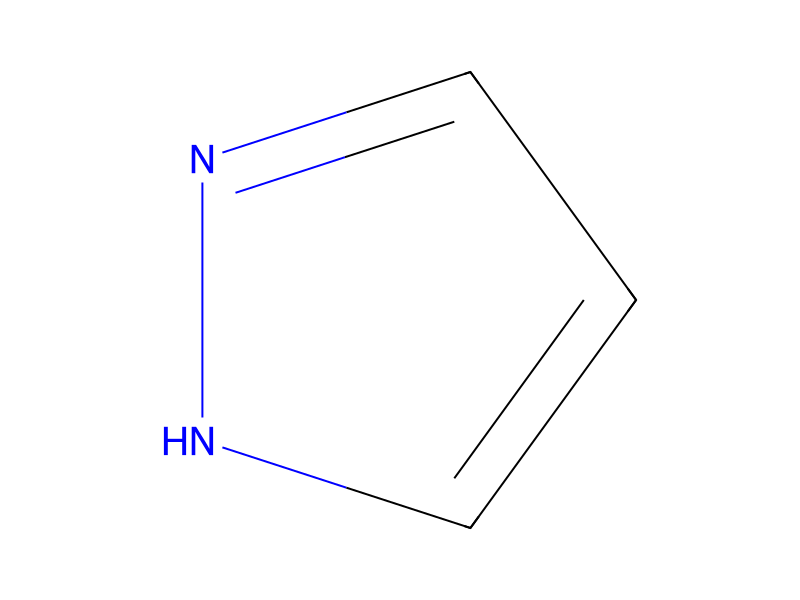


Procedure
General procedure for pyrazole formation: An ethanolic solution (3 mL) of 4-methoxybenzoylacetonitrile (500 mg, 2.85 mmol), t-butylhydrazine hydrochloride (391 mg, 3.14 mmol), and catalyticp-toluenesulfonic acid was stirred under argon at 90° C. for 4 h in a sealed tube. The reaction was concentrated and the residue partitioned between EtOAc and sat. NaHCO3. The organic layer was washed with brine, dried with Na2SO4, filtered and concentrated in vacuo. The residue was chromatographed on silica gel with a gradient of 10-30% EtOAc in Hexanes which yielded 2-tert-Butyl-5-(4-methoxyphenyl)-2H-pyrazol-3-ylamine: 1H NMR (400 MHz, CDCl3) δ 1.70 (s, 9H), 3.58 (br.s, 2H), 3.84 (s, 3H), 5.85 (s, 1H), 6.91 (d, J=8.8 Hz, 2H), 7.69 (d, J=8.8 Hz, 2H); MS (ES+): m/z 246 [MH+], m/z 190 [M-tbutyl].
Workup
- concentrationThe reaction was concentrated
- customthe residue partitioned between EtOAc and sat. NaHCO3
- washThe organic layer was washed with brine
- dry with materialdried with Na2SO4
- filtrationfiltered
- concentrationconcentrated in vacuo
- customThe residue was chromatographed on silica gel with a gradient of 10-30% EtOAc in Hexanes which
Sources & evidence
- ORD record
- ord-0af7dba21592418a85f1f79b7d788ffb
- Source dataset
- uspto-grants-2009_02
- Patent number
- US07485658B2
Reaction notes
Loading…