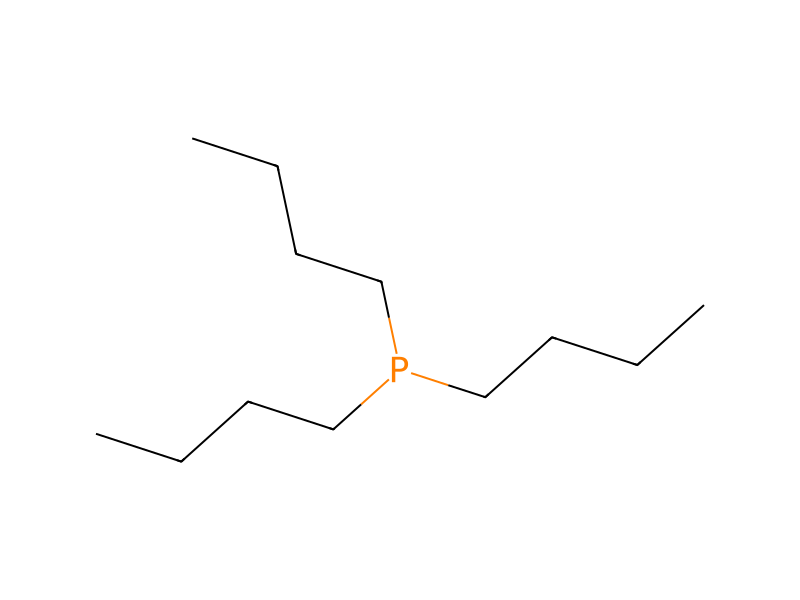
Tributylphosphine → (2R,3R,4R)-3-butyl-4-t-butyldimethylsiloxy-2-(2-octynyl)cyclopentanone
Reaction equation

C(P(CCCC)CCCC)CCC.[CH2:14]([Li])[CH2:15][CH2:16][CH3:17].[O:19]([C@@H:27]1[CH2:31][C:30](=[O:32])[CH:29]=[CH:28]1)[Si:20]([C:23]([CH3:26])([CH3:25])[CH3:24])([CH3:22])[CH3:21].C([Sn](Cl)(CCCC)CCCC)CCC.Br[CH2:48][C:49]#[C:50][CH2:51][CH2:52][CH2:53][CH2:54][CH3:55]>O1CCCC1.CCOCC.CN(C)P(=O)(N(C)C)N(C)C>[CH2:14]([C@H:28]1[C@H:27]([O:19][Si:20]([C:23]([CH3:26])([CH3:25])[CH3:24])([CH3:22])[CH3:21])[CH2:31][C:30](=[O:32])[C@@H:29]1[CH2:48][C:49]#[C:50][CH2:51][CH2:52][CH2:53][CH2:54][CH3:55])[CH2:15][CH2:16][CH3:17]Participants
Reactant 5



Product 1

Reagents, catalysts & solvents 3



Conditions
- Temperature
- 19 °C
Procedure
Cuprous iodide (198 mg; 1.04 mmole) was weighed into a 150 ml reaction tube purged with argon, and the inside of the tube was dried under reduced pressure. Then, the reaction tube was again purged with argon. Dry tetrahydrofuran (10 ml) and tributylphosphine (0.673 ml; 2.70 mmoles) were introduced into the reaction tube, and stirred at 19° C. with stirring to form a uniform solution. The solution was cooled to -78° C., and n-butyllithium (1.60M, 0.647 ml, 1.04 mmoles) was added, and the mixture was stirred at -78° C. for 10 minutes. Then, a solution of (R)-4-t-butyldimethylsiloxy-2-cyclopentenone (200 mg, 0.942 mmole) in tetrahydrofuran (15 ml) was added dropwise at -78° C. over 0.8 hours using a syringe drive. The mixture was stirred at -78° C. for 10 minutes. Then, hexamethylphosphoric triamide (2 ml) was added, and the mixture was stirred for 40 minutes at -78° C. Tributyltin chloride (0.28 ml, 1.04 mmole) was added, and the temperature was raised to -30° C. A solution of 1-bromo-2-octyne (197 mg, 1.04 mmole) in tetrahydrofuran (2 ml) was added, and the mixture was stirred for 17.5 hours. Ether (10 ml) was added to the reaction mixture, and the mixture was successively washed with a saturated aqueous ammonium chloride solution (10 ml), a saturated aqueous potassium thiocyanate solution (10 ml) and a saturated aqueous sodium chloride solution (10 ml). The separated organic layer was dried over anhydrous sodium sulfate. The dried product was filtered and concentrated under reduced pressure. The resulting crude product was separated by silica gel column chromatography (Merck 7734, 6% water, 20 g; hexane:ethyl acetate=30:l) to give (2R,3R,4R)-3-butyl-4-t-butyldimethylsiloxy-2-(2-octynyl)cyclopentanone (58.8 mg, 0.155 mmole, 16%) which coincided with the product obtained in (i) above.
Workup
- custompurged with argon
- customthe inside of the tube was dried under reduced pressure
- customThen, the reaction tube was again purged with argon
- stirringwith stirring
- customto form a uniform solution
- temperatureThe solution was cooled to -78° C.
- stirringthe mixture was stirred at -78° C. for 10 minutes
- stirringThe mixture was stirred at -78° C. for 10 minutes
- stirringthe mixture was stirred for 40 minutes at -78° C
- temperaturethe temperature was raised to -30° C
- stirringthe mixture was stirred for 17.5 hours
- washthe mixture was successively washed with a saturated aqueous ammonium chloride solution (10 ml)
- dry with materialThe separated organic layer was dried over anhydrous sodium sulfate
- filtrationThe dried product was filtered
- concentrationconcentrated under reduced pressure
- customThe resulting crude product was separated by silica gel column chromatography (Merck 7734, 6% water, 20 g; hexane:ethyl acetate=30:l)
Sources & evidence
- ORD record
- ord-f2e4d8528cdf439b8e5933d32d7c077f
- Source dataset
- uspto-grants-1994_07
- Patent number
- US05329035
Reaction notes
Loading…