4-Methoxy-3,5-dimethylaniline → 1-Amino-2-methyl-4-methoxy-naphthalene
Reaction equation

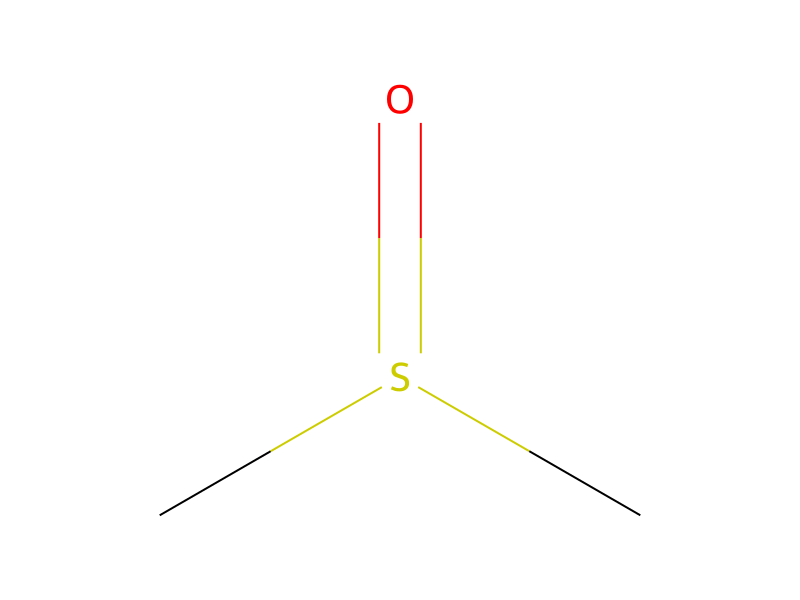
[CH3:1]C1C(C)=C(N)C=CC=1OC.CC1C=C(N)C=C(C)C=1OC.[NH2:23][C:24]1[C:33]2[C:28](=[CH:29][CH:30]=[CH:31][CH:32]=2)[C:27]([O:34][CH3:35])=[CH:26][CH:25]=1>CS(C)=O>[NH2:23][C:24]1[C:33]2[C:28](=[CH:29][CH:30]=[CH:31][CH:32]=2)[C:27]([O:34][CH3:35])=[CH:26][C:25]=1[CH3:1]Participants


Procedure
In recent years, attempts were made to produce 4-alkoxyanilines in one step from the nitrobenzenes of the above general formula (I) in the presence of noble catalysts in a substantially anhydrous mixed solvent composed of an alcohol and sulfuric acid. For example, Journal of the Chemical Society of Japan [1979 (11), page 1532] reported that 2,4-dimethoxyaniline was obtained in a maximum yield of 27.8% from o-nitroanisole as a material by adding dimethyl sulfoxide (DMSO for short) as a catalyst poison to the reaction system. Journal of the Chemical Society of Japan [1980 (2), page 245] states that 2.2% of p-anisidine was obtained from nitrobenzene, and particularly, when o-methylnitrobenzene was used as a starting material, 2-methyl-4-methoxyaniline was obtained in a maximum yield of 70.2% by adding DMSO (in the absence of DMSO, the yield was 48.3%). Journal of the Chemical Society of Japan [1982 (7), page 1237], subsequently published, reported that 2,3-dimethyl-p-anisidine, 2,6-dimethyl-p-anisidine, 1 -amino-4-methoxy-naphthalene, and 1-amino-2-methyl-4-methoxy-naphthalene were obtained from the corresponding nitro compounds in the presence of DMSO in a maximum yield of 67.4% (63.7% in the absence of DMSO), 72.1% (45.2% in the absence of DMSO), 68%, and 55%, respectively. Furthermore, it was reported long ago that p-anisidine was obtained in a yield of about 40% from phenylhydroxylamine in a mixed solvent of methanol and sulfuric acid [Ber., 31, 1500 (1898)].
Sources & evidence
- ORD record
- ord-fb9865dc10184132b615458621ec457f
- Source dataset
- uspto-grants-1986_11
- Patent number
- US04625062
Reaction notes
Loading…