(-)-Matairesinol → (-)-Secoisolariciresinol
Reaction equation

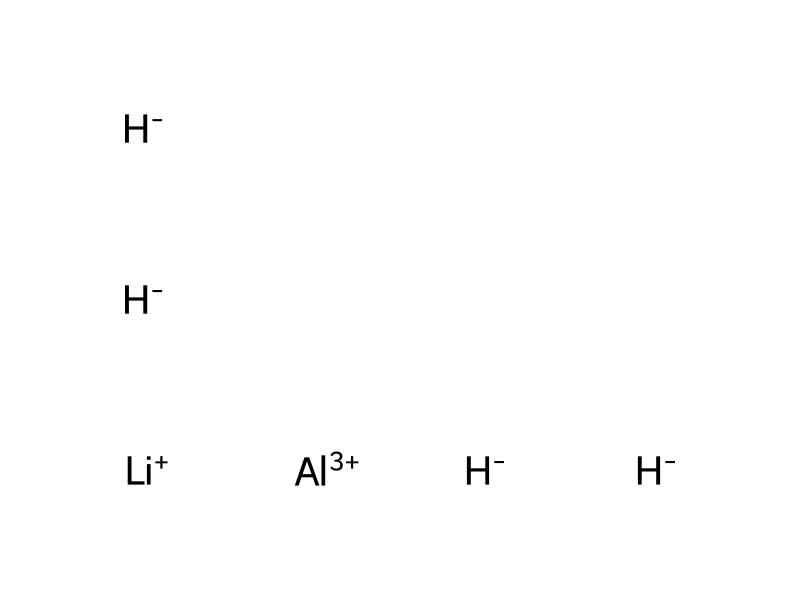
[CH3:1][O:2][C:3]1[CH:4]=[C:5]([CH2:10][C@@H:11]2[C@@H:16]([CH2:17][C:18]3[CH:19]=[CH:20][C:21]([OH:26])=[C:22]([O:24][CH3:25])[CH:23]=3)[C:14](=[O:15])[O:13][CH2:12]2)[CH:6]=[CH:7][C:8]=1[OH:9].[H-].[H-].[H-].[H-].[Li+].[Al+3]>>[CH3:25][O:24][C:22]1[CH:23]=[C:18]([CH2:17][C@H:16]([C@H:11]([CH2:12][OH:13])[CH2:10][C:5]2[CH:6]=[CH:7][C:8]([OH:9])=[C:3]([O:2][CH3:1])[CH:4]=2)[CH2:14][OH:15])[CH:19]=[CH:20][C:21]=1[OH:26].[CH3:1][O:2][C:3]1[CH:4]=[C:5]([C@H:10]2[O:15][CH2:14][C@H:16]3[C@@H:11]2[CH2:12][O:13][C@H:17]3[C:18]2[CH:19]=[CH:20][C:21]([OH:26])=[C:22]([O:24][CH3:25])[CH:23]=2)[CH:6]=[CH:7][C:8]=1[OH:9]Participants



Procedure
In total, 18 lignans and 9 norlignans were prepared by semisynthetic methods using hydroxymatairesinol (HMR) as a starting material. Hydroxymatairesinol was isolated from Norway spruce (Picea abies) knotwood material as previously described (Willför et al. 2003). Matairesinol (MAT) and Enterolactone (ENL) were prepared according to previously described methods (Eklund et al. 2003). Dimethylmatairesinol (MeMR) was prepared by methylation of MAT with MeI and K2CO3 in dry acetone. The corresponding didemethylmatairesinol (demethylMR) was prepared by demethylation of MAT using AlCl3 in pyridine. Oxomatairesinol (OMR) was prepared by oxidation of HMR as previously described (Eklund and Sjöholm 2003). 7-Methoxymatairesinol (7MeOMR) was obtained by treatment of HMR with MeONa in methanol (Eklund et al. 2004). The cyclooctadienelignan COD was prepared by cyclisation of MeMR by VOF3 according to the literature (Damon et al. 1976). 7-Hydroxysecoisolariciresinol (7-OH SECO), Lariciresinol (LARI) and Cyclolariciresinol (CLARI) were prepared according to our previously reported method (Eklund et al. 2002a). Conidendrin was obtained by acid treatment of HMR and the corresponding dimethylconidendrin (DMCON), by methylation equally as for MAT as described above. Secoisolariciresinol (SECO) was prepared by LiAlH4 reduction of MAT essentially in the same way as for 7-OH SECO (Eklund et al. 2002a). Pinoresinol (PINO) was isolated from spruce resin as described by Erdtman (1934). Nortrachelogenin (NTG) was isolated from pine knotwood material as previously described (Ekman et al. 2002). The lactol Carissanol (CARS) and the diol Carinol (CAR) were prepared by LiAlH4 reduction of NTG according to the literature (Khamlach et al. 1990). The 9-norlignans X,X-Me and Imperanene (IMP) were semisynthetically prepared from HMR as previously published (Eklund et al 2002b). Further acid catalyzed cyclisation of these derivatives gave cycloX, cycloXMe, cycloXOH which were further transformed to the corresponding arylnaphtalene derivatives ArX and ArxMe by DDQ oxidation. The saturated derivative dHX was obtained by hydrogenation with Pd/C and H2 in ethanol (Eklund et al. manuscript in preparation). The identity and purity of all compounds was analyzed by NMR-spectroscopy, HRMS and GC-MS. A 100 mM stock solution of these compounds was prepared in EtOH or DMSO at room temperature.
Sources & evidence
- ORD record
- ord-4256b5c7f47d445abfbf19bae04daf3d
- Source dataset
- uspto-grants-2015_10
- Patent number
- US09168243B2
Reaction notes
Loading…