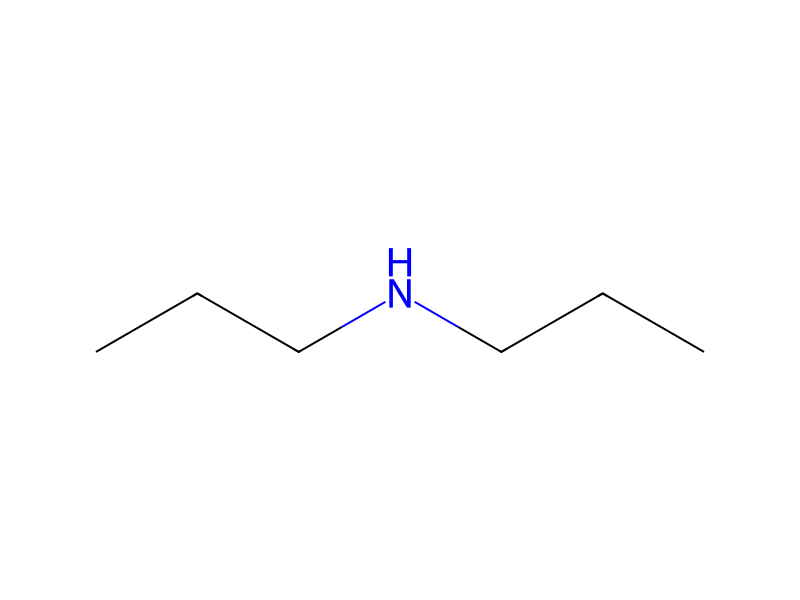
Dipropylamine → HCID 13506607, compound
Reaction equation

S(Cl)(Cl)=O.[OH:5][C:6]1[CH:11]=[CH:10][C:9]([CH2:12][C:13]([OH:15])=O)=[CH:8][C:7]=1[N+:16]([O-:18])=[O:17].[CH2:19]([NH:22][CH2:23][CH2:24][CH3:25])[CH2:20][CH3:21]>C1COCC1.C(Cl)(Cl)Cl>[CH2:19]([N:22]([CH2:23][CH2:24][CH3:25])[C:13](=[O:15])[CH2:12][C:9]1[CH:10]=[CH:11][C:6]([OH:5])=[C:7]([N+:16]([O-:18])=[O:17])[CH:8]=1)[CH2:20][CH3:21]Participants
Reactant 3


Product 1

Reagents, catalysts & solvents 2


Procedure
Thionyl chloride (50 ml, 680 mmol) was added dropwise to a solution of (4-hydroxy-3-nitrophenyl)acetic acid (25 g, 127 mmol) obtained in 1) in THF (100 ml) at room temperature, and the mixture was heated under reflux for 2 hours. The reaction solution was concentrated, and the resultant residues were dissolved in chloroform (250 ml) and added dropwise over 1 hour to a solution of dipropylamine (35 ml, 255 mmol) in chloroform (300 ml) under cooling with ice-bath. After this addition, the reaction solution was washed with water and aqueous saturated sodium bicarbonate, and the organic layer was dried over anhydrous sodium sulfate and concentrated. The residues were crystallized from ethyl acetate-hexane, whereby N,N-dipropyl-(4-hydroxy-3-nitrophenyl) acetamide (26.5 g) was obtained as crystals with a mp of 55 to 57° C.
Workup
- temperaturethe mixture was heated
- temperatureunder reflux for 2 hours
- concentrationThe reaction solution was concentrated
- dissolutionthe resultant residues were dissolved in chloroform (250 ml)
- temperatureunder cooling with ice-bath
- additionAfter this addition
- washthe reaction solution was washed with water and aqueous saturated sodium bicarbonate
- dry with materialthe organic layer was dried over anhydrous sodium sulfate
- concentrationconcentrated
- customThe residues were crystallized from ethyl acetate-hexane
Sources & evidence
- ORD record
- ord-9a9026b8f9664ab1a457a05b8e57bcbf
- Source dataset
- uspto-grants-2007_06
- Patent number
- US07229986B2
Reaction notes
Loading…