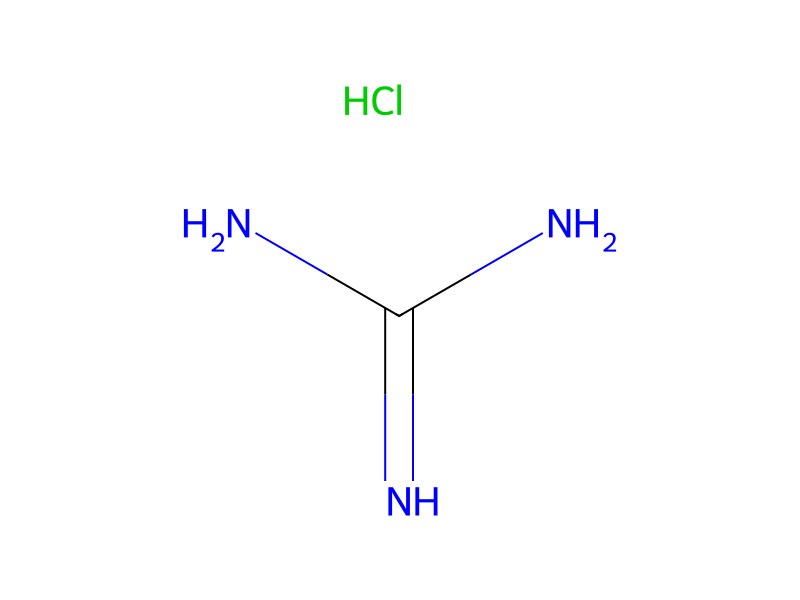
Guanidine Hydrochloride → HCID 178513073、化合物
反応式

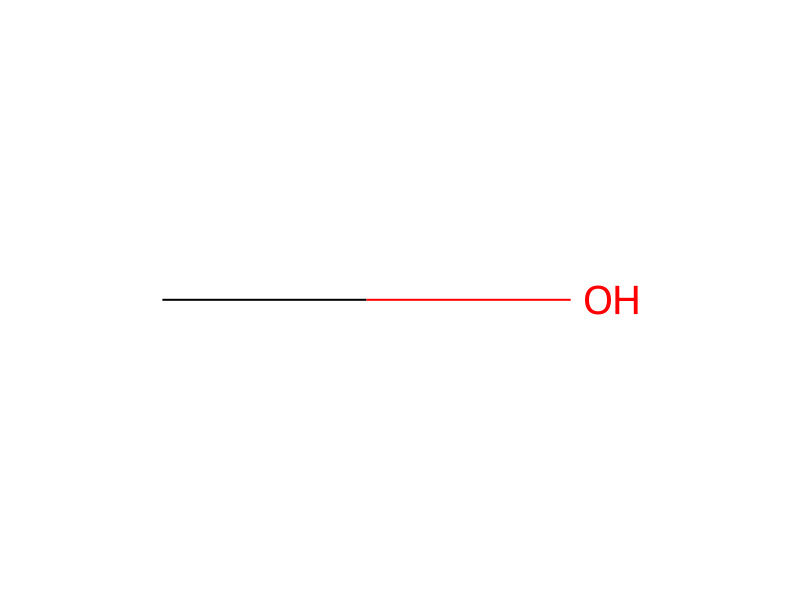
[Na].Cl.[NH2:3][C:4]([NH2:6])=[NH:5].Cl.Cl[C:9]([C:11]1[C:19]2[C:14](=[N:15][CH:16]=[CH:17][CH:18]=2)[N:13]([C:20]2[C:29]3[C:24](=[CH:25][CH:26]=[CH:27][CH:28]=3)[N:23]=[CH:22][CH:21]=2)[CH:12]=1)=[O:10]>CO>[N:23]1[C:24]2[C:29](=[CH:28][CH:27]=[CH:26][CH:25]=2)[C:20]([N:13]2[C:14]3=[N:15][CH:16]=[CH:17][CH:18]=[C:19]3[C:11]([C:9]([NH:5][C:4]([NH2:6])=[NH:3])=[O:10])=[CH:12]2)=[CH:21][CH:22]=1参加物


実験手順
1.5 g (65 mmol) of sodium (washed beforehand in toluene) were added gradually to 100 cm3 of methanol at a temperature in the region of 20° C. under an argon atmosphere. After dissolving with stirring, 6.5 g (68 mmol) of guanidine hydrochloride were added and the mixture was stirred at a temperature in the region of 20° C. for 2 h. The reaction mixture was subsequently concentrated to dryness under reduced pressure (2.7 kPa) and the residue was twice in succession taken up in 70 cm3 of dichloromethane (stabilized over amylene) and concentrated to dryness under reduced pressure (2.7 kPa). The residue was subsequently taken up in a mixture of 50 cm3 of tetrahydrofuran and 50 cm3 of dichloromethane under an argon atmosphere at a temperature in the region of 20° C. and then 11.8 mmol of 3-chlorocarbonyl-1-(quinolin-4-yl)-1H-pyrrolo[2,3-b]pyridine hydrochloride were added thereto with stirring. After stirring at a temperature in the region of 20° C. for 15 h, the reaction mixture was concentrated to dryness under reduced pressure (2.7 kPa). The solid residue was taken up in 70 cm3 of 0.1N sodium hydroxide and the insoluble material was filtered off and then dissolved in 200 cm3 of dichloromethane. After separation by settling, the organic phase was dried over magnesium sulfate and then concentrated to dryness under reduced pressure (2.7 kPa). The residue was purified by flash chromatography on a column of silica gel (0.04–0.06 mm), elution being carried out with a dichloromethane/methanol/triethylamine (88/10/2 by volume) mixture. The fractions comprising the expected product were combined and concentrated to dryness under reduced pressure (2.7 kPa) and the solid residue was taken up in a mixture of 60 cm3 of pentane, 10 cm3 of diethyl ether and 0.1 cm3 of methanol which was brought to reflux for 10 minutes. After returning to a temperature in the region of 20° C., filtering and washing with 10 cm3 of pentane, the solid was dried at a temperature in the region of 40° C. under reduced pressure (2.7 kPa). 1.56 g of N-[1-(quinolin-4-yl)-1H-pyrrolo[2,3-b]pyridine-3-carbonyl]guanidine were thus obtained in the form of a cream solid melting at 230° C. (the product was partially salified with 3.7% of hydrochloric acid, the base form melts at 164° C.). Mass spectrum: DCI: m/z=331 MH+ base peak.
後処理
- dissolutionAfter dissolving
- stirringthe mixture was stirred at a temperature in the region of 20° C. for 2 h
- concentrationThe reaction mixture was subsequently concentrated to dryness under reduced pressure (2.7 kPa)
- concentrationconcentrated to dryness under reduced pressure (2.7 kPa)
- additionThe residue was subsequently taken up in a mixture of 50 cm3 of tetrahydrofuran and 50 cm3 of dichloromethane under an argon atmosphere at a temperature in the region of 20° C.
- stirringwith stirring
- stirringAfter stirring at a temperature in the region of 20° C. for 15 h
- concentrationthe reaction mixture was concentrated to dryness under reduced pressure (2.7 kPa)
- filtrationthe insoluble material was filtered off
- dissolutiondissolved in 200 cm3 of dichloromethane
- customAfter separation
- dry with materialthe organic phase was dried over magnesium sulfate
- concentrationconcentrated to dryness under reduced pressure (2.7 kPa)
- customThe residue was purified by flash chromatography on a column of silica gel (0.04–0.06 mm), elution
- concentrationconcentrated to dryness under reduced pressure (2.7 kPa)
- additionthe solid residue was taken up in a mixture of 60 cm3 of pentane, 10 cm3 of diethyl ether and 0.1 cm3 of methanol which
- temperatureto reflux for 10 minutes
- customAfter returning to a temperature in the region of 20° C.
- filtrationfiltering
- washwashing with 10 cm3 of pentane
- customthe solid was dried at a temperature in the region of 40° C. under reduced pressure (2.7 kPa)
出典と根拠
- ORDレコード
- ord-c316564c81f64a00bf7ac1c3ded7a466
- 出典データセット
- uspto-grants-2007_06
- 特許番号
- US07230007B2
反応ノート
読み込み中…