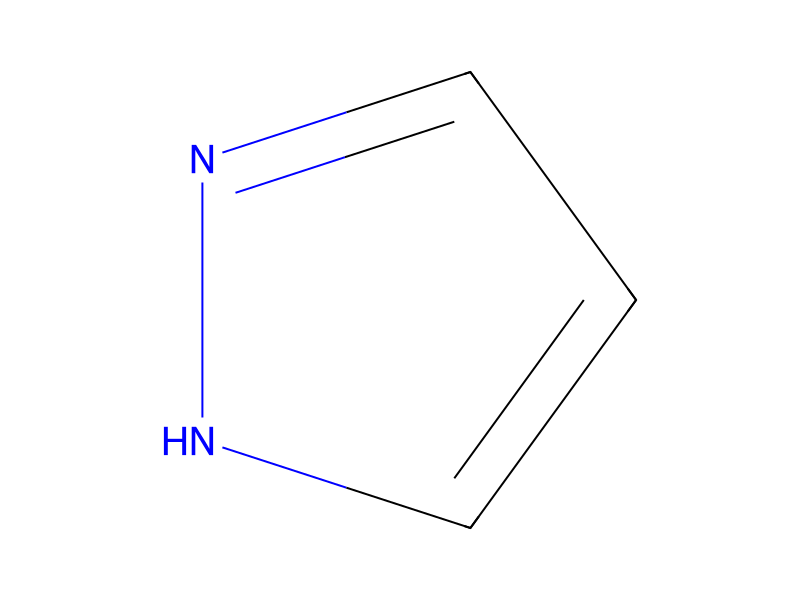
Pyrazole → Ethyl 4-(4-fluorophenyl)-2,4-dioxobutanoate
Reaction equation

N1C=CC=N1.[F:6][C:7]1[CH:12]=[CH:11][C:10]([C:13](=[O:15])[CH3:14])=[CH:9][CH:8]=1.[C:16](OCC)(=[O:22])[C:17]([O:19][CH2:20][CH3:21])=[O:18]>>[F:6][C:7]1[CH:12]=[CH:11][C:10]([C:13](=[O:15])[CH2:14][C:16](=[O:22])[C:17]([O:19][CH2:20][CH3:21])=[O:18])=[CH:9][CH:8]=1Participants


Procedure
In a further embodiment, a pyrazole cyclization reaction is provided in Scheme 14A. In this embodiment, 1-(4-fluorophenyl)ethanone is reacted with diethyl oxalate to provide ethyl 4-(4-fluorophenyl)-2,4-dioxobutanoate. In one embodiment, this reaction is performed in the presence of a base such as potassium tert-butoxide. In another embodiment, this reaction is performed at about room temperature for about 24 hours. The pyrazole ring is then generated by reaction of ethyl 4-(4-fluorophenyl)-2,4-dioxobutanoate with hydrazine hydrate to provide ethyl 3-(4-fluorophenyl)-1H-pyrazole-5-carboxylate. In one embodiment, this reaction is performed in at elevated temperatures. In another embodiment, this reaction is performed in ethanol and glacial acetic acid for about 2 to 16 hours. Ethyl 3-(4-fluorophenyl)-1H-pyrazole-5-carboxylate is then reduced with lithium aluminum hydride to provide 3-(4-fluorophenyl)-1H-pyrazol-5-yl-methanol. In one embodiment, the reduction is performed in THF at a temperature of about 0° C. to about room temperature overnight. 3-(4-Fluorophenyl)-1H-pyrazole-5-carbaldehyde is then formed by oxidizing 3-(4-fluorophenyl)-1H-pyrazole-5-methanol. In one embodiment, the oxidation is performed using PCC. In another embodiment, the oxidation is performed in dichloromethane at about room temperature overnight. 3-(4-Fluorophenyl)-1H-pyrazole-5-carbaldehyde may then converted to a compound of Formula (I-A) using the methods described herein.
Workup
- customis provided in Scheme 14A
Sources & evidence
- ORD record
- ord-3c8915790c9d41529f12f9bf5e963316
- Source dataset
- uspto-grants-2016_02
- Patent number
- US09266873B2
Reaction notes
Loading…