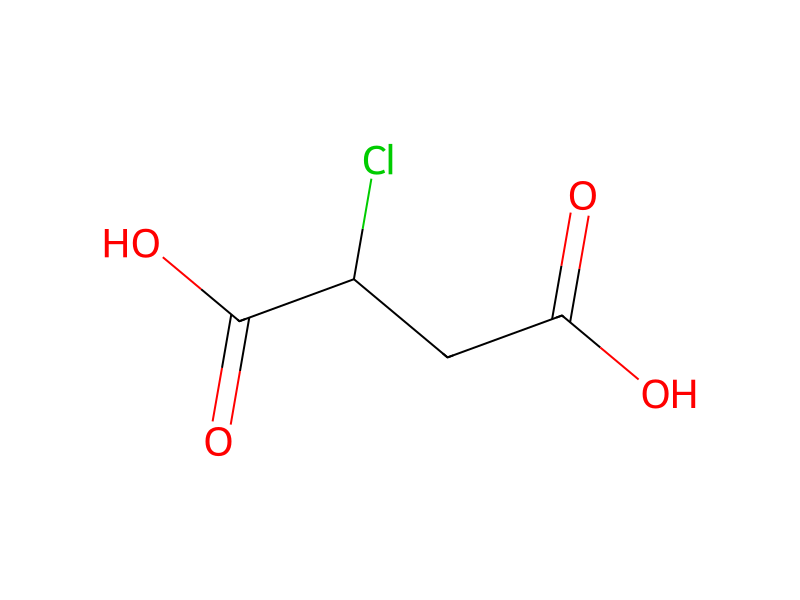
Chlorosuccinic acid → Bromosuccinic acid, (-)-
Reaction equation

[Br:1][CH:2]([CH2:6][C:7]([OH:9])=[O:8])[C:3]([OH:5])=[O:4].ClC(CC(O)=O)C(O)=O>>[CH2:6]([C:7]([OH:9])=[O:8])[C@H:2]([Br:1])[C:3]([OH:5])=[O:4]Participants


Procedure
In the reference cited above (J. A. Frick et al., 1992), the preparation of S-(−)-chlorosuccinic acid is simply described as: “S-aspartic acid was converted to S-chlorosuccinic acid by treatment with sodium nitrite in hydrochloric acid”. In the diagram on page 621 of the reference cited, the yield of the synthesis step from S-aspartic acid to S-chlorosuccinic acid is 70%. In the experimental part, the only example of preparation is provided for S-bromosuccinic acid, with a yield of 88%. The bromosuccinic acid preparation conditions are not the same as those described for chlorosuccinic acid, though they are taken as an example by analogy. From the industrial point of view, the synthesis of bromosuccinic acid described by Frick et al. is not very convenient in economic terms. In the first place, the dilutions of the reaction mixture are very high; by way of an example, S-(+)-aspartic acid is present to the extent of 5% w/v in the final reaction mixture. A distinct disadvantage arises in the case of isolation of the end product by extraction, which requires a substantial amount of ethyl acetate in order to obtain a 3% w/v solution of S-(−)-bromosuccinic acid. In addition, the end product, obtained with a stoichiometric yield of 88%, is not very pure, particularly as regards optical purity (e.e.=94%)
Workup
- customreaction mixture
- extractionA distinct disadvantage arises in the case of isolation of the end product by extraction, which
Sources & evidence
- ORD record
- ord-77af7942663e4d1aa64f0063e828e857
- Source dataset
- uspto-grants-2004_01
- Patent number
- US06677476B1
Reaction notes
Loading…