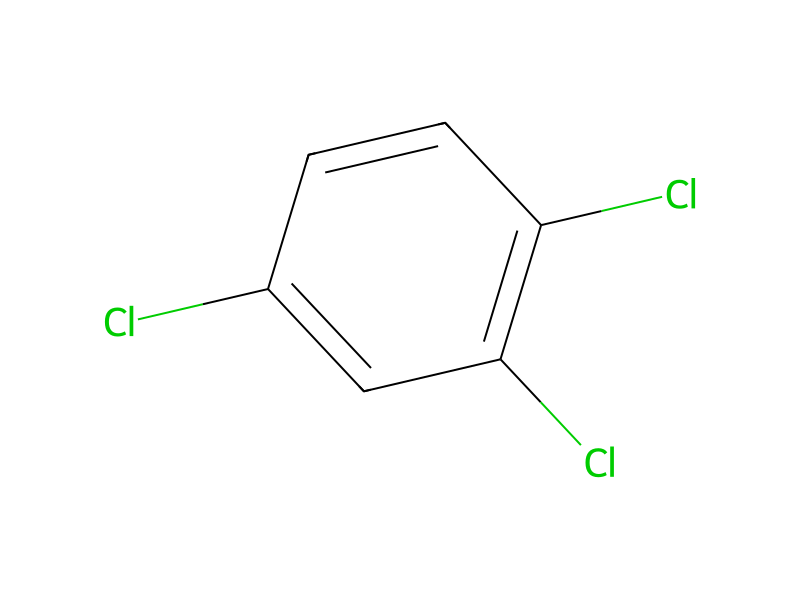
1,2,4-Trichlorobenzene → 1H-Indene-5-carboxylic acid, 2,3-dihydro-2-(3-hydroxy-2-quinolinyl)-1,3-dioxo-
Reaction equation

[OH:1][C:2]1[C:3]([CH3:15])=[N:4][C:5]2[C:10]([C:11]=1C(O)=O)=[CH:9][CH:8]=[CH:7][CH:6]=2.[CH:16]1[C:21]([C:22]([OH:24])=[O:23])=[CH:20][C:19]2[C:25]([O:27][C:28](=O)[C:18]=2[CH:17]=1)=[O:26].ClC1C=CC(Cl)=CC=1Cl>>[OH:1][C:2]1[C:3]([CH:15]2[C:25](=[O:26])[C:19]3[C:18](=[CH:17][CH:16]=[C:21]([C:22]([OH:24])=[O:23])[CH:20]=3)[C:28]2=[O:27])=[N:4][C:5]2[C:10]([CH:11]=1)=[CH:9][CH:8]=[CH:7][CH:6]=2Participants


Procedure
To a 250-mL round-bottom-flask, 3-hydroxy-2-methylquinoline-4-carboxylic acid (4.0 g, 0.02 mol), 1,2,4-benzenetricarboxylic anhydride (3.8 g, 0.02 mol) and 1,2,4-trichlorobenzene were added and the mixture was refluxed for 2 hours under nitrogen. After the mixture was cooled to room temperature, a yellow precipitate formed and was collected by filtration. The solid was washed with methanol, refluxed with water and collected by hot filtration to give 2-(3-hydroxy-quinolin-2-yl)-1,3-dioxo-indan-5-carboxylic acid as yellow powder (3.2 g, 0.009) in 48% yield. m.p.>350°. UV-Vis (DMSO) λmax: 424 (32,200), 442 (39,600). In order to convert the acid form into the corresponding tetrabutyl ammonium salt, 2 g of the acid was suspended in methanol (100 mL) and tetrabutyl ammonium hydroxide (1.0 M, 6.0 mL) was added slowly. Because the deprotonation of the first proton (carboxylic acid proton) of the yellow dye does not change its absorption spectrum while the deprotonation of the second proton (hydroxy group) shifts its absorption significantly, the addition of base can be followed easily by UV-Vis spectroscopy. After most of the yellow solid went into the solution, the mixture was filtered and the filtrate was collected. The solvent was removed under vacuum and the resulting residue was washed with ether to give the title compound (3.2 g). UV-Vis (CH2Cl2) λmax: 424 (32,400), 442 (40,000).
Workup
- temperaturethe mixture was refluxed for 2 hours under nitrogen
- customa yellow precipitate formed
- filtrationwas collected by filtration
- washThe solid was washed with methanol
- temperaturerefluxed with water
- filtrationcollected by hot filtration
Sources & evidence
- ORD record
- ord-70776e4ba49a4a0a831213877b37aba8
- Source dataset
- uspto-grants-2003_03
- Patent number
- US06537410B2
Reaction notes
Loading…