Imidazole → ethyl (S)-3-t-butyldimethylsilyloxybutanoate
Reaction equation

[OH:1][C@@H:2]([CH3:9])[CH2:3][C:4]([O:6][CH2:7][CH3:8])=[O:5].N1C=CN=C1.[Si:15](Cl)([C:18]([CH3:21])([CH3:20])[CH3:19])([CH3:17])[CH3:16]>CN(C)C=O>[Si:15]([O:1][C@@H:2]([CH3:9])[CH2:3][C:4]([O:6][CH2:7][CH3:8])=[O:5])([C:18]([CH3:21])([CH3:20])[CH3:19])([CH3:17])[CH3:16]Participants
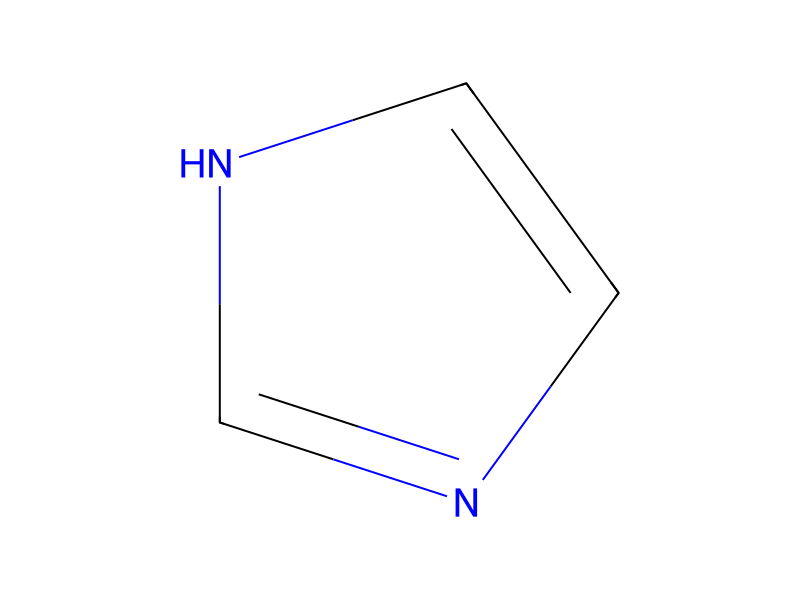


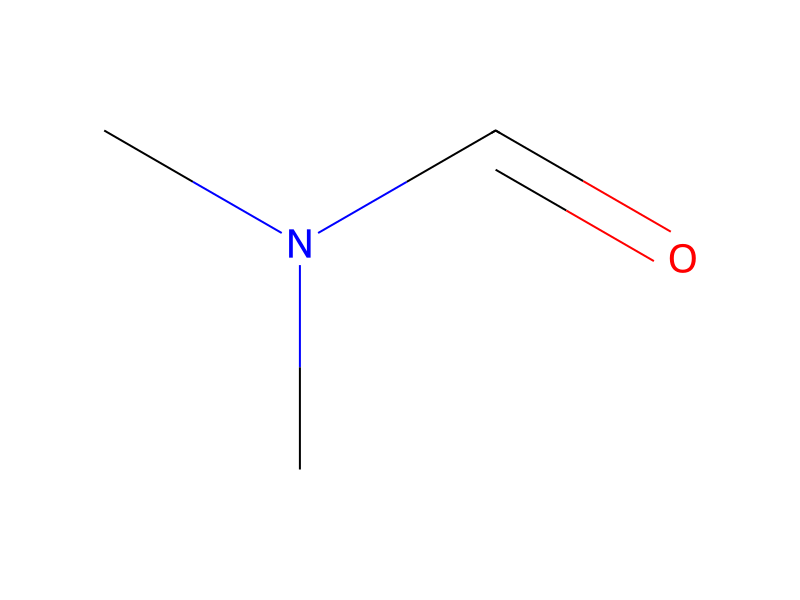
Procedure
To a solution of 8 g of ethyl (S)-3-hydroxybutanoate and 6.2 g of imidazole in 40 ml of dimethylformamide was added 10.9 g of t-butyldimethylsilyl chloride at room temperature, the mixture was stirred for 12 hours, and the solution was poured into ice water and extracted with ether. The extract was washed with a saturated aqueous solution of sodium hydrogencarbonate, water and then a saturated aqueous solution of sodium chloride and dehydrated over magnesium sulfate, the solvent was removed by distillation, and the residue was subjected to distillation under a reduced pressure to obtain 11.8 g of ethyl (S)-3-t-butyldimethylsilyloxybutanoate. A solution of 9.8 g of the obtained compound in 20 ml of anhydrous ether was added dropwise into a suspension of 1.0 g of lithium borohydride in 100 ml of anhydrous ether at room temperature in an argon current, and then, 3.72 ml of a 1M solution of lithium triethylborohydride in tetrahydrofuran was added dropwise into the mixture. The mixture was refluxed for 3 hours, a saturated aqueous solution of ammonium chloride was added to the mixture, and the mixture was extracted with ether. The ether extract was washed with a saturated aqueous solution of sodium chloride and dehydrated on magnesium sulfate, the solvent was removed by filtration, and the residue was subjected to distillation under a reduced pressure to obtain 7.9 g of (S)-3-t-butyldimethylsilyloxy-1-butanol. A solution of 5.7 g of p-toluenesulfonyl chloride in 10 ml of pyridine was added dropwise into a solution of 5.4 g of the obtained compound in 8 ml of pyridine at 0° C., the mixture was stirred at 5° C. for 3 hours, a small amount of water was added to the mixture, and the mixture was stirred for 30 minutes. The solution was poured into a saturated aqueous solution of ammonium chloride and extracted with ether, the ether extract was washed with water, a saturated aqueous solution of copper sulfate, water and then a saturated aqueous solution of sodium chloride in order, and the solvent was removed by distillation. The residue was dissolved in 200 ml of acetone and 35 g of sodium iodide and 20 g of sodium hydrogencarbonate were added to the solution. The mixture was refluxed for 2 hours, concentrated, poured into ice water, and extracted with ether. The ether extract was washed with a 10% aqueous solution of sodium thiosulfate and then with a saturated aqueous solution of sodium chloride, and dehydrated over magnesium sulfate. The solvent was removed by distillation and the residue was purified by the silica gel column chromatography using hexane as the eluent to obtain 5.9 g of (S)-3-t-butylmethylsilyloxy-1-iodobutane. To a solution of 1.02 ml of diisopropylamine in 12 ml of anhydrous tetrahydrofuran was added 4.8 ml of a 1.58M solution of n-butyl lithium in hexane at -40° C. in an argon atmosphere, and the mixture was stirred for 20 minutes. Then, 12 ml of 1.5 g of methyl 4-methoxymethoxyphenylacetate in anhydrous tetrahydrofuran was added dropwise into the mixture at -78° C. over a period of 1 hour, and the mixture was stirred for 20 minutes. Then, a solution of 2.34 g of (S)-3-t-butylmethylsilyloxy-1-iodobutane and 1.3 g of hexamethylphosphoramide in 3 ml of tetrahydrofuran was added to the mixture. Then, the mixture was stirred at -40° C. for 3 hours, and an aqueous solution of ammonium chloride was added to the formed solution. The mixture was extracted with ether, and the ether extract was washed and dehydrated over magnesium sulfate. The solvent was removed by distillation and the residue was purified by the silica gel column chromatography using hexane/ethyl acetate as the eluent to obtain 1.8 g of methyl 2-(4'-methoxymethoxyphenyl-5-t-butyldimethylsilyloxy)hexanoate. In 3 ml of ethanol was dissolved 0.45 g of the obtained compound, and 3 ml of a 10% aqueous solution of sodium hydroxide was added to the solution, and the mixture was stirred for 12 hours. The pH value was adjusted to 3 and the mixture was extracted with methylene chloride. The extract was dissolved in 3 ml of tetrahydrofuran, 3 ml of 6N hydrochloric acid was added to the solution, the mixture was stirred at room temperature for 2 hours, and water was added to the mixture. Then, the mixture was extracted with chloroform, and the extract was washed with water and then with a saturated aqueous solution of sodium chloride. The solvent was removed by distillation, azeotropic dehydration was carried out with benzene, and the residue was purified by the silica gel column chromatography using dichloromethane/methanol as the developing solvent to obtain 0.16 g of (5S)-2-(4-hydroxyphenyl)-5-methyl-δ-valerolactone. Then, 72 mg of the obtained compound was dissolved in 2 ml of methylene chloride, and 87 mg of 4-octyloxybenzoic acid, 72 mg of N,N'-dicyclohexylcarbodiimide, and 13 mg of N,N-dimethylaminopyridine were added to the solution, and the mixture was stirred at room temperature for 16 hours. Insoluble substances were removed by filtration and the solvent was removed by distillation, and the residue was purified by the silica gel column chromatography using hexane/ether as the eluent to obtain 130 mg of (5S)-2-(4'-octyloxy-4-benzoyloxy)phenyl-5-methyl-δ-valerolactone. When the obtained compound was fractionated and purified by the high-speed liquid chromatography (HPLC), there were obtained (2S,5S)-2-(4'-octyloxy-4-benzoyloxy)phenyl-5-methyl-δ-valerolactone and (2R,5S)-2-(4'-octyloxy-4-benzoyloxy)phenyl-5-methyl-δ-valerolactone. These compounds showed the following phase transitions. ##STR35##
Workup
- extractionextracted with ether
- washThe extract was washed with a saturated aqueous solution of sodium hydrogencarbonate, water
- customthe solvent was removed by distillation
- distillationthe residue was subjected to distillation under a reduced pressure
Sources & evidence
- ORD record
- ord-6450f16940694740bc64602a079d1fd4
- Source dataset
- uspto-grants-1992_09
- Patent number
- US05149462
Reaction notes
Loading…