Tri-o-tolylphosphine → Ethyl 2,6-diethyl-4-methylphenylacetate
Reaction equation
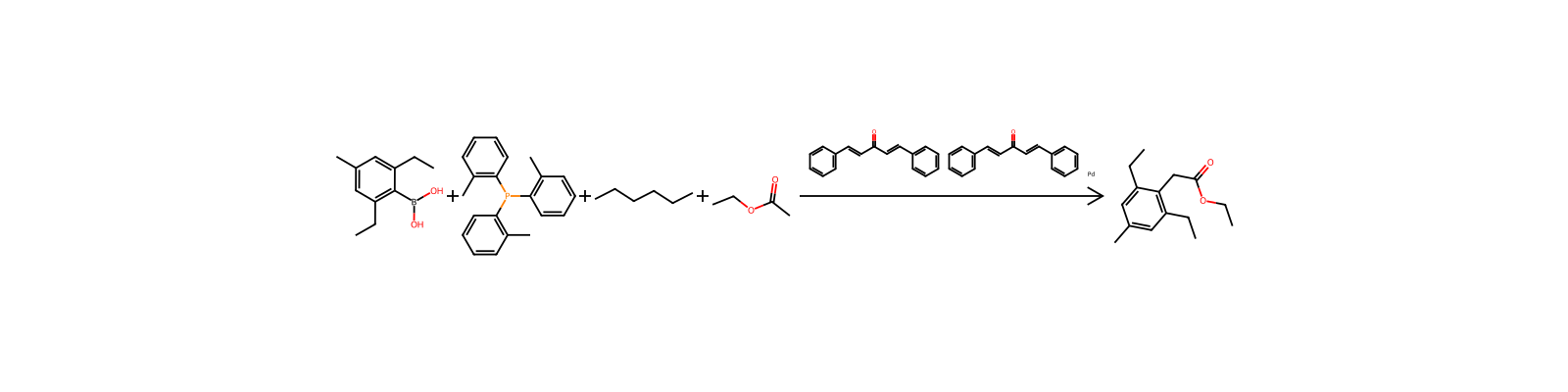
[CH2:1]([C:3]1[CH:8]=[C:7]([CH3:9])[CH:6]=[C:5]([CH2:10][CH3:11])[C:4]=1B(O)O)[CH3:2].CC1C=CC=CC=1P(C1C=CC=CC=1C)C1C=CC=CC=1C.CCCCCC.[C:43]([O:46][CH2:47][CH3:48])(=[O:45])[CH3:44]>C1C=CC(/C=C/C(/C=C/C2C=CC=CC=2)=O)=CC=1.C1C=CC(/C=C/C(/C=C/C2C=CC=CC=2)=O)=CC=1.[Pd]>[CH2:1]([C:3]1[CH:8]=[C:7]([CH3:9])[CH:6]=[C:5]([CH2:10][CH3:11])[C:4]=1[CH2:44][C:43]([O:46][CH2:47][CH3:48])=[O:45])[CH3:2]Participants




Procedure
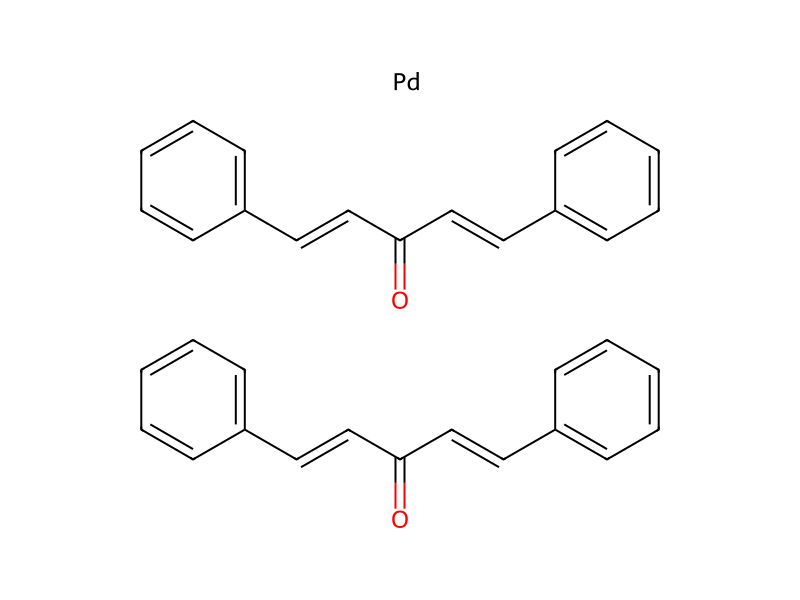
Ethyl 2,6-diethyl-4-methylphenylacetate was prepared by the general experimental method from 2,6-diethyl-4-methylphenylboronic acid (186 mg, 1.00 mmol). This involved using 5.75 mg [0.01 mmol] of Pd(dba)2 and 9.1 mg [0.03 mmol] of P(o-tolyl)3. After workup by column chromatography (hexane/ethyl acetate, 5:1), ethyl 2,6-diethyl-4-methylphenylacetate is obtained as a colourless liquid in a yield of 54% of theory. 1H NMR (400 MHz, CDCl3): δ=6.91 (s, 2H), 4.16 (q, J=7.2 Hz, 2H), 3.71 (s, 2H), 2.61-2.69 (m, 4H), 2.32 (s, 3H), 1.19-1.28 (m, 9H) ppm; 13C NMR (101 MHz, CDCl3): δ=171.9, 143.0, 136.7, 127.2, 127.1, 60.6, 34.0, 26.4, 21.1, 15.1, 14.2 ppm; MS (70 eV), m/z (%): 234 (37) [M+], 161 (100), 147 (33), 133 (40), 119 (13); IR (NaCl): ν=2966 (s), 1739 (s), 1458 (w), 1156 (m), 1032 (m) cm−1; elemental analysis: (theor): C=76.88, H=9.46, (exp): C=75.85, H=9.38.
Sources & evidence
- ORD record
- ord-bc100f4d868045d18f1fab32fc623671
- Source dataset
- uspto-grants-2013_08
- Patent number
- US08507688B2
Reaction notes
Loading…