4-Bromobenzyl bromide → 4-Bromobenzyl bromide
Reaction equation

[Br:1][C:2]1[CH:9]=[CH:8][C:5]([CH2:6][Br:7])=[CH:4][CH:3]=1.[CH2:10]([Mg:13][Cl:14])[CH:11]=[CH2:12]>C1COCC1>[CH2:10]([Mg:13][Cl:14])[CH:11]=[CH2:12].[Br:1][C:2]1[CH:9]=[CH:8][C:5]([CH2:6][Br:7])=[CH:4][CH:3]=1.[Br:1][C:2]1[CH:9]=[CH:8][C:5]([CH2:6][CH2:12][CH:11]=[CH2:10])=[CH:4][CH:3]=1Participants


Procedure
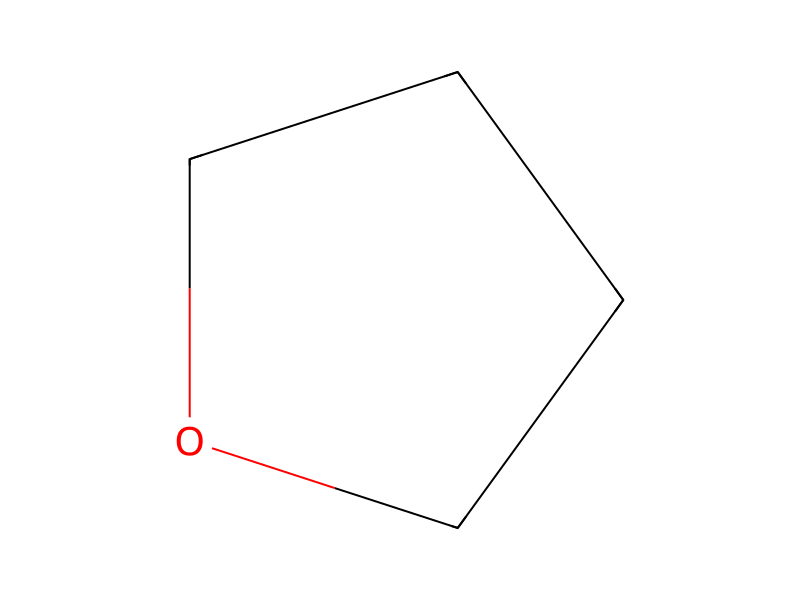
The synthesis starts from the inexpensive, commercially available starting materials 4-bromobenzyl bromide and allylmagnesium chloride (solution in THF). Alkylation of allylmagnesium chloride by 4-bromobenzyl bromide in THF gave 4-(4-bromophenyl)-1-butene (11a) in 96% yield (8-gram scale); the product was easily isolated by extraction with ethyl acetate. Following the general procedure of Walker (Walker, K. A. M.; Burton, P. M.; Swinney, D. C., Eur. Patent 0 492 474 B1, Mar. 5, 1997), the alkene 11a was converted into (±)-4-(4-bromophenyl)-1,2-epoxybutane (12a) using peracetic acid-sodium acetate in methylene chloride; the clean product was easily isolated (in 98% yield at 10-gram scale) by extraction with methylene chloride. Following the general procedure of Walker (Walker, K. A. M.; Burton, P. M.; Swinney, D. C., Eur. Patent 0 492 474 B1, Mar. 5, 1997), the nucleophilic ring-opening of the epoxide 12a led to the desired product (±)-4-(4-bromophenyl)-1-(1H-imidazol-1-yl)-2-butanol (13a); in our modification, the solid product was easily precipitated from the reaction mixture with water and collected by filtration (the excess of imidazole is simply washed away with water leaving the pure product in 84% yield). In our original synthetic route, we oxidized such imidazole-alcohol derivatives using Swern-oxidation conditions. An improvement to the Swern-oxidation procedure for the oxidation of secondary alcohols (such as 13a) was also accomplished. In particular, we wanted to circumvent the use of large quantities of anhydrous halogenated solvent and also the cumbersome external cooling conditions. After much experimentation, we managed to successfully replace the typical Swern conditions (DMSO-oxalyl chloride in CH2Cl2 at −78° C.) with those of another DMSO-based oxidation procedure utilizing DMSO-P2O5 at room temperature. Thus, the imidazole-alcohol 13a (equivalent to the free base form of QC-79) was oxidized using this procedure to give 4-(4-bromophenyl)-1-(1H-imidazol-1-yl)-2-butanone (5c) in 88% yield; the solid product was easily precipitated from the reaction mixture using an aqueous solution of potassium carbonate, and collected by filtration (the excess of DMSO and potassium phosphate salts are simply washed away with water leaving the pure product). The imidazole-ketone 5c obtained from this method can be used to form the imidazole-dioxolane QC-56 by the acid-catalyzed ketal formation reaction (ethylene glycol, p-TsOH.H2O, toluene) already described in section I.II step (d,e). The advantage of this large-scale synthetic route is the high-yielding reactions in combination with the simple isolation of products in relatively pure form, avoiding the numerous distillations [helpful in the purification of 3c] and chromatographic separations of our original synthetic route.
Sources & evidence
- ORD record
- ord-bbe66e704dc84773919c5ec67052a68f
- Source dataset
- uspto-grants-2013_08
- Patent number
- US08513294B2
Reaction notes
Loading…