Formamidine acetate → 4-[4-(4-Fluorophenyl)-1-pyrrolidin-3-yl-1H-imidazol-5-yl]pyrimidine
Reaction equation

[F:1][C:2]1[CH:7]=[CH:6][C:5]([C:8]2[N:9]=[CH:10][N:11]([CH:19]3[CH2:23][CH2:22][N:21](C(OC(C)(C)C)=O)[CH2:20]3)[C:12]=2[C:13]2[CH:18]=[CH:17][N:16]=[CH:15][N:14]=2)=[CH:4][CH:3]=1.NC1N=C(C2N(C3CCN(C(OC(C)(C)C)=O)C3)C=NC=2C2C=CC(F)=CC=2)C=CN=1.C(O)(=O)C.C(N)=N.FC1C=CC(C2N=CN(C3CCNC3)C=2C2C=CN=C(N)N=2)=CC=1>>[F:1][C:2]1[CH:7]=[CH:6][C:5]([C:8]2[N:9]=[CH:10][N:11]([CH:19]3[CH2:23][CH2:22][NH:21][CH2:20]3)[C:12]=2[C:13]2[CH:18]=[CH:17][N:16]=[CH:15][N:14]=2)=[CH:4][CH:3]=1Participants
Reactant 4
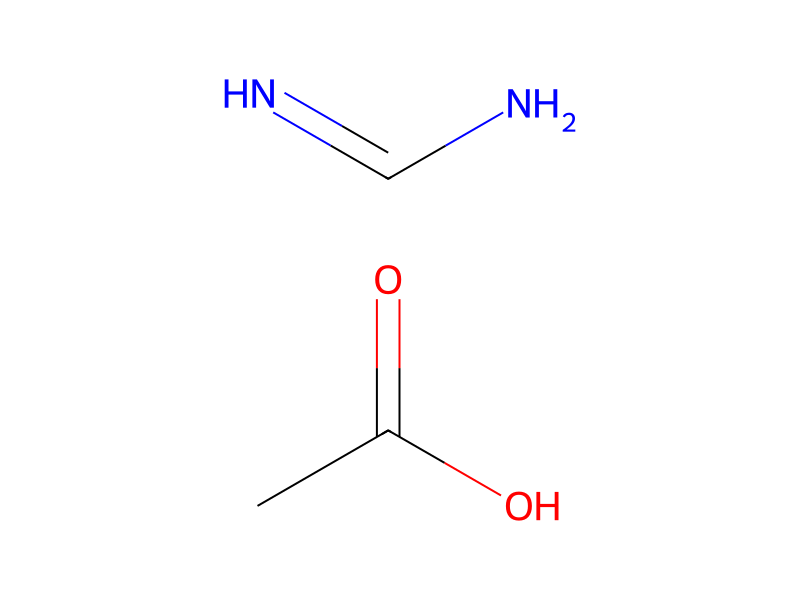


Product 1

Procedure
tert-Butyl 3-[4-(4-fluorophenyl)-5-pyrimidin-4-yl-1H-imidazol-1-yl]pyrrolidine-1-carboxylate (C19, prepared according to the general procedure for the synthesis of tert-butyl 3-[5-(2-aminopyrimidin-4-yl)-4-(4-fluorophenyl)-1H-imidazol-1-yl]pyrrolidine-1-carboxylate (C17) in Example 7, except that formamidine acetate was used in place of guanidine hydrochloride) was converted to the product using conditions similar to those employed for transformation of tert-butyl 3-[5-(2-aminopyrimidin-4-yl)-4-(4-fluorophenyl)-1H-imidazol-1-yl]pyrrolidine-1-carboxylate (C17) to 4-[4-(4-fluorophenyl)-1-pyrrolidin-3-yl-1H-imidazol-5-yl]pyrimidin-2-amine (C18) in Example 7. The product was obtained as a solid. Yield: 1.58 g, 5.11 mmol, 70%. LCMS m/z 310.4 (M+1). 1H NMR (400 MHz, CD3OD) δ 2.16 (m, 1H), 2.37 (m, 1H), 3.02 (m, 1H), 3.09 (dd, J=12.2, 4.6 Hz, 1H), 3.21 (m, 1H), 3.3 (m, 1H, assumed; obscured by solvent signal), 5.32 (m, 1H), 7.09 (dd, J=8.6, 8.6 Hz, 2H), 7.26 (d, J=5.2 Hz, 1H), 7.38 (dd, J=8.3, 5.5 Hz, 2H), 8.15 (s, 1H), 8.63 (d, J=5.5 Hz, 1H), 9.28 (s, 1H).
Workup
- customThe product was obtained as a solid
Sources & evidence
- ORD record
- ord-f9e9f4b0b379441494a53aab961fc34e
- Source dataset
- uspto-grants-2013_08
- Patent number
- US08518944B2
Reaction notes
Loading…