1-Amino-2,4-dibromoanthraquinone → 1-Amino-2-bromo-4-hydroxyanthraquinone
Reaction equation

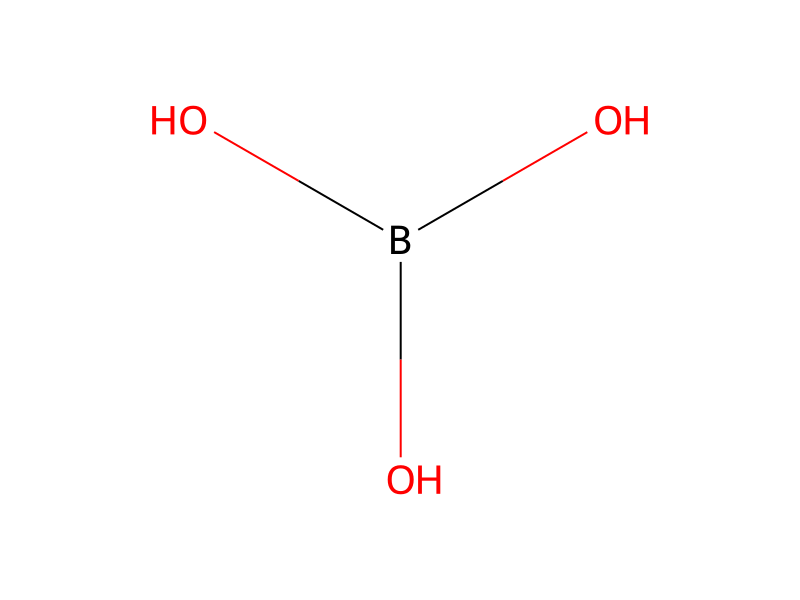
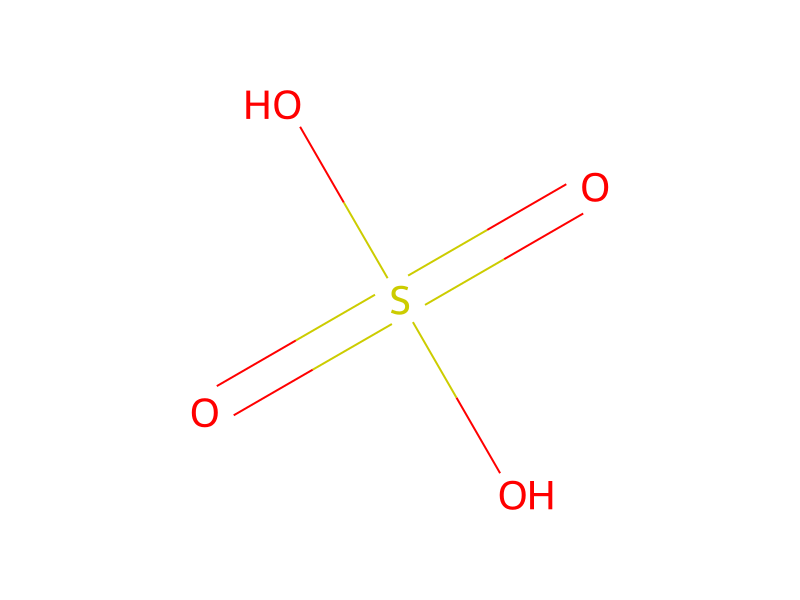
NC1C2C(=[O:16])C3C(=CC=CC=3)C(=O)C=2C=CC=1.[NH2:18][C:19]1[C:32]2[C:31](=[O:33])[C:30]3[C:25](=[CH:26][CH:27]=[CH:28][CH:29]=3)[C:24](=[O:34])[C:23]=2[C:22](Br)=[CH:21][C:20]=1[Br:36].B(O)(O)O>S(=O)(=O)(O)O>[NH2:18][C:19]1[C:32]2[C:31](=[O:33])[C:30]3[C:25](=[CH:26][CH:27]=[CH:28][CH:29]=3)[C:24](=[O:34])[C:23]=2[C:22]([OH:16])=[CH:21][C:20]=1[Br:36]Participants
Reactant 3


Product 1

Reagents, catalysts & solvents 1
Procedure
Further, German Offenlegungsschrift No. 28 17 890 discloses a one-vessel process and starting from 1-aminoanthraquinone, which is first converted by bromination into 1-amino-2,4-dibromoanthraquinone, which is in turn, without being isolated, reacted in sulfuric acid, in the presence of boric acid, to give 1-amino-2-bromo-4-hydroxyanthraquinone. The process is simple to perform and affords the desired product in good yield. The shortcoming of this process is, however, that the mixture of dilute sulfuric acid and boric acid formed during working up cannot be easily regenerated. For example, glassy residues are obtained and it is often necessary to neutralise the waste sulfuric acid, e.g. with calcium carbonate or slaked lime. In addition, the 1-amino-2-bromo-4-hydroxyanthraquinone obtained by this process is contaminated by compounds that are brominated in the 3-position. Such impurities result in changes in shade during the dye synthesis, i.e. standard shade dyes are not obtained.
Workup
- customwithout being isolated
Sources & evidence
- ORD record
- ord-72b0a6a90ab0450ba542b365630340af
- Source dataset
- uspto-grants-1987_03
- Patent number
- US04648994
Reaction notes
Loading…