Boronic Acid → trans-2,4-Diamino-6-methyl-5-[3-(4-trifluoromethylphenyl)-3-methyl-1-butenyl]pyrimidine
Reaction equation

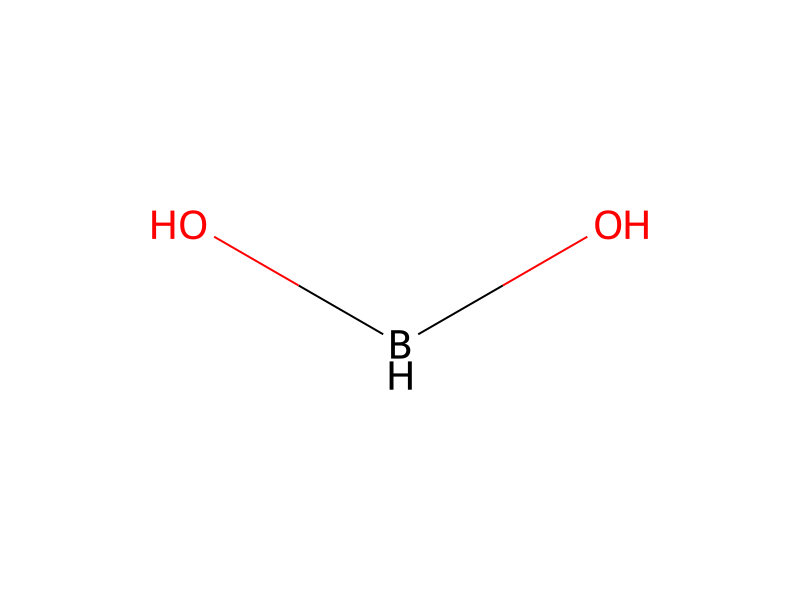
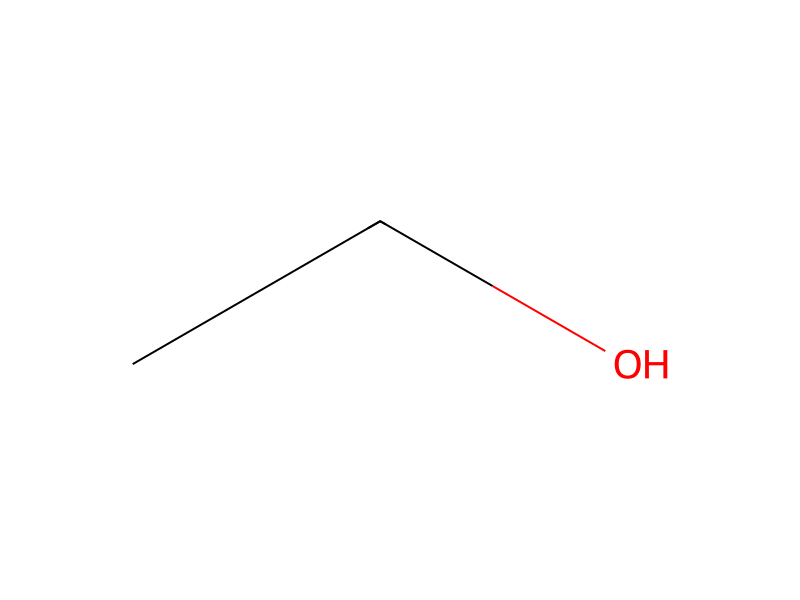
[CH3:1][C:2]([C:9]1[CH:14]=[CH:13][C:12]([C:15]([F:18])([F:17])[F:16])=[CH:11][CH:10]=1)([CH3:8])/[CH:3]=[CH:4]/B(O)O.[Na].B(O)O.[NH2:23][C:24]1[N:29]=[C:28]([NH2:30])[C:27](I)=[C:26]([CH3:32])[N:25]=1>C(O)C>[NH2:23][C:24]1[N:29]=[C:28]([NH2:30])[C:27](/[CH:4]=[CH:3]/[C:2]([C:9]2[CH:14]=[CH:13][C:12]([C:15]([F:18])([F:17])[F:16])=[CH:11][CH:10]=2)([CH3:8])[CH3:1])=[C:26]([CH3:32])[N:25]=1Participants
Reactant 4


Product 1

Reagents, catalysts & solvents 1
Procedure
Example 17, wherein U is alkenylene [e.g., --CH=CHC(CH3)2 --], teaches a desirable method for preparing Compound 68, in which a substituted phenylmethyl halide, for example, 4-trifluoromethylphenylmethyl bromide, is treated with potassium cyanide in water, yielding the corresponding substutited phenylacetonitrile. The so-prepared acetonitrile may then be treated with potassium tert.-butoxide in tetrahydrofuran, then reacted with a lower alkyl halide, for example iodomethane, yielding the corresponding 2-alkyl-2-(substituted phenyl)propanenitrile. The propanenitrile is then treated with diisobutylaluminium hydride which converts it to the corresponding propanaldehyde, for example, 2-methyl-2-(4-trifluoromethylphenyl)propanaldehyde. The propanaldehyde may then be reacted with bromomethyl triphenylphosphonium bromide and potassium tert.-butoxide in tetrahydrofuran, affording the cis/trans-1-bromo-3-alkyl-3-(substituted phenyl)-1-butene intermediate. This compound, in turn can be dehydrohalogenated with potassium tert.-butoxide in tert.-butanol, affording the corresponding butyne, for example, 3-methyl-3-(4-trifluoromethylphenyl)-1-butyne. Using methods taught by G. W. Kabaika et al. [Synthetic Communications, 11(3), 247-251 (1981) and Synthetic Communications, 13(12), 1027-1032 (1983)], the 1-butyne is reacted with 1,3,2-benzodioxaborole to form a boronic acid, in the present case, trans-3-methyl-3-(4-trifluoromethylphenyl)-1-butenylboronic acid. The sodium salt of the boronic acid may in turn be reacted with 2,4-diamino-5-iodo-6-methylpyrimidine in the presence of tetrakistriphenylphosphine palladium(0) in ethanol, yielding the targeted trans-2,4-diamino-6-methyl-5-[3-(4-trifluoromethylphenyl)-3-methyl-1-butenyl]pyrimidine (Compound 68).
Sources & evidence
- ORD record
- ord-291ae4fcd8844b8db5d8d848bd753f16
- Source dataset
- uspto-grants-1997_12
- Patent number
- US05696259
Reaction notes
Loading…