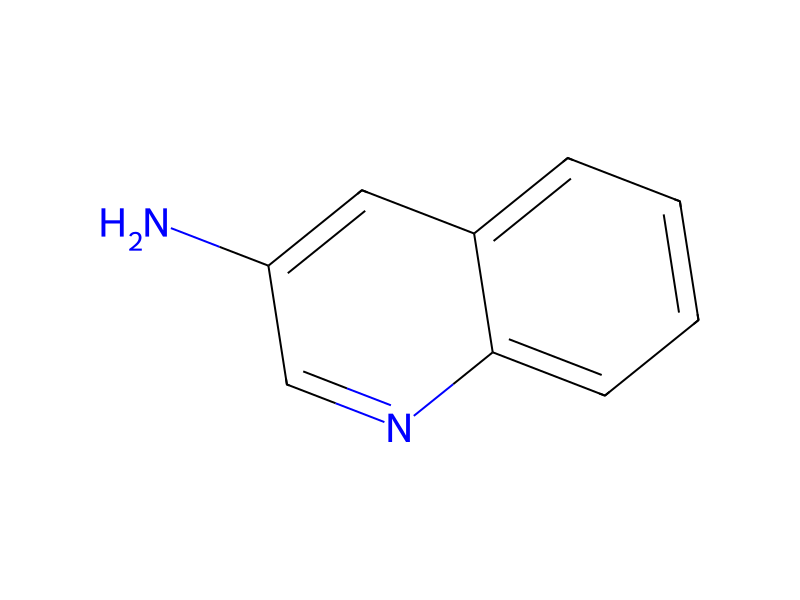
3-Aminoquinoline → HCID 66815687, compound
Reaction equation

[C:1]([O:5][C:6]([N:8]([CH3:18])[C:9]1[CH:17]=[CH:16][C:12]([C:13]([OH:15])=O)=[CH:11][CH:10]=1)=[O:7])([CH3:4])([CH3:3])[CH3:2].[N:19]1[C:28]2[C:23](=[CH:24][CH:25]=[CH:26][CH:27]=2)[CH:22]=[C:21]([NH2:29])[CH:20]=1>C(#N)C>[C:1]([O:5][C:6](=[O:7])[N:8]([CH3:18])[C:9]1[CH:10]=[CH:11][C:12]([C:13](=[O:15])[NH:29][C:21]2[CH:20]=[N:19][C:28]3[C:23]([CH:22]=2)=[CH:24][CH:25]=[CH:26][CH:27]=3)=[CH:16][CH:17]=1)([CH3:2])([CH3:3])[CH3:4]Participants
Reactant 2

Product 1

Reagents, catalysts & solvents 1

Procedure
A solution of 4-(tert-butoxycarbonyl-methyl-amino)-benzoic acid (3.36 g, 13.4 mmol), O-benzotriazol-1-yl-N,N,N,N′N′-tetramethyluronium hexafluorophospate (HBTU) (5.22 g, 13.8 mmol) and N,N-diisopropylethyl (4.8 mL, 27.5 mmol) in acetonitrile (200 mL) was stirred at ambient temperature for ten minutes. Quinolin-3-ylamine (1.93 g, 13.4 mmol) was added, and the solution was heated at reflux for 20 hours. The solvent was evaporated in vacuo, and the residue was partitioned between 1 N aqueous sodium hydroxide and dichloromethane. The product was purified by flash silica gel chromatography, using 67% ethyl acetate in hexane as the eluant to give the product as a colorless solid, 4 g (80%). MS: m/z 378 (MH+). 1H NMR (CDCl3): 1.51 (s, 9 H), 3.29 (s, 3 H), 7.33 (d, 2 H), 7.53 (d of d, 1 H), 7.65 (d of d, 1 H), 7.85 (d, 2 H), 8.04 (d, 1 H), 8.70 (br s, 1 H) and 8.86-8.91 (m, 2 H).
Workup
- temperaturethe solution was heated
- temperatureat reflux for 20 hours
- customThe solvent was evaporated in vacuo
- customthe residue was partitioned between 1 N aqueous sodium hydroxide and dichloromethane
- customThe product was purified by flash silica gel chromatography
Sources & evidence
- ORD record
- ord-219568cd42ce4b7694a9a10d77dcdde3
- Source dataset
- uspto-grants-2013_03
- Patent number
- US08394828B2
Reaction notes
Loading…