反应详情
EQUATION
反应方程式

REACTANTS
反应物
PRODUCTS
产物
PROCEDURE
实验过程
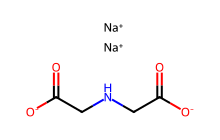
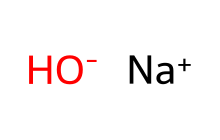
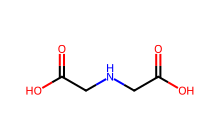
One conventional processes for the preparation of PMIDA starts with iminodiacetic acid (IDA), and requires the involved preparation of that material from its alkali metal salt. More specifically, the IDA moiety is produced by the alkaline hydrolysis of iminodiacetonitrile (IDAN) or by the oxidative dehydrogenation of diethanolamine under alkaline conditions. If sodium hydroxide is used as the base, the product from either of these methods is an aqueous disodium iminodiacetate (DSIDA) solution. This solution is the feedstock used either directly for conversion to PMIDA or to produce IDA for subsequent conversion to PMIDA. In the second case, disodium IDA solution is typically acidified with sulfuric acid or other strong mineral acid and the resulting IDA is separated from sodium sulfate or sodium salt of the strong mineral acid by fractional crystallization. This isolation of IDA by fractional crystallization, which is described in U.S. Pat. No. 3,808,269, requires an evaporative crystallizer for crystallization of anhydrous sodium sulfate, a cooling crystallizer for crystallization of IDA, two centrifuges, solids conveying equipment, and a sodium sulfate dryer, and storage silos or bins for the isolated IDA and dry sodium sulfate. Mother liquors can be recycled but a portion must be purged to remove impurities. An economically and environmentally significant amount of IDA is lost in this purge stream.