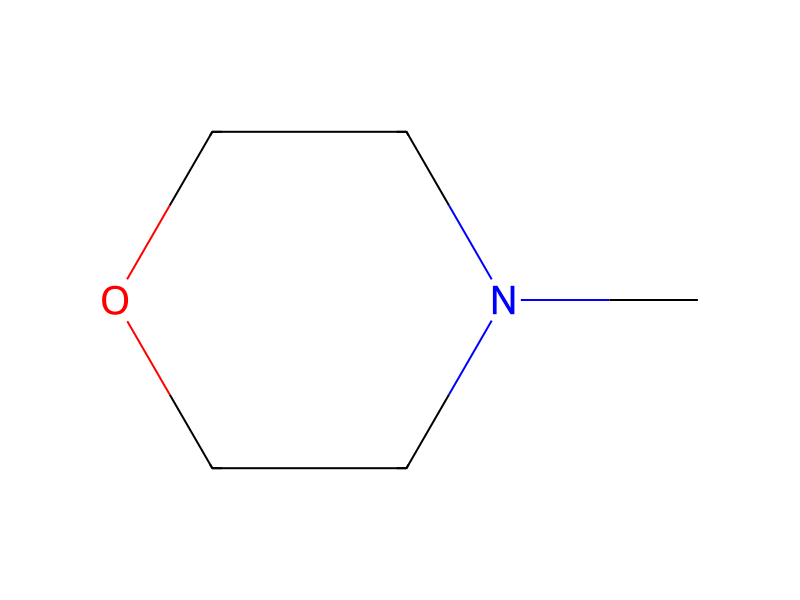
4-Methylmorpholine → tert-butyl 2-({[(1S)-3-hydroxy-1-phenylpropyl]amino}carbonyl)-1,3-thiazolidine-3-carboxylate
Reaction equation

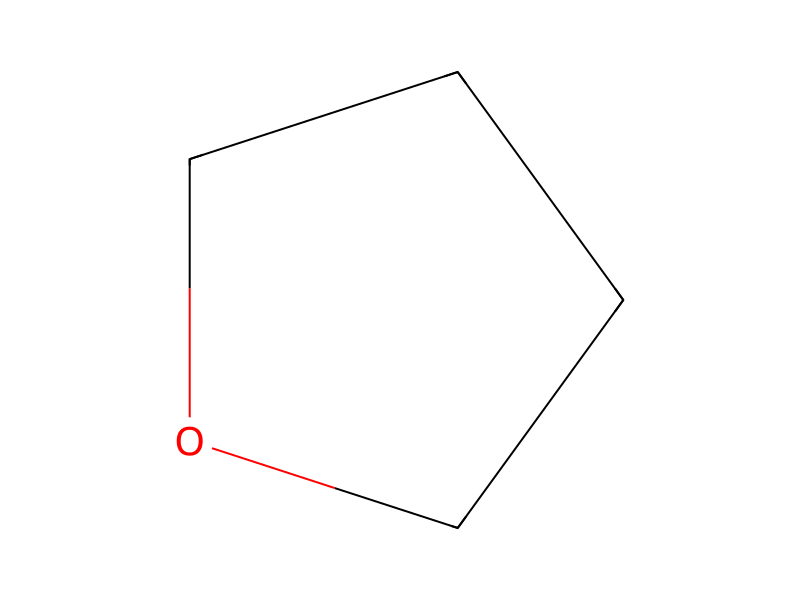
[C:1]([O:5][C:6]([N:8]1[CH2:12][CH2:11][S:10][CH:9]1[C:13]([OH:15])=O)=[O:7])([CH3:4])([CH3:3])[CH3:2].CN1CCOCC1.C(OC(Cl)=O)C(C)C.[NH2:31][C@H:32]([C:36]1[CH:41]=[CH:40][CH:39]=[CH:38][CH:37]=1)[CH2:33][CH2:34][OH:35]>C1COCC1>[OH:35][CH2:34][CH2:33][C@H:32]([NH:31][C:13]([CH:9]1[N:8]([C:6]([O:5][C:1]([CH3:2])([CH3:3])[CH3:4])=[O:7])[CH2:12][CH2:11][S:10]1)=[O:15])[C:36]1[CH:41]=[CH:40][CH:39]=[CH:38][CH:37]=1Participants
Reactant 4


Product 1

Reagents, catalysts & solvents 1
Conditions
- Temperature
- -25 °C
Procedure
Commercial 3-(tert-butoxycarbonyl)-1,3-thiazolidine-2-carboxylic acid (III) (1 g, 4.29 mmol) was dissolved in dry THF (50 ml). A mechanical stirrer was placed in the flask and the solution stirred vigorously. The solution was cooled down to −25° C. and N-methyl morpholine (1.084 g, 10.72 mmol) was added in dry THF (5 ml). A solution of isobutyl-chloroformate (0.615 g, 4.5 mmol) in dry THF (10 ml) was then added dropwise over a period of 10 minutes with continued vigorous stirring, the reaction's exotherm being maintained at the optimal temperature of −25° C. by the use of a dry-acetone bath. After the complete addition of the chloroformate, the reaction mixture was stirred at −25° C. for 30 min after which time an amine (IV)/(IV*), e.g., (3S)-3-amino-3-phenyl-1-propanol (0.778 g, 5.14 mmol) was added drop-wise over a period of 10 min. The reaction mixture was allowed to gradually warm to room temperature and stirred overnight. The solvent was removed and the residue re-dissolved in ethyl acetate (150 ml). The organic layer was washed subsequently with a saturated solution of ammonium chloride (100 ml), saturated bicarbonate (100 ml) and brine (100 ml). Organics then dried with magnesium sulfate and concentrated in vacuo. The product (V), e.g., tert-butyl 2-({[(1S)-3-hydroxy-1-phenyl-propyl]amino}carbonyl)-1,3-thiazolidine-3-carboxylate, was finally obtained as a white foam (1.5 g, 95%). The antipodal intermediate, tert-butyl 2-({[(1S)-3-hydroxy-1-phenyl-propyl]amino}carbonyl)-1,3-thiazolidine-3-carboxylate, as well as the racemic inter-mediate, tert-butyl 2-({[3-hydroxy-1-phenylpropyl]amino}carbonyl)-1,3-thiazolidine-3-carboxylate were made according to the same protocol, starting from commercial (3R)-3-amino-3-phenylpropan-1-ol or 3-amino-3-phenylpropan-1-ol, respectively.
Workup
- customA mechanical stirrer was placed in the flask
- temperaturethe reaction's exotherm being maintained at the optimal temperature of −25° C. by the use of
- customa dry-acetone bath
- additionAfter the complete addition of the chloroformate
- additionwas added drop-wise over a period of 10 min
- temperatureto gradually warm to room temperature
- stirringstirred overnight
- customThe solvent was removed
- dissolutionthe residue re-dissolved in ethyl acetate (150 ml)
- washThe organic layer was washed subsequently with a saturated solution of ammonium chloride (100 ml), saturated bicarbonate (100 ml) and brine (100 ml)
- dry with materialOrganics then dried with magnesium sulfate
- concentrationconcentrated in vacuo
Sources & evidence
- ORD record
- ord-cdebee24e1e64ad78b2c56758ce9f5fc
- Source dataset
- uspto-grants-2013_04
- Patent number
- US08415480B2
Reaction notes
Loading…