Hydrogen Bromide → 2-(4-Bromo-3-fluorophenyl)-2-oxoacetaldehyde
Reaction equation

[Br:1][C:2]1[CH:7]=[CH:6][C:5]([C:8](=[O:10])[CH3:9])=[CH:4][C:3]=1[F:11].Br.CS(C)=[O:15]>>[Br:1][C:2]1[CH:7]=[CH:6][C:5]([C:8](=[O:10])[CH:9]=[O:15])=[CH:4][C:3]=1[F:11]Participants

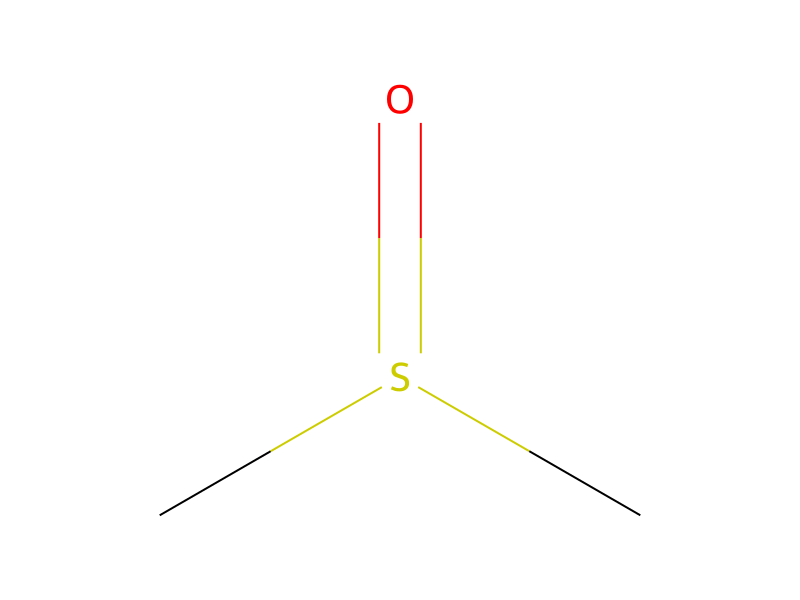


Conditions
- Temperature
- 60 °C
Procedure
To a solution of 1-(4-bromo-3-fluorophenyl)ethanone (4, 890.8 g, 4.1 mol) in DMSO (4 L) was slowly added a solution of 48% aqueous hydrogen bromide (HBr, 1420 ML, 12.5 mol, 3.0 equiv). The reaction temperature was gradually increased from 20° C. to 50° C. during the course of the addition. The reaction mixture was subsequently heated to 60° C. and stirred at 60° C. overnight. The resulting dimethyl sulfide was removed by distillation and the residue was poured into ice water (28 L). The resulting yellow precipitate was collected by filtration (save the filtrate) and washed with water (5 L). The yellow solid was dissolved in ethyl acetate (EtOAc, 5 L), washed with brine (1 L) and dried over anhydrous sodium sulfate (Na2SO4). The solution was then concentrated under the reduced pressure and the resulting solid was dried in a vacuum oven at 45° C. to give the desired product, 2-(4-bromo-3-fluorophenyl)-2-oxoacetaldehyde, as its hydrate (hydrate of 5, 730.6 g, 1020.9 g theoretical, 71.6% yield). The aqueous phase (filtrate) was extracted with ethyl acetate (3×5 L) and the combined organic phase was washed with water (2×2 L), brine (2 L) and dried over anhydrous sodium sulfate (Na2SO4). The solution was concentrated under reduced pressure and the resulting solid was dried in a vacuum oven at 45° C. to give the second crop of 2-(4-bromo-3-fluorophenyl)-2-oxoacetaldehyde hydrate (hydrate of 5, 289.4 g, 1020.9 g theoretical, 28.3% yield; total 1020 g, 1020.9 g theoretical, 99.9% yield) which was used in the subsequent reaction without further purification. For hydrate of 5: 1H NMR (400 MHz, DMSO-d6) δ ppm 8.00-7.70 (m, 3H), 6.69 (br s, 2H), 5.59 (s, 1H).
Workup
- temperatureThe reaction temperature was gradually increased from 20° C. to 50° C. during the course of the addition
- customThe resulting dimethyl sulfide was removed by distillation
- additionthe residue was poured into ice water (28 L)
- filtrationThe resulting yellow precipitate was collected by filtration (save the filtrate) and
- washwashed with water (5 L)
- dissolutionThe yellow solid was dissolved in ethyl acetate (EtOAc, 5 L)
- washwashed with brine (1 L)
- dry with materialdried over anhydrous sodium sulfate (Na2SO4)
- concentrationThe solution was then concentrated under the reduced pressure
- customthe resulting solid was dried in a vacuum oven at 45° C.
Sources & evidence
- ORD record
- ord-927036543c1a413da294b52946984ae7
- Source dataset
- uspto-grants-2013_04
- Patent number
- US08420645B2
Reaction notes
Loading…