Hydrochloric Acid → HCID 131711685, compound
Reaction equation
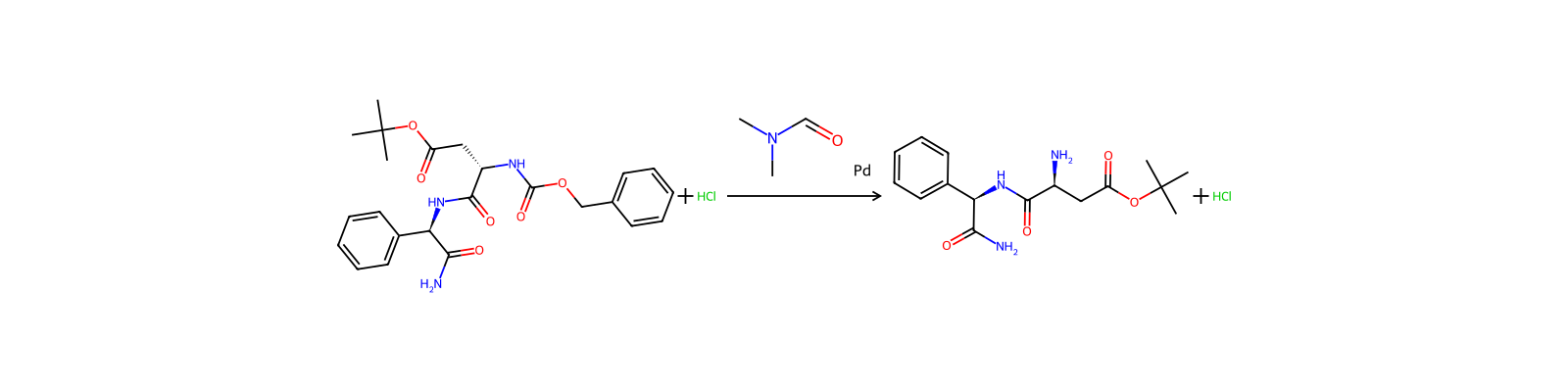
[NH:1](C(OCC1C=CC=CC=1)=O)[C@H:2]([C:11]([NH:13][C@@H:14]([C:21]([NH2:23])=[O:22])[C:15]1[CH:20]=[CH:19][CH:18]=[CH:17][CH:16]=1)=[O:12])[CH2:3][C:4](=[O:10])[O:5][C:6]([CH3:9])([CH3:8])[CH3:7].[ClH:34]>CN(C=O)C.[Pd]>[NH2:1][C@H:2]([C:11]([NH:13][C@@H:14]([C:21]([NH2:23])=[O:22])[C:15]1[CH:16]=[CH:17][CH:18]=[CH:19][CH:20]=1)=[O:12])[CH2:3][C:4](=[O:10])[O:5][C:6]([CH3:7])([CH3:8])[CH3:9].[ClH:34]Participants
5
Reactant 2


Product 1

Reagents, catalysts & solvents 2


Procedure
12.83 g (28.2 mmoles) of Z-Asp(OtBu)-D-Phg-NH2, prepared as described in Example 1, Step 3, are dissolved in 200 ml of DMF, and 2.46 ml (28.2 mmoles) of concentrated hydrochloric acid and 2 g of palladium-on-carbon catalyst are added to the cooled solution. Gaseous hydrogen is bubbled through the resulting suspension for 2.5 hours under stirring. The catalyst is filtered off, the filtrate is evaporated, the residue is dissolved in ethanol, and the solution is decolourized. Ethanol is evaporated in vacuo, and the residue is triturated with ether. 10.0 g (99%) of H-Asp(OtBu)-D-Phg-NH2.HCl are obtained; the chromatographically uniform substance melts at 169°-170° C. Rf4 =0.15.
Workup
- customGaseous hydrogen is bubbled through the resulting suspension for 2.5 hours
- filtrationThe catalyst is filtered off
- customthe filtrate is evaporated
- dissolutionthe residue is dissolved in ethanol
- customEthanol is evaporated in vacuo
- customthe residue is triturated with ether
Sources & evidence
- ORD record
- ord-c0f88a8ea36d4d5eb7e0d73abb58a44d
- Source dataset
- uspto-grants-1980_01
- Patent number
- US04183909
Reaction notes
Loading…