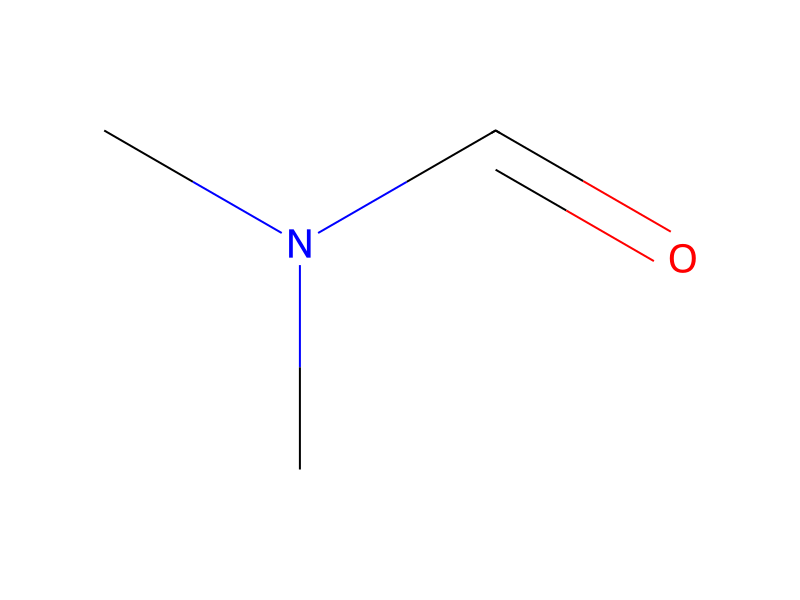
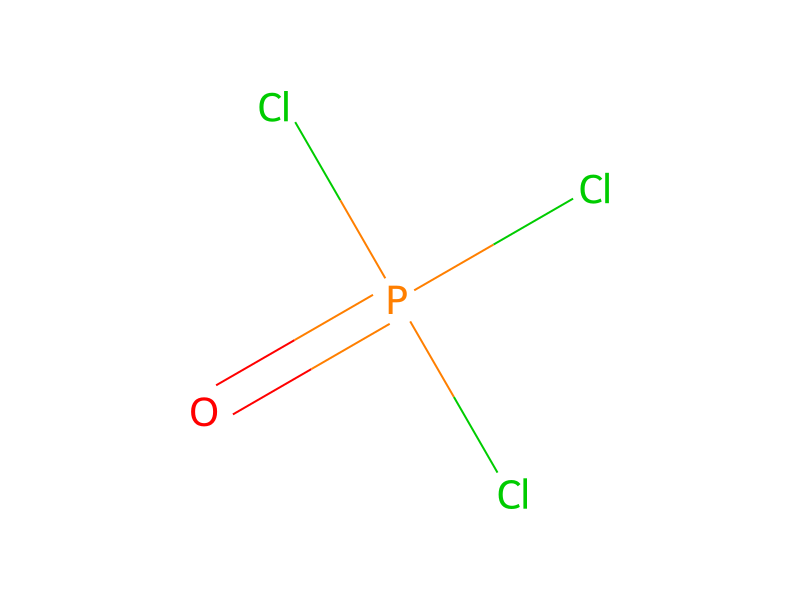
Dimethylformamide → 5-Chloro-2,3-dihydrobenzo[b]oxepine-4-carbaldehyde
Reaction equation

[O:1]1[CH2:7][CH2:6][CH2:5][C:4](=O)[C:3]2[CH:9]=[CH:10][CH:11]=[CH:12][C:2]1=2.O=P(Cl)(Cl)[Cl:15].CN(C)[CH:20]=[O:21]>>[Cl:15][C:4]1[C:3]2[CH:9]=[CH:10][CH:11]=[CH:12][C:2]=2[O:1][CH2:7][CH2:6][C:5]=1[CH:20]=[O:21]Participants


Procedure
Scheme 2 shows a general method of preparation of N,N-disubstituted 4,5-dihydrobenzo[b]thieno[2,3-d]oxepine-2-carboxamide intermediates 69. 3,4-Dihydrobenzo[b]oxepin-5(2H)-one intermediates 66 are formylated with phosphorus oxytrichloride and dimethylformamide (DMF) to give 5-chloro-2,3-dihydrobenzo[b]oxepine-4-carbaldehyde intermediate 70. Cyclization of 70 with a mercapto acetate ester (HSCH2CO2R where R is alkyl or aryl) in potassium carbonate and DMF gives the 4,5-dihydrobenzo[b]thieno[2,3-d]oxepine-2-carboxylate ester intermediate 71. Saponification of 71 with lithium hydroxide in THF and water gives the acid (R═H) which is treated with thionyl chloride at reflux followed by a secondary amine (HNR5R6), such as N-methyl-2-chloroaniline, with a catalytic amount of DMAP (4,4-dimethylaminopyridine), triethylamine, and dichloromethane to give 4,5-dihydrobenzo[b]thieno[2,3-d]oxepine-2-carboxamide intermediates 69. Alternatively, the acid is treated with oxalyl chloride and a catalytic amount of DMF to generate the acid chloride, followed by reaction with the amine and potassium carbonate in acetonitrile to give amides such as 69. Where one of R1, R2, R3, or R4 is bromo, the bromine of 69, or of another intermediate such as 66, 70, 71, may be displaced by: (i) carbonylative amination to give amide (—NR12C(═O)R10, (ii) formylation (—CHO) followed by reductive amination to —CH2NR10R11, (iii) Suzuki coupling with aryl or heteroaryl, (iv) Sonagoshira coupling to give alkynyl (—C≡CR10), or (v) amination (—NR10R11).
Sources & evidence
- ORD record
- ord-1e79cb134bc5438d888ba91a6f833f90
- Source dataset
- uspto-grants-2011_04
- Patent number
- US07928248B2
Reaction notes
Loading…