Hydrogen Cyanide → 4-Pentenenitrile
Reaction equation

C#N.C=CC=C.C(#N)[CH2:8][CH2:9][CH2:10][CH2:11][C:12]#[N:13].[C:15](#[N:20])[CH2:16][CH2:17][CH:18]=[CH2:19]>[Ni]>[C:12](#[N:13])[CH2:11][CH2:10][CH:9]=[CH2:8].[C:15](#[N:20])[CH2:16][CH:17]=[CH:18][CH3:19]Participants
Reactant 4
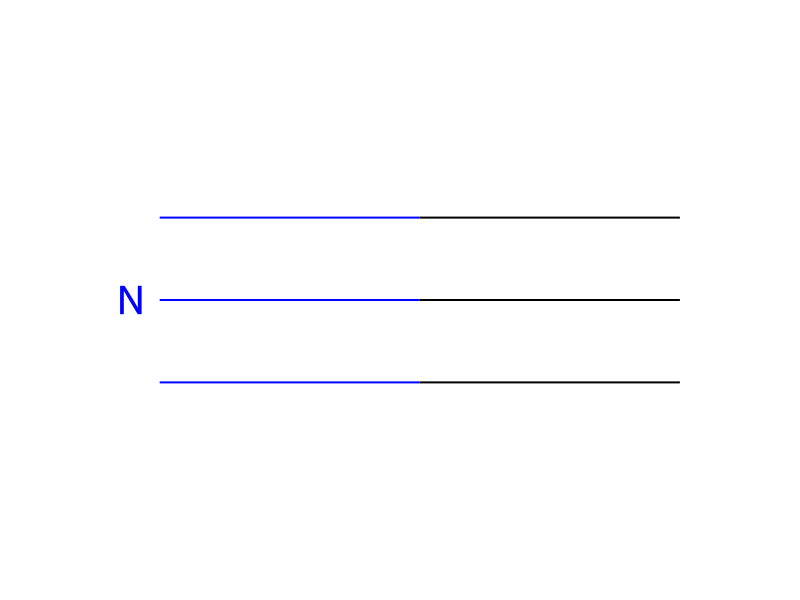


Product 2

Reagents, catalysts & solvents 1
Procedure
The process of the present invention is applied to a waste stream from a process which involves the direct addition of two molecules of hydrogen cyanide to a molecule of butadiene thereby producing adiponitrile. The process is conducted in two steps. With reference to the drawing, the first step (reactor 1) involves the addition of one molecule of hydrogen cyanide (stream 2) to dry butadiene (stream 3) in the presence of a catalyst (stream 4) consisting of zero-valent nickel usually in the form of a nickel tetrakis-tritolylphosphite, to produce a mixture of cis- and trans-3-pentenenitrile and 4-pentenenitrile. This reaction mixture is withdrawn from reactor 1 via line 5, treated to remove impurities and then introduced into reactor 6 along with additional HCN (line 7), ligand (line 8) and triarylborane catalyst promoter such as triphenylborane (line 9). In this reaction which can be conducted in one or more steps, 4-pentenenitrile is formed by the in situ isomerization of 3-pentenenitrile. The 4-pentenenitrile is then converted to adiponitrile by the addition of one molecule of HCN. The effluent from the reactor 6 is passed to extractor 13 and there contacted with cyclohexane (line 14). The cyclohexane extractant (line 15) is subsequently directed to further treatment for product recovery. During the hydrocyanation as described as hereinabove a portion of the zero-valent nickel catalyst is oxidized to nickel cyanide which is insoluble in the reaction medium and which forms insoluble complexes with the triarylborane. The tails from the extraction vessel (line 16) contain such complexes which are subsequently separated from the tails (line 16) by centrifuge 17. A typical analysis of this sludge is set forth below in Table I.
Workup
- customto produce
- customThis reaction mixture is withdrawn from reactor 1 via line 5
- additiontreated
- customto remove impurities
- additionintroduced into reactor 6 along with additional HCN (line 7), ligand (line 8) and triarylborane catalyst promoter such as triphenylborane (line 9)
- customIn this reaction which
Sources & evidence
- ORD record
- ord-9554a6e37d6843ff8a133ce6b4f3ad24
- Source dataset
- uspto-grants-1978_04
- Patent number
- US04082811
Reaction notes
Loading…