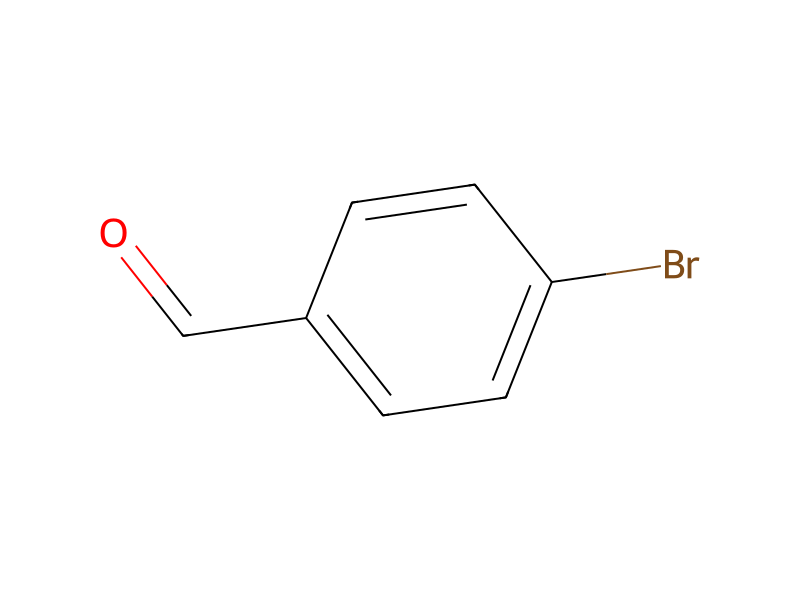
4-Bromobenzaldehyde → 4-(5-(4-(diphenylamino)phenyl)-1-methyl-1H-pyrrol-2-yl)benzaldehyde
Reaction equation

[CH3:1][N:2]1[C:6]([Sn](CCCC)(CCCC)CCCC)=[CH:5][CH:4]=[C:3]1[C:20]1[CH:38]=[CH:37][C:23]([N:24]([C:31]2[CH:36]=[CH:35][CH:34]=[CH:33][CH:32]=2)[C:25]2[CH:30]=[CH:29][CH:28]=[CH:27][CH:26]=2)=[CH:22][CH:21]=1.Br[C:40]1[CH:47]=[CH:46][C:43]([CH:44]=[O:45])=[CH:42][CH:41]=1>>[C:25]1([N:24]([C:31]2[CH:36]=[CH:35][CH:34]=[CH:33][CH:32]=2)[C:23]2[CH:37]=[CH:38][C:20]([C:3]3[N:2]([CH3:1])[C:6]([C:40]4[CH:47]=[CH:46][C:43]([CH:44]=[O:45])=[CH:42][CH:41]=4)=[CH:5][CH:4]=3)=[CH:21][CH:22]=2)[CH:26]=[CH:27][CH:28]=[CH:29][CH:30]=1Participants


Procedure
As shown in scheme 1, 4-bromo-N,N-diphenylaniline (11) is reacted with 1-methyl-2-(tributylstannyl)-1H-pyrrole by Stille coupling reaction to obtain 4-(1-methyl-1H-pyrrole-2-yl)-N,N-diphenylaniline (12). n-butyl lithium is reacted with 4-(1-methyl-1H-pyrrole-2-yl)-N,N-diphenylaniline (12), and then tributylstannylchloride is added thereto to obtain 4-(1-methyl-5-(tributylstannyl)-1H-pyrrole-2-yl)-N,N-diphenylaniline (13). 4-(1-methyl-5-(tributylstannyl)-1H-pyrrole-2-yl)-N,N-diphenylaniline (13) is reacted with 4-bromobenzaldehyde by Stille coupling reaction to obtain 4-(5-(4-(diphenylamino)phenyl)-1-methyl-1H-pyrrol-2-yl)benzaldehyde (14a). Finally, 4-(5-(4-(diphenylamino)phenyl)-1-methyl-1H-pyrrol-2-yl)benzaldehyde (14a) is reacted with cyanoacetic acid in acetic acid by using ammonium acetate as a catalyst, and (E)-2-cyano-3-[4-(5-(4-(diphenyl-amino)phenyl)-1-methyl-1H-pyrrol-2-yl)]phenyl)acrylic acid (15a) is synthesized.
Sources & evidence
- ORD record
- ord-e0ec6a4049d14cf480d0737954815b5f
- Source dataset
- uspto-grants-2009_08
- Patent number
- US07569704B1
Reaction notes
Loading…